Well, Aaron will like it.
Month: March 2011
The Brother Outsider
Today is Bayard Rustin's birthday, the invisible man of the civil rights movement. If you have never netflixed the documentary about him, give it a try.
Rebecca Mansour: The Big Reveal
Ladies and gentlemen, the woman behind the Twitter jabs.
The GOP And Afghanistan
Chris Good asks a question rather bluntly:
Would GOP primary voters rather hear that we should stick with the war effort, or would they rather hear that something is going badly on Obama's watch?
That's probably how many primary voters feel, which is a pity. The trouble with the American discussion of the wars in Iraq and Afghanistan is that it has often been about America and abstract arguments, rather than Afghanistan and reality. But it does strike me as interesting how skepticism about the war has gained traction on the right. The CW is that the neocons are winning in the GOP. And it's true that the likeliest nominees, Palin and Romney, are still sounding the 1980s drum.
But others? Not so much. Huckabee has mused publicly about the ever-receding end-game; Ron Paul opposes it and is now joined by Gary Johnson.
Santorum has expressed skepticism about democratization in places like Afghanistan. Mitch Daniels' position is opaque, but he is very close to the realist-moderate Dick Lugar. Ditto Huntsman, whose social moderation would be well complemented by a non-ideological foreign policy stance.
The point is not that interventionism and rhetoric have lost their primacy in Republican foreign policy thinking. It is that as the primary debates begin, there will actually be a debate about Afghanistan and Iraq and their legacy. It may even be the case that, when you add in the fiscal hawks seeking savings from the Pentagon budget, those skeptical of neoconservative militarism and nation-building could out-number the true believers. And that's a major shift.
“And Then You Hear Chains”
A friend visits Bradley Manning in Quantico:
You can hear Bradley coming from a long way away because of the chains – his feet have chains on them, they go to a leather belt around his waist. His hands go into them and he has no free movement of his hands.
Even the Washington Post has now condemned his treatment.
Why No Looting In Japan? Ctd
A reader writes:
The notion that there is no looting in Japan is a myth, and I'm frankly shocked that Gregory Pflugfelder (the Columbia professor quoted by CNN) bought into it, going so far as to say there's not even a word for looting. There is a word for this, and it's ????? (kajibadorobou). It literally means "thief at a fire," but it extends more broadly in a metaphorical sense to people who take advantage of a crisis to commit a crime.
And there are, in fact, reports of this happening.
There are reports of theft, there are reports of gangs of men going around trying to get into people's houses by pretending they're checking their gas or electricity, and there are news reports of people stocking up on supplies in exactly the way the family in the anecdote you posted suggested would be "selfish." Anyone who doesn't know this simply isn't following the story very closely.
To be fair, you do have to somewhat look for stories like this about looting and crimes, because it's a myth that the Japanese media buys into. The terrible Hanshin Earthquake in 1995 was also covered as if everyone acted calmly and there were no crimes, but in fact historical distance reveals that numerous thefts and rape incidents occurred as awful people took advantage of this situation.
The idea that there is no looting in Japan is just the positive side of the standard stereotype about how Japanese people are cold, emotionless automatons. This is not to say that Japanese people are uniquely bad, but they're not uniquely good either. They're like anyone else. Most people in a crisis do their best to stick together and help each other, but there are also immoral monsters who take advantage of a crisis. This is true in Japan, it's true in the US, and it's probably true most anywhere.
(To be clear, while Pflugfelder is a great scholar who I really admire, his work is really on the history of sexuality in Japan. His book "Cartographies of Desire: Male-Male Sexuality in Japanese Discourse, 1600-1950" is fascinating and is probably the best source in English about the history of homosexuality in Japan, but he's not exactly the person I would go to about this kind of a question. Going to him because he's an "expert on Japanese culture" would be like asking Judith Butler or Michel Foucault about looting in a western country because they're "experts on western culture.")
Another writes:
An NPR story by Jason Beaubien this morning mentioned looting in the earthquake- and tsunami-affected areas of Japan.
Another:
With regard to your reader who wrote, "If they hoarded, others would go without," please see this. Again, these simplistic cultural stereotypes really do nothing to enlighten us, and meanwhile provide fodder for racists.
Another:
I have to disagree with the readers you quote here. I work for a local government in Japan, and I can say that a lot of facts as given are wrong.
The first reader you quote refers to an "official family record." I believe what this reader is referring to is koseki, which means "household register." These are not registered with the police; they are registered with municipalities. (Also, no municipalities in Japan have their own police. Police in Japan are run by the prefectural governments.) The only thing that koseki have on them is vital records: births, deaths, marriages, divorces, name changes, etc; they do not include criminal records. Also, if your sister got divorced, this would not appear on your koseki because the minute she got married, she would have been removed from your parent's koseki and been put in a new koseki with her husband. If she got divorced, she would be put in a new koseki belonging to no one but her and any children she got parental rights to. (I should note, this system is a barrier to mutual custody in Japan because children must be put in one household or the other on the koseki system.)
As for the claim that the information on a koseki might affect whether or not a university would admit an applicant, I cannot really comment beyond saying that I find this claim high suspect. I believe that exam results and the high school you attended probably play far bigger roles.
As for the claim by Gregory Pflugfelder, I can think of a few words that come close to looting: ?? dorob? "robber", ?? g?t? "robbery", ?? ryakudatsu "looting". The "they-don't-have-a-word-for-that" argument is best avoided (see here) because the non-existence claim is almost always wrong, and even if it were true, the link between that linguistic fact and how society behaves is extremely tenuous.
By the way, my wife tells me that there were many cases of rape in the aftermath of the K?be earthquake in 1995 (see here). Hopefully, nothing like that will happen after this earthquake.
Another:
As far as my Japanese bona fides: I majored in Japanese language and culture in college, studied abroad in Tokyo, and worked in Japan for several years before coming back to go to law school in DC. My wife, who I met while studying abroad, is Japanese, and her family lives in Tokyo now. (I should also mention that they all were in Kobe during the catastrophic 1995 earthquake.) I would like to say at the outset that I don't subscribe to a view of Japan being somehow culturally unique, as any salient characteristic can likely find its analogue in our own due to the essentiality of human nature writ large; that being said, within this possible range, there are clearly certain characteristics that are more pronounced in Japanese culture than our own.
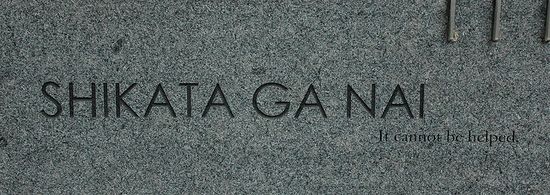
First, I'd agree with commentary about the Japanese people being by historical necessity somewhat resigned to natural disasters and thus culturally more resilient when they strike. When I talk to my friends and family in Japan today about their situations, they all used the same expression, "Shikata ga nai," (?????, "it can't be helped") that a reporter from the Atlantic reported Japanese saying back in 1926 in the Atlantic Monthly article while covering the terrible 1926 Tokyo earthquake. Just as he wrote then, it is "almost the Japanese national motto." When I first learned this expression in my first year of Japanese class, I immediately was attracted to the stoic philosophy it embodies; somethings are simply beyond our control, and we can only find strength to suffer through them.
That leads to another concept in Japanese culture of gaman (??, loosely, "endurance" or "perseverance"), of putting up with something unpleasant without complaint. Being known as gamandzuyoi (????, a compound of gaman and tsuyoi, the word for "strong", meaning having a high capacity for this endurance) is highly valued. The common response I hear or read from Japanese people across the country is in this vein of gaman; each person feels a duty to struggle on, and that they don't really have the right to complain, since someone else inevitably must have it worse. People in Tokyo certainly are not complaining about the relative inconvenience of rolling blackouts and food shortages in the light of more serious disasters in Sendai, but even the people of Sendai feel their situation is not as serious as others within the same area or near Fukushima.
This I think explains why people are less apt to loot out of panic or fear of what has happened or what is to come. But I think there is also a clear cultural explanation of why people would not loot generally: the strong group mentality in Japanese society both fosters solidarity and instills fear of incurring shame.
The very word in Japanese used to mean "human being" in Japanese, ningen, is written with two characters (??) that mean "person" and "between" respectively, giving the word the loose meaning of "between people." A person is what lies between others; more directly, a person is defined by their relationships to others. Traditionally, this would be the Confucian relationships between parents and children, adults and rulers etc. Now, it would encompass the family, friends, classmates at school, or coworkers. One basically is identified through these groups (an average person introducing themselves would literally identify him or herself this way: Takeshi who works at Mitsubishi would introduce himself as "Mitsubishi's Takeshi"). Obviously the largest of these groups would be "Japanese people" as a whole.
(Photo: Wiki)
Serious Journalism
Yglesias says "people in the 'writing about important things' business need to roll up our sleeves and try harder to make our output compelling to people":
In the print world, I think people got too complacent about the idea of reporting out a worthy story, plopping it on page A3, and forgetting about it. Was anyone actually reading that story? It’s not clear to me that they were. On the web if you want people to read worthy journalism it’s made clear that this is actually a two-step process. First you have to produce the worthy content, and then you have to get someone to read the worthy content.
Ezra Klein counters:
Stories about payment fraud in Medicare will never dominate “most popular” lists. But so long as they’re in a publication that regulators and hospitals fear, they can have an impact — even if the vast majority of the paper’s readers never notice them.
Chart Of The Day
The Economist's "interactive index of unrest in the Arab world" (embedded below) can be adjusted by moving around the weights below:
The View From Rush Limbaugh’s Recession: “A Safety Net As A Hammock”
A reader writes:
I'm sure your reader is a qualified diagnostician who has examined both men throughly and concluded they are able to work. The thing is, there are lots of diabilities that don't "show", and they are usually talked about when it comes to handicapped parking spaces … I know, I've been there.
I looked hale and hearty, but walking from the end of the parking lot to the store entrance was beyond my capabilities for months. I solved the problem by using cabs, which drop you right by the door. I limited it to once every two weeks, for the supermarket. Otherwise I did without. In the meantime I would take two walks everyday. An extra three houses was a major accomplishment. But look at me in the store, I was hale and hearty.
Your reader sees them going out fishing or hunting. He doesn't see them stopping for 20 minutes on the short walk to the dock or hunting blind. Or the biweekly visits to the doctor. Or the visits to the physical therapist … who tells them to get out and walk more. It's very easy to see the neighbor take off for some fishing and say, "He could work!"
Another writes:
I’ve more experience than I care to with regard to people on Social Security Disability.
I personally know a person, age 30, who has received it because she has "gender identity issues" that have affected her ability to integrate socially into the workforce (that’s her claim; I can’t verify independently). But she works and collects wages under the table in addition to her disability compensation.
I also have two uncles in their late 50s, early 60s, who are on SSD, and they fill their days with hunting, fishing, berry picking in the summer, working under the table jobs (usually construction/carpentry work). A cousin, 50, diabetic, college educated quit the Post Office and got SSD when she no problems that kept her from working her job.
On the other hand, my wife, who is bipolar, has advanced lupus, severe crowd anxieties (we seldom go out in public, shop for groceries at odd hours when few people are there, and buy a lot of goods delivered via Amazon), and has chronic knee injuries and arthritis that often keep her on the ground floor of our two story. But she still managed to keep working as an architect until last year, when at the age of 40 she had a meltdown at the office when all of her afflictions came to a head. She sure could use the disability assistance, but has been denied three times now.
I was an unemployed IT engineer at the time. Lucky for me, I found a job (at about half my prior wages) shortly after she lost hers, but we are struggling to get by at one-third the combined wages we had three years ago.
Myself, I’ve got an inoperable spinal cord tumor (in that it’s too entangled to remove, but surgery has lessened its debilitating effects) and resultant damage that has qualified me for SSD, but I’ve chosen to remain in the work force for my own sanity. Fortunately, my job skills don’t need much physical labor and I have the employer flexibility I need to work around my issues.
Sadly, most of the people I’ve known on SSD use the safety net as a hammock, and I’ve known way to many who really do deserve it, but often give up in frustration.
Another:
Of course there are people who game the system. But without percentages, it means nothing.
Every time disability benefits have been restricted, judges have restored them after face-to-face meetings with those affected. I know someone with a degenerative neurological condition who is severely disabled (can't walk or write, has vision problems, etc). Twice in the past 30 years (in moments of austerity) her disability services were slated to be cut pending review. She was forced to go to distressing and (for her) exhausting lengths – endless calls with social workers, finding a pro bono lawyer, paying for transporation to court – to retain her benefits, even though a single glance revealed how severely disabled she was. While I'm sure the arduous process rooted out shirkers, what the truly disabled were put through was shameful.
In an era when those who brought down our financial system get multi-million dollar salaries and bonuses, when the wealthy pay the lowest taxes in 50 years, when there are huge tax breaks for corporations with billions in profits, it blows my mind to see teachers, the poor, and those with disabilities attacked.
Explicit fraud should never be tolerated, and the Obama administration efforts to root out Medicare fraud are necessary and admirable. However, when there are gray areas (instances where abuse seems obvious but can be difficult to prove), percentages matter. When the percentage in the gray area is relatively small, the moral and financial costs of rooting out abuse far exceed any benefits to society.
Another:
The flip side of that coin is that, in order to make sure all the truly disabled are taken care of, the rules have to be written loose enough for a certain amount of abuse to slip through. So, if you're going to have a safety net that actually catches all the truly needy, you're going to have to put up with catching some who aren't. So, anecdotal evidence that there is some abuse might actually be evidence that the system is working.
And another:
Your reader wrote, "There is no way anyone could collect a SS disability check if they had a spouse worth millions, as your reader states, unless there was fraud involved." Not true.
There are two different Social Security programs. Supplemental Security Income (SSI) is poverty based – basicallyfor older adults and people with disabilities who are poor. Social Security Disability Insurance (SSDI) is the program you get if you (or your parent or spouse) have paid into for a number of years (generally ten) through payroll taxes, and the amount of your past earnings determines the amount of your monthly check. Since SSDI is a disability insurance program not a poverty program, it doesn't matter whether you or your spouse have unearned income or assets that make you a millionaire – your check is not based on your family wealth. It's based on whether you meet Social Security's definition of disabled. (That definition requires that your disability prevent you from having EARNED income above a certain level – but UNEARNED income, from investments, for example, doesn't matter.)
That said, a fraud might be taking place if those two guys' doctors falsified medical records so they would be found disabled. Hard to believe it would that easy. In my work I'm dealing with people who are denied a disability determination despite having severe medical conditions.
One more:
I suspect there is some confusion of Social Security Disability and disability benefits through the Veterans' Administration. $2500 a month to a guy whose only decision is whether to hunt or fish on a given day is believable through the VA's disability system. I work in a large defense agency and have a number of co-workers who are active outdoorsmen while collecting large disability checks from the VA. I don't know what their qualifying disabilities are; one is visibly handicapped, the others have no obvious outward signs of disability. I don't make any judgement on the VA system based on my lay observations, but I have noticed confusion between the two types of disability benefit.
The VA benefit rates are here (note that a 100% rating is not the same as 100% disabled).
The Paper Tiger Trap

Larison demolishes David Kopel's arguments:
A government doesn’t reveal itself to be a paper tiger by not intervening in conflicts in which it has no stake and doesn’t have a real interest. In fact, jumping into conflicts where there are no U.S. interests is a good way to create the impression of weakness later on, as there will be enormous pressure to get out immediately when something goes wrong (and something always goes wrong). One way to avoid appearing as a “paper tiger” is not to make every conflict the business of the U.S. government.
(Photo: Terry Border's art piece, "How to catch a paper tiger")
 The Dish