Visually impaired Indian students take the Intermediate (10+2) economics examination on laptops at an examination centre at Shamshabad, on the outskirts of Hyderabad on March 16, 2011. Netra Vidyalaya Junior College provides free education exclusively for low socio-economic blind students. The question paper was scanned and recorded in the laptops of 29 students who listened to the questions through their headphones and typed the answers. By Noah Seelam/AFP/Getty Images.
Month: March 2011
Who Is Responsible? Ctd
I don’t agree that intervention in another country’s civil war makes the U.S. part of Libya’s government, but it does mean that our government has made commitments to one political faction and has obliged itself to achieving their goal of becoming Libya’s government. That implicates the U.S. not only in what results from the escalation of the conflict, but also in what our newfound clients do with the weapons and power our government might provide them. The more entangled the U.S. becomes in another country’s civil war, the more that the U.S. is responsible for the behavior of its local allies. That doesn’t mean that the U.S. will actually have control over those allies, which puts the U.S. in the ridiculous position of having to answer for the misdeeds of its clients without having the authority to prevent them.
Why No Looting In Japan? Ctd
A reader writes:
I don't believe looting stems from a cultural issue, but rather societal, which is very different.
Looting is more likely to occur when groups of people feel they have been abandoned or trapped and anarchy results, or simply when people are afraid of starving or dying of exposure. After Katrina, we had the first situation, along with a bit of the second. After the Haiti earthquake, we had both in full force.
The devastation in Japan has been horrific, but its extremely stable society so far has not become anarchic. The huge amounts of poverty in Haiti, and in New Orleans for that matter, by comparison to Japan, make those societies much closer to anarchy and revolt (and looting) even without an earthquake or flood. The citizens' relationship with their government is also extremely important – looting is more likely if people believe their government is corrupt and not trustworthy.
For the first several days after both of these events in the Americas, people worked hard to rescue and to help each other. As I recall, it took several days for desperation and fear to set in; along with it came the realization that sufficient outside help could not or would not come, residents were trapped, and the government essentially broke down. At that point most major looting and violence began.
Not true. According to the AP, the day after New Orleans was hit:
"It's downtown Baghdad," said tourist Denise Bollinger, who snapped pictures of looting in the French Quarter. "It's insane."
Another writes:
I think the main reason for the lack of looting might be because the tsunami devastated everything, not just flooding it. The pictures we've seen have been of total destruction and death, it looks like there's little to steal, let alone people to steal it – and there doesn't seem to be enough damage in Tokyo or other major cities that weren't leveled to facilitate looting. On top of that, there are nuclear reactors in the first stages of meltdown keeping people away from the towns that felt the brunt of the quake and tsunami.
Yet the authors of the articles you link to seem to want to point toward cultural or development reasons. And look what that has created: read some of the comments (3300 of them so far) for the Telegraph's story. It seems that the racists are coming out in force on this one, and want to make a point of "ethnic purity" and homogeneity with a lack of immigration as the main reason there haven't been reports of looting.
Overall, I think that anybody who sees a disaster like this and immediately wonders whether or not people are taking things from local stores either already has his mind made up as to "why" or simply wants others to back them up so they don't appear to be casting the aspersions that they are too cowardly to openly cast.
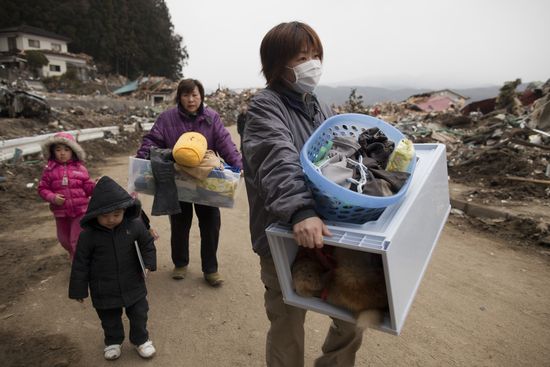
(Photo: The Sasaki family carry some of their personal belongings from their home that was destroyed after the devastating earthquake and tsunami on March 15, 2011 in Rikuzentakata, Miyagi province, Japan. By Paula Bronstein/Getty Images)
The Brutality In Bahrain, Ctd
More footage of government thugs cracking down on dissent:
A more disturbing scene after the jump – one of security forces shooting a man and leaving him for dead:
Earlier clips here.
“A Cheap Oppo Research Shop”
Chait elegantly disembowels the Weekly Standard's, er, standards.
Faux Principles, Ctd
Disgusted by Evan Bayh’s new jobs, Ezra Klein pulls no punches:
The “corrosive system of campaign financing” that Bayh considered such a threat? He’s being paid by both McGuire Woods and Apollo Global Management to act as a corroding agent on their behalf. The “strident partisanship” and “unyielding ideology” he complained was ruining the Senate? At Fox News, he’ll be right there on set while it gets cooked up. His warning that “what is required from members of Congress and the public alike is a new spirit of devotion to the national welfare beyond party or self-interest” sounds, in retrospect, like a joke. Evan Bayh doing performance art as Evan Bayh. Exactly which of these new positions would Bayh say is against his self-interest, or in promotion of the general welfare?
The Saudi Menace And Bahrain
The theocratic dictatorship is flexing its muscles, via the Sunni monarchy in Bahrain, now murdering its own citizens just days after a visit by Bob Gates. Marc Lynch sees the significance of the Saudi move:
The sectarian framing in Bahrain is a deliberate regime strategy, not an obvious "reality." The Bahraini protest movement, which emerged out of years of online and offline activism and campaigns, explicitly rejected sectarianism and sought to emphasize instead calls for democratic reform and national unity. While a majority of the protestors were Shi'a, like the population of the Kingdom itself, they insisted firmly that they represented the discontent of both Sunnis and Shi'ites, and framed the events as part of the Arab uprisings seen from Tunisia to Libya. Their slogans were about democracy and human rights, not Shi'a particularism, and there is virtually no evidence to support the oft-repeated claim that their efforts were inspired or led by Iran.
The Bahraini regime responded not only with violent force, but also by encouraging a nasty sectarianism in order to divide the popular movement and to build domestic and regional support for a crackdown.
It appears that the Saudi theocrats, observing the threat of peaceful democratic protests throughout the Arab world, have decided to change the subject to the Sunni-Shia divide, rousing sectarian passions, and moving Iraq more firmly into Iran's Shia camp. It's called distract, divide and rule. In my view, it is short-sighted, inflammatory and in the end will make the regime more hated and less stable. And this, unlike Libya, requires an American response. Because Bahrain hosts the Fifth Fleet.
We should back neither Sunni or Shia, but democracy and human rights. Which means, in this case, moving the fleet, if necessary. The Obama administration cannot and should not back this brutality or this sectarian provocation.
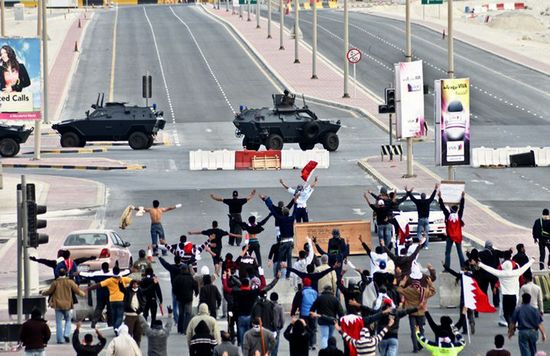
(Photo: Anti-government protestors open their arms in front of military vehicles near Pearl Square in Bahraini capital Manama, on March 16, 2011, after Bahraini police killed at least two protesters and wounded dozens more as they assaulted a peaceful protest camp in the capital's Pearl Square, an opposition party official said. AFP/Getty.)
The Brutality In Bahrain
It’s hard to imagine a more telling image than shooting an unarmed protester point-blank: Nick Kristof says of the extremely graphic one below, “This video of a protester killed in Bahrain BY OUR ALLY is almost impossible to watch”:
How To Help Japan, Ctd
GiveWell, a website that performs charity research, has advice:
We believe that
- Those affected have requested very little, limited aid. Aid being offered far exceeds aid being requested. …
- Charities are aggressively soliciting donations, often in ways we feel are misleading …
- Any donation you make will probably be used (a) by the charity you give it to, for activities in a different country; (b) for non-disaster-relief-and-recovery efforts in Japan.
- If you’re looking to pursue (a) and help people in need all over the world, we recommend giving to the best charity you can, rather than basing your giving on who is appealing to you most aggressively with images and language regarding Japan.
- If you prefer (b), a gift to the Japanese Red Cross seems reasonable.
Overall, though, a gift to Doctors Without Borders seems to us like the best way to effectively “respond to this disaster”. We feel they are a leader in transparency, honesty and integrity in relief organizations, and the fact that they’re not soliciting funds for Japan is a testament to this. Rewarding Doctors Without Borders is a move toward improving incentives and improving disaster relief in general.
Earlier suggestions here.
(Hat tip: MR)
The Tea Party Delusion
Actually, it's Rush Limbaugh's delusion that they're going to launch a third party – hey, it could happen – and that the third party would represent a majority of Americans:
I think what everybody misunderstands about this Tea Party business — and I think it's one of the reasons why it's resented, and I think one of the reasons that the intelligentsia on both sides has problems with Palin ('cause she's associated with it) — is that the Tea Party doesn't have a leader. It's not of Washington. It's not of Yale. It's not of Harvard. It is not of Brown or Temple or Trinity or any of these other places. It's right out there in good, old-fashioned grassroots — and if you want to kill the Tea Party, there's no one person to go to the kill it. You gotta kill principles. You've gotta wipe out total ideas. That constitutes a threat.
So there's no real getting rid of the Tea Party when you boil it all down. So the Tea Party is… I mean, they do have some fundraising arms. I know this because I get the spam e-mail from 'em (and I say that with great affection) but look at Wisconsin. They haven't slackened off, their passion hasn't wavered. Their expectations are just as high as ever, and if they're not met, they have come to life and organized on the basis of real events and real principle. They have not been talked into anything. They don't exist because some rabble-rouser has gotten 'em all worked up. The Tea Party people, that whole organization (as it's defined) is the epitome of genuine. So third party. Who knows where they'll go, if that's what they think it takes to effect the outcome that they want, especially they know that they're the majority of thinking in the country, too? They know that they represent the majority of thinking of the people in this country.
It's as though Limbaugh is reacting to the increasing disdain shown him by establishment Republicans by dreaming up an alternative party that he could lead.
 The Dish