Glenn Greenwald, in that way he has, asks the toughest question about American exceptionalism. Yes, it’s clear Obama believes in the unique role of the US in global politics, and world history, despite the Big Lie from Romney et al. But do we all mean the same thing when we talk of this idea? And is this more than mere national solipsism and myth?
It’s easy to see where Romney, for example, gets his belief. Mormonism is the only all-American religion, placing Jesus in America itself (“I just got crucified, you guys”). But for Christians, the notion of God preferring one land-mass or population, apart from the Jewish people from whom the Messiah came, is obviously heretical. As a Catholic, I see no divine blessing for any country, and  the notion that God would make such worldly distinctions strikes me as surreal as it did when I first wrapped my head around the phrase “Church of England”. If God is God, one island on one planet in a minor galaxy is surely the same as any other, and the truth about our universe surely cannot be reduced to one country’s patriotism. Yes, we can ask, as Lincoln did, for God’s blessing. But seeking God’s blessing is not the same as being God’s country – with all the hubristic aggression that can lead to.
Some Straussians see Lincoln as the Second Founder and the abolition of slavery as the return of the West to natural rights. And it certainly seems true that in Lincoln’s words and America’s example, key ideas about human equality and dignity gained momentum – and you can hear those ideas today in the mouths of a new Arab generation, in a culture so alien to our own it is close to impossible to understand in its complexity. What deeper proof that these ideas are universal and true?
But this also reveals the limits of American exceptionalism. If America’s ideals are universal, they cannot be reduced to the ownership of one country. And that country’s actual history – as opposed to Bachmannite mythology – is as flawed as many others. Why, after all, did America need a Second Founding under Lincoln – almost a century after it was born? Which other advanced country remained so devoted to slavery until the late nineteenth century? Which other one subsequently replaced slavery with a form of grinding apartheid for another century? Besides, much of the thought that gave us the American constitution can be traced back to European thinkers, whether in Locke or Montesquieu or the Enlightenment in general. Seeing America as the sole pioneer of human freedom is to erase Britain’s unique history, without which America would not exist. It is to erase the revolutionary ideas of the French republics. It’s historically false.
But was the discovery of America some kind of divine Providence? The Puritans certainly thought  so. And the blessing of a vast continental land mass with huge resources is certainly rare in human history. But, of course, that land mass was available so easily because of the intended and unintended genocide of those who already lived there – which takes the edge off the divine bit, don’t you think? Call me crazy (and they do) but my concept of God does not allow for God’s blessing of genocide as a means for one country’s hegemony over the earth.
This is not to say that America doesn’t remain, by virtue of its astonishing Constitution, a unique sanctuary for human freedom. We are freer here in terms of speech than in most other advanced countries, cowed by p.c. laws and restrictions. We are freer here in labor and capital than most other countries. To feel pride in this is natural. It is why I love this place and yearn to be one of its citizens. And the vast wealth of an entire continent, unleashed by freedom’s flourishing, gave this land of liberty real and awesome global power, which it used to vanquish the two great evils of the last century – Nazism and Communism. This is the noble legacy so many now seek to perpetuate, with good intentions and benign hearts, despite the disastrous and costly interventions of the last decade.
But as the 20th Century wore on, this kind of power had its usual effect, and the establishment of a massive global military machine, as Eisenhower so presciently noted, created the risk of a permanent warfare sustained by domestic interests. Throw into the mix a bevy of intellectuals busy constructing rationales for a uni-polar world – on the neocon right and the neoliberal left – and we slowly became, at best, the indispensable nation and at worst, a benign imperial bully.
In other words, America’s ideals are not unique to America, and America’s success led it to the same temptations of great powers since ancient times. America’s exceptional freedom and exceptional wealth did not exempt it from unexceptional human nature or the unexceptional laws of history. To believe anything else is to engage in nationalist idolatry. In retrospect, Vietnam was a form of madness brought on by paranoia. In Iraq, America actually presided over 100,000 civilian deaths as it failed to perform even minimal due diligence in invading and occupying another country (while barely a few years later, we invoked – with no irony or even memory – the risk of mass murder as a reason to invade another country). And US forces are still there – and the same alliance that gave us the Libya campaign will surely soon be arguing for extending their presence as the Potemkin democracy slowly collapses. In Afghanistan, the graveyard of so many empires, we are busy sending drones to hit targets with inevitable civilian casualties in a war that has no end, no discernible goal, and has now lasted longer than any war in the country’s history. When America finds itself in wars where it can accidentally kill nine children gathering firewood, it seems somewhat abstract to talk uncritically of America’s moral superiority. And when America has also crossed the line into legalized torture, and refuses to acknowledge or account for it, let alone hold the war criminals responsible, it has lost the moral standing to dictate human rights to the rest of the world.
Obama had a chance to turn this around.
He did end the active torture of prisoners of war. He promised to end the war in Iraq, to close Gitmo and to reframe America’s relationship to the world. But he refused to bring the torturers of the last administration to justice, thereby effectively withdrawing from the Geneva Conventions. We remain in Iraq, we have much more aggressive war in Afghanistan, and Gitmo is still open. The kind of humiliations we once inflicted on prisoners of war are now inflicted on American citizens in custody, as in the case of Bradley Manning. And with all this still on our plate, Obama has just – unilaterally – committed America to an intervention in a third civil war in a third Muslim country, with the grave risk of our taking responsibility for another effort at nation-building abroad, when nation-fixing at home was the reason he was elected.
America is exceptional in so many ways. But when we use that exceptionalism to violate our own values, and to meddle in places we have no business or interest meddling in, then, in some ways, we are attacking that very exceptionalism, and ignoring its real power – the power of example and restraint, the belief that freedom can only be won by the people seeking it – not by those seeking to impose their ideals onto a recalcitrant world.
The glib hubris of the Libyan intervention is a sign that the change we hoped for really has morphed into the wet military dreams of neoconservatism and the utopian notion of the US as the rescuer of all those subjected to tyranny we believe we can opportunistically save – for a few days or weeks. What I see here is far from exceptional. It is the routine pattern of the rise and fall of all republics that become empires. It is what happened to Rome and Spain and Britain: Success, over-reach, hubris, bankruptcy and decline. And the withering of the sinews of a republic’s body – as in the supine, divided, incompetent Congress, and a court so deferent to the emperor’s unrestricted power in waging war wherever he pleases.
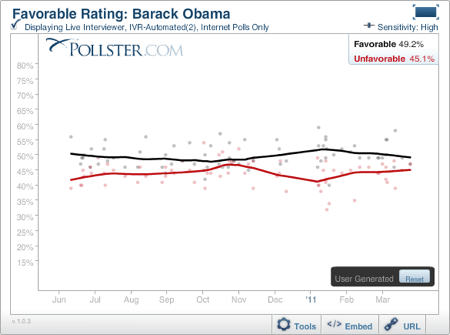
In this, especially with this Libya clusterfuck, Obama reverted to embracing the forces he was elected to resist and restrain. One appreciates the difficulty of this and the horrible moral dilemma of Benghazi; and I still hope for success – beause I see no sane alternative to Obama anywhere and no one can hope that the monster Qaddafi stays in power. But the Libya decision was a deep break with the essential argument for the Obama presidency – and that break is one that the Obamaites seemed not to grasp in their insular, secret and arrogant decision-making process. I fear it has already profoundly weakened the president’s credibility and strength – and will become as big a burden to him as Iraq was to Bush. He now appears not only more distant from his campaign promises – but also more incoherent. More important, it is impossible to sustain the image of this president as the antidote to Bush when, in picking another Muslim civil war to intervene in – however differently frame – he seems to be Bush-lite.
For those of us who wanted him – and still want him – to succeed, it is a crushing disappointment. Even if success emerges, this capitulation to the very strains that took the US into the ditch of 2008 is a form of pragmatism too far.


 The Dish