No Chernobyl

CHARREDPaulaBronstein:Getty

And here's why:

A concern for the people not just of Japan but the Pan Pacific area is whether Fukushima will turn into the next Chernobyl with radiation spread over a big area. The answer is that this scenario is highly unlikely, because of the wildly different design of the two reactors.

The reason why radiation was disseminated so widely from Chernobyl with such devastating effects was a carbon fire. Some 1,200 tonnes of carbon were in the reactor at Chernobyl and this caused the fire which projected radioactive material up into the upper atmosphere causing it to be carried across most of Europe. There is no carbon in the reactors at Fukushima, and this means that even if a large amount of radioactive material were to leak from the plant, it would only affect the local area.

The Japanese authorities acted swiftly and decisively in evacuating people living within 20km of the plant, and ensuring people living within 30km of the plant remained in their homes, with windows and doors closed. The radiation measured so far at Fukushima is 100,000 times less than that at Chernobyl.

I do not have the expertise to assess this judgment, but it sure is reassuring. We may also be overlooking something in the nuclear panic: the humanitarian disaster of the freezing post-tsunami north east of Japan:

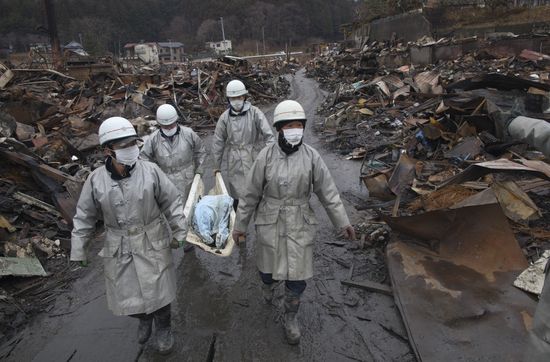
As well as an official death toll now over 4,200, which will inevitably rise much higher, hundreds of thousands of people have been left homeless, in many cases losing just about every possession. Their plight has been made worse by the severe weather affecting much of Japan's north-east at the moment, with some areas experiencing blizzards and temperatures of -5C. There are temporary evacuation shelters but these are generally basic and often very chilly. Food and fuel are in short supply.

(Photo: Rescue workers carry a charred body from the rubble of a village destroyed by the devastating earthquake, fires and tsunami March 16, 2011 in Kesennuma, Miyagi province, Japan. By Paula Bronstein/Getty Images)

Palin’s Base Shrinks But Intensifies

Palin-cover-244

A new ABC/WaPo poll finds her negatives among Republicans at an all-time high. The Hill summarizes:

Palin has a 58 percent net favorable rating among Republicans, and a 37 percent net unfavorable rating. While that rating is still positive, it's the worst she's had with Republicans since she emerged on the national stage; her previous low was 63-31 percent.

But look behind the headlines and you find something more interesting:

“Strong” favorability matters in primaries, where motivation to turn out is an important factor. Among strong Tea Party supporters, strongly favorable views of Huckabee and Palin are highest, at 45 and 42 percent, respectively; strongly favorable views of Gingrich and Romney drop off in this group to 35 and 31 percent, respectively.

There’s a similar pattern in a related group, leaned Republicans who say they are “very” conservative. Palin and Huckabee (at 45 and 44 percent) again attract much higher strongly favorable ratings among strong conservatives than do Gingrich and Romney (30 and 28 percent).

In primaries, enthusiasm matters. And if Huckabee doesn't run …

That Damn Wikileaks

Have you noticed how almost every single big story in the last few months has been buttressed by something found in the Wikileaks trove of government cables? The latest:

A US embassy cable obtained by the WikiLeaks website and seen by The Daily Telegraph quoted an unnamed expert who expressed concern that guidance on how to protect nuclear power stations from earthquakes had only been updated three times in the past 35 years. The document states:

"He [the IAEA official] explained that safety guides for seismic safety have only been revised three times in the last 35 years and that the IAEA is now re-examining them. Also, the presenter noted recent earthquakes in some cases have exceeded the design basis for some nuclear plants, and that this is a serious problem that is now driving seismic safety work."

The cables also disclose how the Japanese government opposed a court order to shut down another nuclear power plant in western Japan because of concerns it could not withstand powerful earthquakes.

Damn information. Whatever happens, the public must be protected from it.

Darkness Visible

Another rupture at a second reactor, releasing radioactive steam. Worse, the attempt to cool the reactors from the air has been aborted, given high radiation levels. But, in the miasma of nuclear news, we’re told that the second ruptured reactor may not be a severe one, and that the number of emergency workers at the plant has now doubled.

We use the word “hero” these days rather promiscuously, sometimes becoming a synonym for veteran. But these workers, essentially sacrificing their future lives to save millions of others, seem to me to fit the description in inspiring ways. In this darkness, their light flickers.

Do You Want The Good News Or The Good News?

Michael Cohen watches the Afghanistan news cycle:

So once again we’ve hit a point that we seem to hit every few weeks with Afghanistan; reems of data and anecdotal evidence suggests that the war in Afghanistan is going badly; that civilian death tolls have increased; that the Karzai government remains deeply alienated from the US/NATO effort; that our security gains may not be sustainable . . . and then confident predictions from the US military that we are on the cusp of turning the tide in the war.

In short, we have reality in Afghanistan – and then we have what our military and political leaders tell us.

It really is Vietnam all over again, isn’t it? Along the same lines, Greg Scoblete questions the administration’s negligible troop reductions. What I cannot fathom is Obama’s stance on this. Did he intensify the war to prove it was unwinnable, thereby giving him lee-way to withdraw? Did he think the “surge” was worth a shot and an earlier withdrawal would have been too costly initially? Has he merely waited for public opinion to shift decisively? Does he want to use this issue to divide the GOP?

Or, more worryingly, does he believe the bullshit Petraeus is continuing to shovel? Or is he too weak to stand up to the face-saving general?

The Danger Of An Anti-Nuclear Backlash

NuclearGetty

Gregg Easterbrook argues that the Fukushima reactors were too old and that "old reactors designed in the 1950s and 1960s, when far less was known about controlling atomic power, need to be taken out of service and replaced with modern designs that do not have the problems experienced at Fukushima":

If the Japan accidents produce a new wave of opposition to new reactor construction, the result will be to lock into place a profusion of obsolete reactors with antiquated engineering. Japan should have replaced the Fukushima reactors with a modern station years ago. Will other nations refuse to act, and wait till the next obsolete reactor fails?

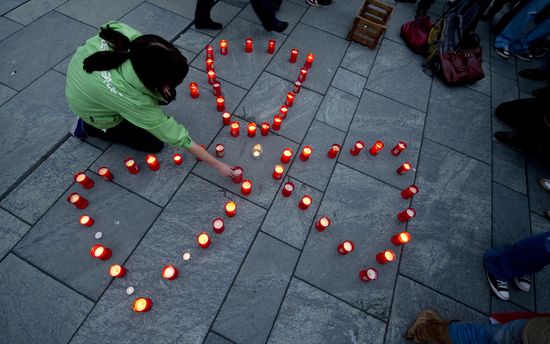
(Photo: A Greenpeace activist lights candles to form the nuclear symbol during an anti-nuclear demonstration in front of the chancellery in Berlin on March 14, 2011. By Johannes Eisele/AFP/Getty Images)

The Tsunami Hits The Global Economy, Ctd

Eamonn Fingleton worries about the economic damage:

Experts on industrial logistics point out that, as world manufacturing has become more technologically advanced, it is more likely that a single supplier, or even a single factory, can be critical to a whole industry. And we know that, in this vein, Japanese corporations enjoy monopolies or oligopolies in a host of crucial niches in supplying advanced materials, components and production machinery for industries like electronics, cars, and aerospace.

In two books in the 1990s, I made a sustained effort to track Japan's more important manufacturing "chokepoints," as they are known to customers. I succeeded in identifying close to 100. Some are well known, such as the YKK Company's global lock on zip fasteners and Shimano's dominance in bicycle gears. Many have hithero gone largely unnoticed, but are actually much more important to the smooth functioning of the world economy: A good example is semiconductor-grade silicon—a highly purified not-an-atom-out-of-place material that only a couple of companies worldwide can make. The leading suppliers, Shin-Etsu and Sumco, are both Japanese and, as far as I can tell, there are no significant suppliers left in either Europe or America. If any of their factories or suppliers have been affected by the earthquake, the entire global electronics industry will be quickly feel the impact. 

Who Is Responsible?

Douthat puts the United States' international obligations in context:

We would become part of the government of Libya, in a sense, if we engage our forces in that country’s civil war. And thus our obligations to Libyans would increase, and so would our share of the guilt if things turns out badly.

It isn’t that we have no obligations to Libyans now: As the dominant power in the globe, we have some responsibility for furthering peace and order just about everywhere on earth. But just as you have certain obligations to your brother or cousin’s or neighbor’s child, but a far greater responsibility for a child that you adopt, so a great power’s obligations increase when it assumes an active role in the politics of another country — and so do the responsibilities it bears for any subsequent disasters. Which is, in turn, a good reason to be wary of taking on too many of those obligations in the first place.

The Economics Of Nuclear Power

NuclearPower

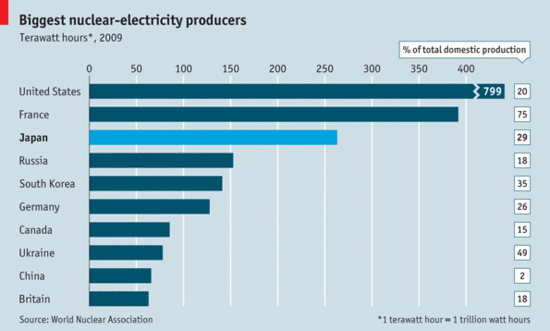
Robert Bryce isn't expecting a nuclear power revival in America – and not because of Japan:

[T]he forces that already undermined the revival of America’s nuclear sector are largely economic, not political. The most formidable obstacle: the ongoing shale gas revolution.

The ability of drillers to unlock vast quantities of natural gas has resulted in an avalanche of methane production and a resulting collapse in prices. Last year, U.S. gas production hit its highest level since 1973. And despite a very cold winter, natural-gas prices have generally stayed below $4 per thousand cubic feet, which is about half the level seen as recently as 2008.

On Sunday morning, I discussed the economics of nuclear with a senior executive in the U.S. nuclear utility sector. He asked, “How can you compete with natural gas when it’s priced at less than $4?” The answer, said the executive, who asked that his name not be used because he was not authorized to speak the media, is, “you can’t.”

Kevin Drum points out that taxing carbon would close the economic gap:

It's perfectly reasonable to argue that the problem here isn't that nukes are genuinely more dangerous or more expensive than other forms of power generation, it's that other forms of power generation aren't forced to pay for their own externalities. Charge them properly for the carbon they emit and the mercury they spew and the particulates they make us breathe and they'd be just as expensive and just as dangerous as nuclear power. I think there's a pretty good case to be made for that. Nonetheless, until we do start charging properly for all those externalities, nukes just aren't going to be cost effective and nothing is going to change that.

(Chart from The Economist)

Longevity Myths

Veronique Greenwood interviews Howard S. Friedman, co-author of The Longevity Project:

One of our longevity myths is "Get married, and you will live longer." The data tell a different story. Marriage was health-promoting primarily for men who were well-suited to marriage and had a good marriage. For the rest, there were all kinds of complications.

For example, women who got divorced often thrived. Even women who were widowed often did exceptionally well. It often seemed as if women who got rid of their troublesome husbands stayed healthy—most women, it seemed, can rely on their friends and other social ties. Men who got and stayed divorced, on the other hand, were at really high risk for premature mortality. It would have been better had they not married at all.