The Arab League And The No-Fly Zone

A reader writes:

The Arab League has requested that the UN approve a No Fly Zone over Libya. If Arab Nations are in favor of imposing a No Fly Zone, why don’t they impose it themselves?

Their bases are well within range of Libyan airspace, and they are well-equipped with modern American and European aircraft. Saudi Arabia has over 150 F-15 fighters, and Egypt has 240 F-16 fighters. Both have additional hundreds of Panavia Tornadoes, Dassault Mirages, MiGs, and miscellaneous other fighter and strike aircraft, as well as dozens of Apache attack helicopters and other support aircraft. Especially considering that many of these weapons were acquired with US grants and loan guarantees, why shouldn’t these Arab countries take the lead?

A good question. They also have the oil money to finance their no-fly zone, as opposed to a bankrupt hegemon already imbroiled in two unwinnable wars.

The Saudi Invasion Of Bahrain

BAHRAINJamesLawlerDuggan:Getty

I am old enough to remember the days when the entire world stopped dead in its tracks as one Middle East autocracy invaded a tiny neighboring state, and the US corralled a massive coalition to repel it. From that moment on, because in part of the threat Saddam's invasion of Kuwait posed to the Saudi oil fields, the US was far more deeply enmeshed in the Middle East's military and political equation than ever before.

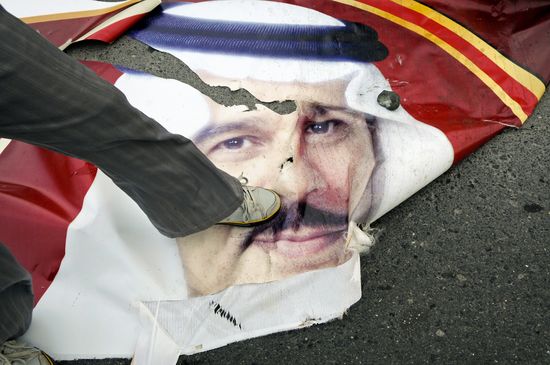
Now fast forward to a thousand troops with tanks streaming over the causeway that connects Saudi Arabia with Bahrain. Now, obviously this is different in as much as the Sunni Bahrainian royalty invited the troops to come in to protect them from the protests of the Shiite majority. But to my mind, that makes it just as bad. A military from one Sunni country has invaded another to suppress democracy, because it might reflect, for the first time, the wishes of the Shiite majority, rather than Sunni despots. And it has not been a merely symbolic action:

Demonstrators and security forces faced off from mid-morning in the Sitra area on the outskirts of Manama. Bystanders reported the sound of gunfire and the scent of teargas by early afternoon, followed by the familiar cacophony of ambulance sirens as they sped casualties towards the city's two main hospitals. By late afternoon, there were numerous reports of clashes inside Shia villages throughout Manama that had led to dozens of injuries.

At least nine people were admitted to hospital with moderate to serious injuries. Hospital officials reported that two victims had what appeared to be gunshot wounds. Many more appeared to be unconscious as they were wheeled into wards amid chaotic scenes.

This strikes me as more significant regionally than Libya's internal revolts. Since when does the international community stand by as one country's military invades another and kills some of its citizens? The answer is a pretty simple one: when the invading country controls 25 percent of the world's oil supply. Room For Debate considers Saudi Arabia's stability here. Bernard Haykel makes the obvious point:

Saudi Arabia cannot become unstable without the world coming literally to a standstill. The kingdom is in a category by itself with respect to energy markets and its role in the global economy. One need only look at the behavior of financial markets whenever its fate is in question to know this with certainty.

But what if nothing can quite prevent the forces of democracy and revolt from reaching the Saudi theocracy? Will the West have to occupy the oil fields?

(Photo: An anti-government protester steps on a torn poster of King Hamad bin Issa al-Khalifa in Manama on March 13, 2011. By James Lawler Duggan/AFP/Getty.)

Neocon Desperation

One of the Bush administration's most pro-war voices, John Bolton, offers this suggestion for intervening in Libya:

possibly a no-drive zone for Gadhafi’s military vehicles …

I kid you not. There is not a word in the piece about possible unintended consequences of launching a third war in a Muslim country in a decade.

The neocons don't think of the future; and they have a remarkable skill at forgetting the past. Especially their own.

Rummy On FOIA

He had this exchange over the weekend at a Nixon Library appearance with Hugh Hewitt:

HH: I once asked President Nixon in his retirement why he signed the Endangered Species Act, and he said well, it seemed like a good idea at the time. You co-sponsored FOIA, the Freedom Of Information Act. What were you thinking?

DR: It seemed like a good idea at the time.

There's an easy solution: store all non-classified government documents electronicaly in a searchable online database as a default. In a lot of government agencies, ending a reliance on dead trees and filing cabinets makes sense anyway. Pro-Publica takes a look at illegitimate refusals to turn over information to the public here. And this story is one of many thousands in which freedom of information laws have helped to uncover official corruption.

The Palin Wars, Ctd

The backlash against the Washington establishment's dissing of Palin is red-hot on the right wing blogs. Two typical rants. From Free Republic:

As far as coward Charles Krauthammer goes….The day I take advice on conservatism from a guy who worked for Mondale and Carter is the day I put a loaded .357 in my mouth and pull the f****** trigger! That clear enough or should I use more big words to be on the same “intellectual stage” as the media elites?

From Legal Insurrection:

What's next, Mr. Labash, should we double-check to see if Palin had breast enlargement surgery? That will get you quoted in Gawker, too. Hey, how about some Palin "hand job" jokes at the next Weekly Standard lunch meeting, that should get a round of laughs. Oh, but pointing that out must make me an Al Sharpton, Rhode Island (and Ithaca) Edition, right?