Hard to agree to when you’re a Republican fundamentalist:
The National Center for Science Education has tracked a record-setting number of nine anti-evolution bills introduced in state legislatures since Jan. 1.
Yay! Win the future with the GOP!
Hard to agree to when you’re a Republican fundamentalist:
The National Center for Science Education has tracked a record-setting number of nine anti-evolution bills introduced in state legislatures since Jan. 1.
Yay! Win the future with the GOP!
It’s hard to keep up with the constant developments in Japan’s nuclear crisis. Here’s an English language live-stream from NHK, Japanese television.
"It looks like to me if shooting these immigrating feral hogs works maybe we have found a [solution] to our illegal immigration problem," – Kansas Republican state representative Virgil Peck.
The myriad little tax shelters, breaks, loopholes and hidden subsidies in the absurdly complex tax code do two things: they distort the market with political, rather than economic, incentives; and they cost a hell of a lot of money. They are a form of spending, however disguised they are as tax cuts. This graph (via Ezra) really does bring this home:
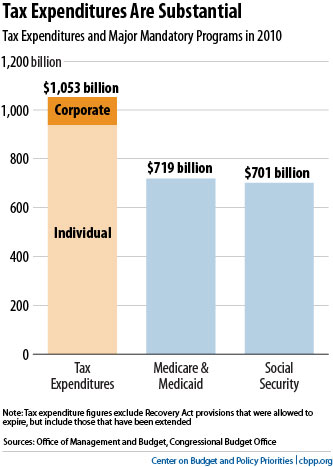
What surprised me: how much of this is non-corporate. And much of the tax breaks go to the relatively well-to-do:
Adding to their inefficiency, many tax expenditure provisions — principally deductions, exemptions, and exclusions — tie the tax subsidies they provide to the marginal tax rate of the beneficiary. The amount of the tax benefit provided increases with income, with the wealthiest households receiving the largest tax subsidies.
There is an obvious, rough solution to the US debt crisis: end these tax breaks (except for philanthropy), simplify and lower tax rates (but in a manner that actually raises net revenue), means-test social security, extend the retirement age, slash defense spending, and focus on the cost-cutting measures already embedded in Obamacare.
It's one of those solutions – like the two-state answer in Israel – that is as obvious as it is apparently impossible.
Babak Dehghanpisheh sounds unsure:
There were few signs of an organized defense in Ajdabiya on Monday. Opposition fighters beat a hasty retreat to the town Sunday night after a sustained assault by government loyalists in the oil port of Brega, 50 miles away. And it appeared that they were just barely starting to regroup. The main checkpoints east and west of the town were only lightly defended. A number of antiaircraft guns and pickups loaded up with heavy machine guns were scattered around town; additional ammo also was being brought in to some checkpoints. But there were no signs of trenches or sandbags, the hallmarks of a more conventional defense strategy.
Still, rebel leaders insist the city is beefing up its defenses covertly.
Ed West wonders:
Why do some cultures react to disaster by reverting to everyone for himself, but others – especially the Japanese – display altruism even in adversity?
Easterly uses the lack of looting to explain a development principle:
Economists have been saying for a while that trust is a good candidate to be a major determinant of development. Think how much contract enforcement is critical to make trade and finance possible. Think how much easier contract enforcement is when nobody tries to cheat.
Avent explains how the "anti-development strain of NIMBYism" is bad for the environment. He notes that "emissions fall a lot more when someone from Houston moves to New York than when someone from New York starts biking":
New York can’t accommodate more people unless it builds more homes, and it can’t build more homes, for the most part, without building taller buildings. And New Yorkers fight new, tall buildings tooth and nail. They fight them on aesthetic grounds, and because they’re worried about parking and traffic, and because they’re worried about their view, and because they just think there’s enough building in New York already, thank you. And many do this while heaping massive scorn on oil executives and the Republican Party over their backward and destructive views on global warming.
Of course, the obstruction of development is offensive for lots of reasons: it makes housing and access to employment unaffordable, it reduces urban job and revenue growth, it tramples on private property rights, and so on. But the environmental hypocrisy is galling, and it’s not limited to New York.

Spencer Ackerman analyzes the escalation in Bahrain, where foreign troops from Saudi Arabia and the UAE have arrived to aid the government:
It’s a move that undercuts the Obama administration’s rosy portrayal of the [Bahraini] monarchy. Despite a paroxysm of violence in February when security forces attacked protesters in the capitol city of Manama, “today, the Pearl Roundabout in Bahrain is a place of nonviolent activism,” Adm. Mike Mullen, chairman of the Joint Chiefs of Staff, assured reporters on March 1. After a visit last week to Bahrain, home to the U.S. Navy’s Fifth Fleet, Gates said he was convinced the royals “are serious about real reform.”
If so, that lasted until about when Gates’ plane went wheels-up.
Security forces are now trying to clear Manama’s financial district of protesters, firing tear gas canisters into demonstrators’ chests. About 1000 Saudi troops entered Bahrain on Monday, ostensibly to protect government installations, but protesters at the Pearl Roundabout set up barricades in preparation for the Saudis attacking them. The leading Shia opposition party, Wefaq, called it a “declaration of war and an occupation.” … [T]he timing of Gates’ trip is sure to spark suspicion in Manama that the U.S. approved of the violence and the invasion.
Jacqwi Campbell files a dispatch from the weekend protests that spurred the intervention. Shayan Ghajar worries that "the military intervention of Saudi Arabia on behalf of the Khalifa dynasty will serve as a greater impetus for Iran to intervene in Bahrain."
(Photo: Bahrain TV via Agence France-Presse/Getty Images, via Newsflick)
Joel Johnson comes to terms with what it means to champion technology:
We squander millions of years’ worth of stored energy, stored life, from our planet to make not only things that are critical to our survival and comfort but also things that simply satisfy our innate primate desire to possess. It’s this guilt that we attempt to assuage with the hope that our consumerist culture is making life better—for ourselves, of course, but also in some lesser way for those who cannot afford to buy everything we purchase, consume, or own.
When that small appeasement is challenged even slightly, when that thin, taut cord that connects our consumption to the nameless millions who make our lifestyle possible snaps even for a moment, the gulf we find ourselves peering into—a yawning, endless future of emptiness on a squandered planet—becomes too much to bear.
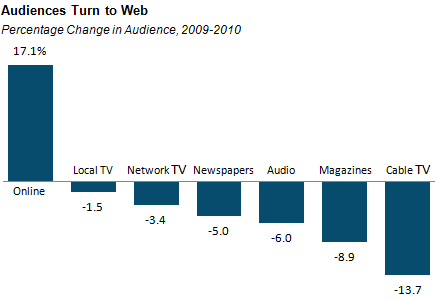
From the The State Of The News Media annual report:
In December 2010, 41% of Americans cited the internet as the place where they got “most of their news about national and international issues,” up 17% from a year earlier. When it came to any kind of news, 46% of people now say they get news online at least three times a week, surpassing newspapers (40%) for the first time. Only local TV news is a more popular platform in America now (50%).
 The Dish