Invisible Bias

Building off the Dish's NPR thread, David Link claims admitting bias is often impossible:

Lesbians and gay men do exist, do fall in love, do form relationships, do raise children.  The law’s neglect of them is now clear to anyone who wants to see it. But those who keep their blinkers on do, in fact, begin to look biased, look like they really don’t want to see something that is right in front of their eyes. Perhaps that isn’t really bigotry or hate, but it looks so willful, so harsh, so mean.

Fighting Qaddafi With A Piece Of Paper

Niall Ferguson insists Obama impose on Libya a document like the Helsinki Final Act of 1975:

So accustomed were the Soviet authorities to lying that they saw no harm in subscribing to these pledges [to uphold human rights]. Indeed, the Final Act was reprinted in full in Pravda. But for dissidents inside the Soviet bloc like the physicist Andrei Sakharov or the Czech playwright Václav Havel, Helsinki represented a huge stick with which to beat their persecutors.

Paul Wells rolls his eyes:

[Libya has] already signed language that’s awfully similar to the Helsinki Final Act.

UN General Assembly Resolution 60/251 set up the United Nations Human Rights Council. Among other things, it says this: “All human rights are universal, indivisible, interrelated, interdependent and mutually reinforcing, and that all human rights must be treated in a fair and equal manner, on the same footing and with the same emphasis.” …

When proposing a method for eliminating Mouammar Gadhafi “before thousands of Libyans [die],” to a president whose “ignorance” and need for “a history lesson” drive you to open mockery, it’s probably best not to propose a solution that took 16 years to work in the first place. Because “what helped the Central and Eastern European revolutionaries of 1989 topple their tyrants,” by Ferguson’s own account, took “two years of haggling” before it was signed, 14 years before the Central and Eastern European revolutionaries of 1989 began their revolutions.

Headline Of The Day, Ctd

A reader writes:

In fairness to the BBC, that's their usual headline style – I think it indicates that the part of the headline in quotation marks is a direct quote from some other source.  Currently I see …

Iran 'to compete at London 2012'
Gunman interest in 'extreme porn'
UK 'gave torture tacit approval'
Carstairs for 'Mafia plot' killer

Another writes:

The BBC puts those infuriating quotation marks around everything it quotes, as you'll see by Googling "BBC headline quotation marks" (here's a helpful discussion on the matter). The fuss around these particular quotation marks, ignoring the BBC's long history of bad quotation marks, says more about the hair-trigger sensitivities of pro-Israeli bloggers than about the BBC. (You didn't draw inferences about the BBC, I know, but blogger you linked to did.)

Another:

There is no doubt this is a disgusting crime, but the quotes are appropriate at this point. So far, there is no evidence that has been reported that a Palestinian is behind this act. They very well may be, but as of now it is an accusation.

One Palestinian group, which is notorious for taking responsibility for acts they didn’t commit, was reported to have taken responsibility for it. Today, it was reported that they denied responsibility for it. Also, reports today indicate that Thai immigrant workers in the settlement were being questioned by Israeli authorities. Israeli soldiers have put an entire Palestinian village in the area under lockdown and have detained dozens of not hundreds of the villagers in the hope of extracting information from them.

It’s quite disturbing that the media would accept that a Palestinian is behind this as a matter of fact before there is any evidence of it. Again, I’m not saying a Palestinian didn’t or couldn’t do this; I am just saying that responsible journalists should treat it as an accusation until it is more than that.

Face Of The Day

110046747

Israeli relatives and friends grieve in Jerusalem's Har Hamuhot cemetery during the funeral of three young children and their parents of the Fogel family, stabbed to death in their beds as they slept in the West Bank settlement of Itamar on March 13, 2011. The killers, who are believed to be Palestinian, are still at large and police are on high alert for fear of possible reprisals by settlers against locals once the burial rites are over. By Menahem Kahana/AFP/Getty Images.

The Hollow Men vs Palin

Larison notes the timing of the Republican anti-Palin message:

As long as she was useful prior to the midterms, the institutions, magazines, and leaders of the movement not only tolerated her, but actively promoted her and gave her typically glowing coverage. Those that couldn’t bring themselves to praise her went out of their way not to criticize her. Now that Palin may represent a political threat to Republican chances of regaining the White House, they are suddenly very concerned about her impact on the quality of conservative argument. Their concern would be interesting if it weren’t so belated and narrowly focused on Palin.

It almost makes one believe that John McCain and Bill Kristol actually hold their base in contempt, believing them to be "poor, undereducated and easily led." And now they have to steer their flock in another direction. In some ways, I have more sympathy with the Palinites and Palin than the cynics and hollow men of Washington's GOP establishment.

Correction Of The Day

A reader writes:

You quoted Dave Ewing as saying, "The headline you won't see: 'Millions saved in Japan by good engineering and government building codes'. But it's the truth". Of course, the next day the NYTimes wrote, "Japan’s Strict Building Codes Saved Lives". One wonders if the Times read Dave's tweet, or if Dave's lack of faith in the journalism industry is simply unwarranted.

Dave promptly tweeted the NYT story, adding, "But it is nice to know that I was wrong".

Nature And The Gods

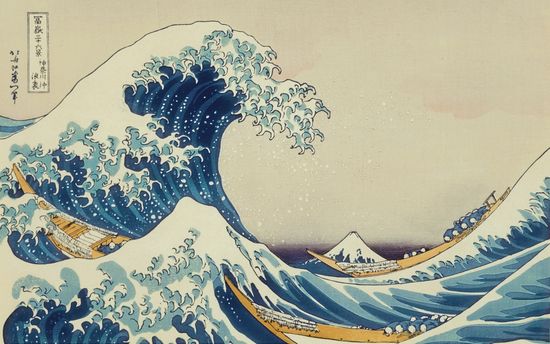
Great_wave

Mark Vernon examines Hokusai's famous print, "The Great Wave of Kanagawa":

It's a religious image, representing the very different approach that Shintoism has towards nature, compared with Christianity. In Christianity, human beings are at the centre of nature: creation is for humanity, along with other creatures, and it's humanity's task to care for it. Hence, in part, the offence we feel when nature turns against us.

In Shintoism, nature is recognised as infinitely more powerful than humankind – as in the wave – and that humankind is in nature with the permission of the gods but with no particular concern from the gods.

The Plan Works, In Theory

David Roberts applies Cowen's lists to environmental economics and policy:

Since energy is a larger percentage of low-income household budgets, energy taxes are regressive by nature. That regressivity can be offset in any number of ways. In fact, it could be offset with a relatively small portion of the revenue — the Center on Budget and Policy Priorities estimates it would take 14 percent to hold low-income consumers harmless. The feds could do it by reducing payroll taxes, funding efficiency programs, issuing per-capita rebates, or some mixture thereof.

The regressivity can be offset, but will it? 

Not if the GOP can help it. For them, alas, cheap gas is about as fundamental as the Second Amendment.

The Nuclear Fallout

110032289

As the radiation crisis in Japan continues, Room For Debate addresses the implications it might have for nuclear policy in the US. MIT's Michael W. Golay takes a realist approach:

[C]omprehensive protection against all seismically-associated nuclear risks would be very expensive, if even possible. Utilizing cost-benefit judgments, every nation with nuclear power has set the strongest earthquake that its nuclear plants must survive intact considerably below the level of the Japanese earthquake.

In considering the nuclear hazards of strong earthquakes, it’s useful to note the results of a study, which I led from 2001 to 2004, for Tokyo Electric Power Company.

The study addressed whether to devote resources to provide robust public protection from nuclear risks that could arise in the event of strong earthquakes or to focus such efforts and researches on the direct effects of the earthquake. We concluded that any earthquake strong enough to damage the reactor, and thus expose the public to harmful radiation, would be much more dangerous to the public in its direct effects, and that it would be more beneficial to devote efforts and resources to general preparedness.

In fact, the current radiation crisis was not caused by the quake itself:

Critics of nuclear energy have long questioned the viability of nuclear power in earthquake-prone regions like Japan. Reactors have been designed with such concerns in mind, but preliminary assessments of the Fukushima Daiichi accidents suggested that too little attention was paid to the threat of tsunami. It appeared that the reactors withstood the powerful earthquake, but the ocean waves damaged generators and backup systems, harming the ability to cool the reactors.

(Photo: A person, who is believed to be have been contaminated with radiation, is carried in a white bag by soldiers at a radiation treatment centre in Nihonmatsu city in Fukushima prefecture on March 13, 2011. Japan battled a feared meltdown of two reactors at a quake-hit nuclear plant Sunday, as the full horror of the disaster emerged on the ravaged northeast coast with thousands feared dead. A total of 22 people have been hospitalised after being exposed to radioactivity, although it was not immediately clear to what degree they were exposed and what condition they were in. By Yomiuri Shimbun/AFP/Getty Images)