A Base Opposed To Governing

Alex Massie checks in on the Lib Dems:

Unfortunately it seems as though a good number of Lib Dem voters have decided that, all things considered chaps, they'd rather not be in government. That way they'd be able to nurture their delusions, pruning and feeding and watering them free from the awkward realities and inconveniences of government. That's their right but they shouldn't be so shocked that the party leadership doesn't share this analysis.

Which means that I agree with a good deal of Fraser's analysis. I'd add, or repeat in fact, that 15% of the vote for a properly Liberal party would not be a bad or depressing destination for Clegg. It is, again, about the maximum the German Free Democrats ever win and that, surely, is the model Clegg must hope to emulate.

Why Fear The Minority?

John Corvino joins the monogamy debate:

While monogamy may be hard, it’s not so hard that a monogamous couple (straight or gay) can’t look at a non-monogamous couple (straight or gay) and conclude, “Nope, that’s not right for us.” After all, people read the Bible without deciding to acquire concubines. More generally (and realistically), people encounter neighbors with different cultural mores while still preferring—and sometimes having good reason to prefer—their own.

As our opponents are fond of reminding us, gays and lesbians make up a relatively small minority of the population. Coupled gays and lesbians make up a smaller minority, coupled gay males an even smaller minority, and coupled gay males in open relationships a smaller minority still. As Jonathan Rauch has written in his excellent book Gay Marriage: Why it is Good for Gays, Good for Straights, and Good for America, “We might as well regard nudists as the trendsetters for fashion.”

Or put it this way. Which couples are more likely to be monogamous: gay men with no social, familial or legal support for their relationships – or couples married under law in front of their families, friends and neighbors? In some ways, you could argue that lesbians have, from the perspective of sex alone, the least need for social support for their relationships, heterosexuals need more, but gay men need it the most of all. And whose mores are likely to define an existing institution: the 98 percent of those already in it, or the 2 percent trying to join?

The Happiest Man In America?

Catherine Rampell reported last week that it may be Alvin Wong – a man that fits the "statistical composite for the happiest person in America, based on the characteristics that most closely correlated with happiness in 2010."  Wong is a "tall, Asian-American, observant Jew who is at least 65 and married, has children, lives in Hawaii, runs his own business and has a household income of more than $120,000 a year."  After flagging research on the correlation between marriage and happiness, Will Wilkinson inserts a few qualifiers:

Many people experience a big boost in post-nuptial happiness, which slowly recedes toward the pre-marriage baseline. However, marriage is a huge downer for others (incompatible partner? not the marrying kind?). These folks mostly get over it, but not entirely. The result (in this study) is that marriage has no effect on average, even though it has a pretty significant effect, one way or another, for most everyone.

The important takeaway, then, is that averages conceal important information. What you want to know is not whether or not marriage makes people happier on average, but whether you are the kind of person for whom happiness is a boon or a bummer. The same goes for children. If you’re young, poor, and single,  a kid is probably not going to brighten your life. If you’re a relatively-rich, highly-educated thirty-something, kids are pretty likely to give your happiness a boost. And even within each of these demographic cohorts, there’s going to be significant variation based on personality, cost-of-living, access to childcare, etc . 

Shacking Up: Why Not? Ctd

A reader writes:

I shacked up with my girlfriend out of necessity. We'd been dating about 15 months when my roommate told me he was moving out. This was during the nadir of the economic downturn and I was an out-of-work entertainment assistant, teaching after-school classes part time to pay the bills, and living in Los Angeles. My options, dictated by finances, were to share a studio apartment with a complete stranger from Craigslist … or share a studio with my girlfriend. (Gee, which do ya think I chose?)

But I didn't want to do it.

I didn't think I was ready. But you know what? Huddling together in our Koreatown foxhole to weather the economic storm made us closer and helped our relationship grow. Since I was coming home to her home, I didn't drink and stay out late so much anymore. We got out of debt together, bought furniture together, and adopted a child – er, I mean, cat – together.

I'm a prototypical 29-year-old privileged white guy: college educated, out of the home, not really a grownup … the kind of child-of-a-boomer who puts off marriage and children until their thirties. But co-habitating gave me a path to adulthood. It's maybe the best thing to ever happen to me.

The First Round Of The Entitlement Fight?

MADISONScottOlson:Getty

Heather Mac Donald thinks that if "Wisconsin’s Republicans, including Walker, are swept out of power because of this vote, they will have gone down for a superb cause." She looks ahead:

This coming empirical test may be a harbinger of the likelihood of significant cuts to entitlements.  I would have thought that it would have been much easier to cut public employee benefits, since they are a finite special interest group, however powerful, than it would be to cut population-wide entitlements.  If it proves impossible even to cut back on government workers’ fat benefits packages, things don’t look good for broader entitlement cuts.

But they could have made their cause far more popular by not slipping into the legislation the ban on most collective bargaining, which went unmentioned in the campaign, thereby avoiding a far larger backlash which created the massive crowd in Madison this weekend – the size of which eclipsed any tea-party march. Over-reaching fiscal conservatives may do more harm to the general cause of fiscal conservatism than Heather grasps.

(Photo: This weekend's anti-Walker rally in Madison, Wisconsin. By Scott Olson/Getty.)

Why The Whites Flew

Ta-Nehisi says the truth about White Flight in Detroit is "both more elegant and more monstrous" than the image of "scared and bigoted whites fleeing the encroaching onyx horde":

[Thomas Sugrue, author of The Origins Of The Urban Crisis,] shows that "White Flight" began long before blacks began moving in significant numbers into white neighborhoods.

It's been some time, but I want to say the outmigration, in Detroit, began as early as the 1940s–a period that most people conveniently consider a golden age. Moreover, Origins (along with Kenneth Jackson's stellar Crabgrass Frontier) shows that the outmigration didn't simply result from rank and individual color prejudice, but from something more systemic–racist federal, state and local public policy. The FHA, conspiring to devalue property as soon as one black family moved in, block busting realtors, and urban renewal advocates effectively colluded to create white flight.

My point here is that "White Flight" wasn't a product of pure capitalism, market forces and culture. It was the result of social engineering. The terms "White Flight" evinces an ignorance of the policies which shaped the future of Detroit and cities around the country.

“Cupcakes And Gangs, Violence And Sugar”

Map

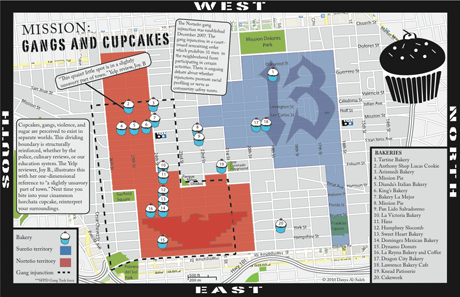
Nicola Twilley features Danya Al-Saleh's map of bakeries in The Mission district of San Francisco overlaid with Norteño and Sureño gang territory:

The insights to be gained from a spatial analysis of cupcake proliferation have been examined on Edible Geography before, in a post inspired by Rutgers Urban Policy lecturer Dr. Kathe Newman’s theory that “cupcake shops can provide a more accurate and timely guide to the frontiers of urban gentrification than traditional demographic and real estate data sets.”

But whereas Dr. Newman’s students mapped cupcakes to track the flow of capital investment into previously depressed parts of the city, Al-Sayeh’s map is designed to draw awareness to the uncomfortable socio-cultural overlaps that occur in such transitional neighbourhoods.

“Next time you bite into your cinnamon horchata cupcake,” concludes Al-Sayeh, “reinterpret your surroundings.”

(Larger version of image in PDF)

Premature Monogamy, Ctd

Several readers are defending this controversial reader against the backlash. One writes:

Perhaps the steam was obscuring your reader's eyes, because it is obvious she didn't actually read the poor man's letter.  Or perhaps she belongs to the rather sizable camp that firmly believes all men are selfish pigs, while giving birth automatically makes any woman a gold-plated Mother Theresa.

The wife stopped giving blow jobs right after the wedding.  To paraphrase Dan Savage, oral sex is standard for both parties, and any model not equipped gets returned to the lot. A few years later, with sex happening once every five weeks or so, his wife didn't say, "I know things are rough right now, help me through this and it will get better, I promise."  Instead, she told him she didn't care if she EVER had sex again, and he should find a "girlfriend." But, as with their prior sex life, she put so may arbitrary rules in place that clearly honesty was not the best policy.

Another writes:

I’ve been going back and forth about whether to sit down and write my experience with non-monogamy. After reading the judmental letters decrying the infidelity of that one husband, I decided to write (probably because I can empathize with him and can’t imagine how it must feel to be stuck in a relationship with a selfish, sexless person).

My husband and I have been married for seven years. We have one child and another on the way. We met online because of the events on 9/11/01 (which is a good long story, but not for today). He lived in D?sseldorf and I lived in Dallas. We dated “internationally” for two years before he moved to the States. In those two years, we were practical about our relationship, so we made it an “open” one. Sex is important to both of us, so we gave each other the freedom to enjoy sex with other partners because we lived so far away from each other.

However, we love each other. So much so that it culminated in that “state of emergency” feeling in which we had to live together. He moved to the States; we got married and moved to Austin.

Since then, we have maintained an open relationship. We have not been monogamous with each other, but we are honest with each another. This type of relationship is perfect for us because we are honest with each other. Of course, we have bouts of jealousy or frustration because of a lack of sex drive (due to pregnancy, tiredness, etc.), but we work through it. We approach these issues intellectually, because that’s who we are.

While I know that sex with my husband is the most intense and close-to-spiritual event that I’ve ever experienced, I also know that the purely physical sensation of having sex with an acquaintance or stranger is just plain fun. My husband and I talk about our separate experiences, which turns us both on and usually leads to hot and heavy very quickly.

Why does this open marriage work for us and not others? I think it boils down to the way we view sex. We don’t view sex as sacred. I don’t think of sex as a rite of marriage. I don’t believe it’s something that I “own” over my husband or vice versa.

I think of sex in practical terms: it feels good; I like to do it; so let’s do what feels good. And part of what feels good, for me at least, is being open and honest with my husband. If I couldn’t be honest about my sexuality, that would be hell for me.

Another:

I think some of your readers were too harsh on the man who said he had secret liaisons because his wife was too tired and too disinterested in sex.  I disagreed with his surreptitious approach, but sympathized with him nonetheless. I’m in a monogamous long-term relationship. He lives in Colombia and I live in Miami (because of DOMA).  He vehemently insisted from the outset that we maintain a monogamous relationship. Generally I prefer them too, but it’s not a deal breaker. Then the separation led to a depression for him and uninterest in sex, with erectile dysfunction as a kicker. Other issues complicated the mix. So when I came down every three months to see him, there was maybe one sexual encounter and it took enormous begging/fighting to get it.

During a calm moment in the middle of the day, I explained to him that his reticence to engage in some sexual activities, plus his refusal of treatment for either depression or ED, effectively vetoed my sex life. I quietly explained that he could have monogamy and I would wait for sex when we got together every few months provided he took ED pills and saw a therapist to ensure the sex would happen. Or the monogamy deal was over.

The next trip led to near-daily sex. And that was that. Savage is right: honesty makes or breaks a relationship.