“It is human nature to look away from illness. We don’t enjoy a reminder of our fragile mortality. That’s why writing on the Internet has become a life-saver to me,” – Roger Ebert, on how computers gave him his voice back.
Month: March 2011
Mr Spock Makes A Few Jokes
Jon Lovett, take a bow:
Come on, I love the press. I even sat for an interview with Bill O’Reilly right before the Super Bowl. That was a change of pace. I don't often get a chance to be in a room with an ego that's bigger than mine.
And while I know I have my share of critics out there, I don't focus on the negative stuff. I just don't pay much attention to it. Most days I barely skim through the comment section of Huffington Post — Daily Kos — Fire Dog Lake — The Daily Dish — boingboing.net.
All right, I hear the criticisms. I do. For example, I know that people think I'm not passionate enough. That I'm too cool. That I'm too detached. But as I was going through my daily routine — sitting alone in my study — meditating, thinking about how to win the future — I pondered this critique, and calmly rejected it — as thoroughly illogical. And for all those who think I golf too much, let me be clear. I'm not spending time on the golf course — I'm investing time on the golf course.
Banking From The Middle Ages
To account for economic disparities between Muslim countries and the West, Wayne Dynes cites the history of hawala, an informal money-transfer system based largely on trust and honor:
[In the Middle Ages], before the Great Divergence, the hawala system spread far and wide. That the first bankers in Italy were familiar with it is shown by the loan- word avallo, which is simply an Italian version of hawala. Yet the European bankers went far beyond their model, to introduce the wide-ranging innovations that we are all familiar with. The Islamic world kept to the more primitive institution of the hawala.
Today, of course, Western banking (sometimes disguised under the rubric of Islamic banking, which is simply Western banking with a few rhetorical changes) flourishes in Islamic countries. So does hawala. That this dual system, with one foot in the past and one in the present, is the norm is one indicator of the way in which Islamic economies are lagging.
The Abusive Cult Of Fred Phelps
The sociopathy extends outward and inward, as one son who escaped the nightmare, explains.
Obama Owns The Treatment Of Manning Now
By firing PJ Crowley for the offense of protesting against the sadistic military treatment of Bradley Manning, the president has now put his personal weight behind prisoner abuse. The man who once said that forced nudity was a form of torture, now takes the word of those enforcing it over a distinguished public servant. Money quote:
A little-known factor in Crowley's comments about Manning was revealed Saturday by April Ryan, a White House correspondent for American Urban Radio who covered Crowley in the Clinton White House. Ryan wrote on Twitter that Crowley "dislikes treatment of prisoners as his father was a Prisoner of War."
While it's true that Crowley's father was imprisoned during World War II, people close him downplay that as a major factor in his comments about Manning, saying the biggest factor is simply that Crowley believes what he said.
Yes. It is not necessary to have had a father as a prisoner of war to see the evil of prisoner abuse, and the stain it places on everyone enforcing it. And in the military, as with Bush, so with Obama. As commander-in-chief, Obama is directly responsible for the inhumane treatment of an American citizen. And Crowley's firing will make it even less likely in the future that decent public servants will speak out against such needless sadism.
Premature Monogamy, Ctd
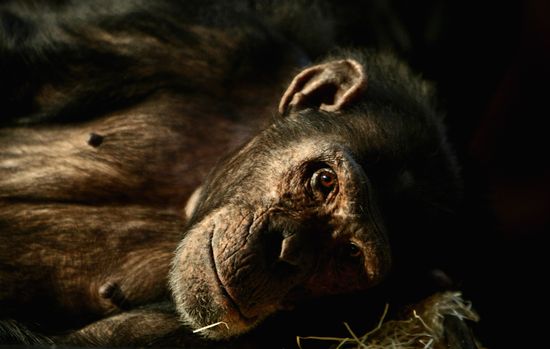
A reader writes:
New research supports the view that:
"If you take the promiscuity that is the main feature of chimp society, and replace it with pair bonding, you get many of the most important features of human society," he said." — 'he' being "Bernard Chapais, a primatologist at the University of Montreal, in his book “Primeval Kinship” (2008).
Dr. Chapais showed how a simple development, the emergence of a pair bond between male and female, would have allowed people to recognize their relatives, something chimps can do only to a limited extent. When family members dispersed to other bands, they would be recognized and neighboring bands would cooperate instead of fighting to the death as chimp groups do."
But there's more to it than that…
"Michael Tomasello, a psychologist at the Max Planck Institute for Evolutionary Anthropology in Germany, said the survey provided a strong foundation for the view that cooperative behavior, as distinct from the fierce aggression between chimp groups, was the turning point that shaped human evolution. If kin selection was much weaker than thought, Dr. Tomasello said, “then other factors like reciprocity and safeguarding one’s reputation have to be stronger to make cooperation work.”
An evolutionary bias towards 'morality'? To match the obvious bias towards increasing intelligence?
Richard Dawkins, call your office.
(Photo:A chimpanzee at Edinburgh Zoo looks up at the new ?5.65 million pound enclosure, the world's largest at 1500 square feet, which can hold up to 40 chimpanzees May 1, 2008 in Scotland. By Jeff J Mitchell/Getty.)
When Fungi Attack

Danielle Venton reports on the latest forms of zombie fungus to emerge:
Once infected by spores, the worker ants, normally dedicated to serving the colony, leave the nest, find a small shrub and start climbing. The fungi directs all ants to the same kind of leaf: about 25 centimeters above the ground and at a precise angle to the sun (though the favored angle varies between fungi). How the fungi do this is a mystery. "It's related to the fungus that LSD comes from," Hughes said. "Obviously they are producing lots of interesting chemicals."
Before dying, ants anchor themselves to the leaf, clamping their jaws on the edge or a vein on the underside. The fungi then takes over, turning the ant's body into a spore-producing factory. It lives off the ant carcass, using it as a platform to launch spores, for up to a year.
Taking It Out On The Oeuvre?
Jessa Crispin explores how we deal with great novelists who were also anti-Semites, like Louis-Ferdinand Céline, author of Journey to the End of the Night:
Artists are not saints. We all know this. What we can’t decide is when to dole out punishment for their actions. Is it enough to prosecute them when they’re alive? Or should we continue to persecute their reputations after their deaths?
Say the name Knut Hamsun, on the other hand, and the first thing in your head is probably “Nazi.” Not Hunger. Not “brilliant Norwegian writer,” but “Nazi.” And while our reaction should be one of disgust, the fact that Hamsun was in his doddering old age showing signs of mental decline even before he went all rah-rah Hitler (he was 80 at the time Germany invaded Norway) — whereas Céline was an intelligent, mentally competent writer in the bloom of youth — it makes you wonder how arbitrary are these reactions.
Is Shark Fin Soup Going The Way Of Bound Feet?

Francis Lam debates bans on the delicacy:
It wouldn't be too much of a stretch to say that much of my grandfather's life was built around that soup, built around the idea that he could show the world and himself that he'd finally made it, that he could literally feed his family his success.
The opposing argument:
[T]he cultural import of the dish is, to be frank, as much about the demonstration of status as anything else, and there is no limit to the creativity of aspirational culture to come up with the next big status symbol. I mean, go ahead and buy another pair of Prada shoes instead of taking me out for shark's fin. It's fine. I don't mind, and after a while, you're not going to mind either. After all, the nature of status symbols is that the more they're attained, the shallower their actual meaning, and the more attractive the next, other thing eventually becomes.
(Photo: Shark fin soup with shrimp dumpling by Flickr user Richard S. Donovan)
Not Enough Solitude
Leon Neyfakh summarizes various new studies:
One ongoing Harvard study indicates that people form more lasting and accurate memories if they believe they’re experiencing something alone. Another indicates that a certain amount of solitude can make a person more capable of empathy towards others. And while no one would dispute that too much isolation early in life can be unhealthy, a certain amount of solitude has been shown to help teenagers improve their moods and earn good grades in school.
 The Dish