Shacking Up: Why Not?

Contra Rob McNiff, Hemant Mehta defends cohabitation before marriage:

McNiff is fixated on this idea that the only thing that binds cohabitators together is sex. If that’s the only reason people lived together — so they could sleep with each other every night — maybe there’d be something to what he’s saying. But the couples I know who lived together before marriage weren’t the sex-crazed-maniacs that McNiff makes them out to be. They were people committed to each other for reasons extending far beyond something physical.

The Image Of Jesus, Ctd

JesusImages

A reader writes:

Contrary to your reader, John the Baptist and James the brother of Jesus were life-long Nazirites, so not only did they have beards, they never shaved. Paul didn't say: "that long hair on a man was a shame", but "Does not nature itself teach you that if a man wears long hair it is a disgrace for him", after saying in the same book (1 Corinthians): "The natural person does not accept the things of the Spirit of God, for they are folly to him…". Paul himself in Acts is described twice as taking short term Nazarite vows. You could interpret Matthew 26:29 "I tell you I will not drink again of this fruit of the vine until that day when I drink it new with you in my Father's kingdom" as Jesus taking a Nazarite vow, and so also not cutting his hair or beard.

Another writes:

You could point to Isaiah 50:6 as an argument for Jesus having a beard. "I offered my back to those who beat me, my cheeks to those who pulled out my beard; I did not hide my face from mocking and spitting."

Another:

A minor but important point: Jesus was a Jew. More importantly, he was involved in or around the Essene sect of John the Baptist and other ultra-religious, almost fanatically observant Jews. Among the most important tenets of this community was not shaving. It's the same biblical precept followed by the Hasidic sects today.

He was an adult, Jewish male. He had a beard.

Another:

I found this discussion especially funny because it started on the first day of Lent, which represents the 40 days Jesus spent in the desert. I'd put my money on Jesus having a beard, certainly by day 40.

Another:

In the Byzantine representations of Jesus, you will see him with a beard as the human, suffering Jesus, and then beardless as the everlasting Christ ruling in Heaven.

Another:

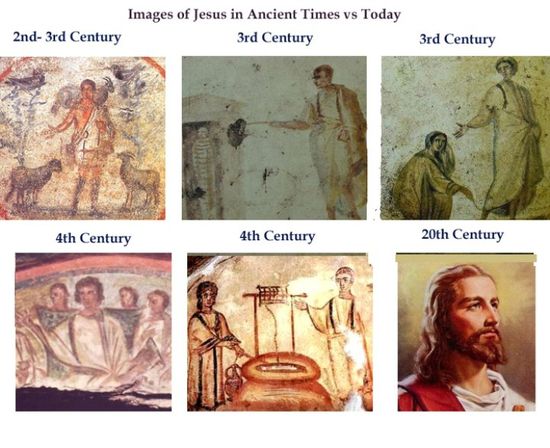
People have always imagined Jesus in their own image. It isn't correct to say that the earliest portraits show him in the style of Zeus – the earliest known portrait is from the early 3rd century AD and shows him as a beardless young philosopher – not a (son of) god, but a revered wise man. To quote from Wikipedia:

The oldest known portrait of Jesus, found in Syria and dated to about 235, shows him as a beardless young man of authoritative and dignified bearing. He is depicted dressed in the style of a young philosopher, with close-cropped hair and wearing a tunic and pallium – signs of good breeding in Greco-Roman society. From this, it is evident that some early Christians paid no heed to the historical context of Jesus being a Jew and visualised him solely in terms of their own social context, as a quasi-heroic figure, without supernatural attributes such as a nimbus (a fourth-century innovation).

See the depiction here and note the lack of stubble! The beard didn't come along until the late 4th century. Here's what it looked like then. Much more on this here. It's a bit sobering, though, to think that the oldest known depiction of Jesus (as opposed to a portrait) is an anti-Christian graffito that may be as old as the 1st or possibly the 2nd century AD – it shows Jesus as a crucified donkey.

Another says of the above image, "From a recent Facebook discussion of the image of Jesus over time."
The Age Of Random

Paul Hiebert examines it:

In a sense, when a teenager deems a person or idea "So random!", they are being dismissive of that person or idea. The teen who utters this word after being confronted with something unfamiliar—an event that doesn't resonate with his understanding of the universe—is in a way regaining control by restoring order. What is random is folly, and therefore not a threat. In other words, it's comforting to consider our beliefs and perspectives as logical—they make sense, after all—while any beliefs or perspectives outside of, or in opposition to our own, must therefore be chaotic, confusing, random.

Holy Drinks

Room For Debate discusses coffee's recent price spike. Eugene Anderson looks at the drink's history: 

Incidentally, in dramatic contrast to wine, coffee has never been worshiped. Tea is associated with religion in East Asia, but not really worshiped as such. (By contrast, chocolate was an extremely sacred drink, used in the highest and most solemn rituals, in pre-Columbian Mexico and Central America.) 

Creating A Space

AP110309060280

J. Peter Nixon vows to make do with less:

Perhaps I’m just a guilt-ridden Catholic, but I don’t think I’m alone in sometimes feeling overwhelmed by Lent. At times it feels like we are merely reproducing some of the negative aspects of our culture:  our tendency to prefer sound to silence, action to thought, and work to rest. 

The central disciplines of Lent—prayer, fasting, and almsgiving—are ultimately about doing less.  They force us to slow down.  I remember a few years back trying to fast completely for an entire day.  To some extent, I will confess, this was an exercise in spiritual machismo.  As my blood sugar dropped, however, I began to be conscious of how fast I was walking and moving and how I needed to slow down if I was going to make it through the day. … Perhaps this Lent we might make it our task to do less and to say less so that we can create the necessary space in our lives where God can speak and give and we can hear and receive.

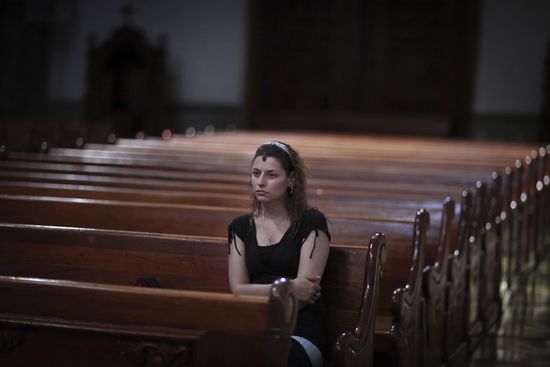
(Photo: A woman with her forehead marked with ash sits in the San Francisco church on Ash Wednesday in Mexico City, Wednesday March 9, 2011. By Alexandre Meneghini/ AP.)

Cinema Of Silences

Dish alum Will Di Novi conveys the feeling of Mike Leigh's quiet films:

[Leigh] captures the seemingly glacial pace at which periods in our lives unfold, and the suddenness with which they inexplicably vanish. As Tom and Gerri lie in bed after another night of Mary’s Chardonnay-induced theatrics, their thoughts begin to drift towards their own mortality. “We’re becoming history,” Tom murmurs, stunned by the thought and yet strangely gratified to glimpse the faded outlines of a life well-lived.  It’s an unsentimental grace note plucked from the cacophony of everyday life, a moment of such intimacy and candor that it confounds the idea there is anything ordinary about these people at all.

Wordless Meaning

After visiting the New York Historical Society, Tom Jacobs contemplates the power of belongings:

Eventually I came upon a display of objects collected from the streets in the immediate aftermath of 9-11.  A shoe, a pack of cigarettes, a few scraps of letterheaded paper, a fireman’s oxygen tank, bits of twisted metal of inscrutable but portentous provenance.  Unexpectedly, and even against my better judgment, I found myself overwhelmed by a wash of powerful and contradictory feelings: sadness, anger, nationalism, and perhaps most of all: a deeply-felt connection to a moment in history and to the lives lost in the event (and to one in particular).  I felt weepy.  Actually weepy.  I cried a little bit.  In the presence of this display, material objects turned unsettlingly fluid, potent, and peculiar.  

A Poem For Sunday

  109949945

“Sonnet” by Robert Nathan first appeared in The Atlantic in July, 1920:

I am no stranger in the house of pain;
I am familiar with its every part,
From the low stile, then up the crooked lane
To the dark doorway, intimate to my heart.
Here did I sit with grief and eat his bread,
Here was I welcomed as misfortune’s guest,
And there’s no room but where I’ve laid my head
On misery’s accomodating breast.
So, sorrow, does my knocking rouse you up?
Open the door, old mother; it is I.
Bring grief’s good goblet out, the sad, sweet cup;
Fill it with wine of silence, strong and dry.
    For I’ve a story to amuse your ears,
    Of youth and hope, of middle age and tears.

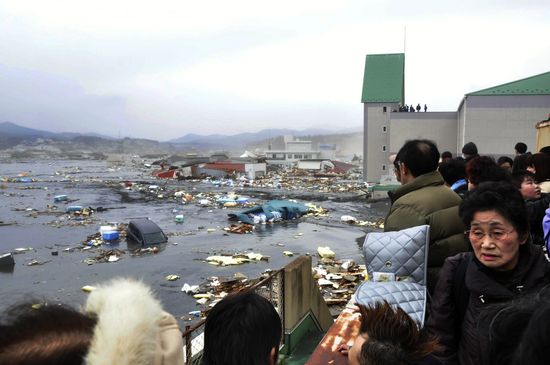
(Photo: Local residents gaze at the devastation after a tsunami tidal wave in Kesennuma city in Miyagi prefecture, northern Japan on March 11, 2011.  By Yomiuri Shimbun / STR/AFP/Getty Images.)

Could Have Been

Tony Woodlief remembers the birthday of a daughter who died 12 years ago, at the age of three:

I suppose we all of us have shadowed places in our lives, places where reside only the ill-formed shapes of what might have been, never clear and untouchable and framed only by their absence of light. But we have what has yielded those shadows as well, or at least the memories of them. I can’t know how her voice would sound today, but I can recall her singing ABCs; I can’t know what it’s like for her head to reach my shoulder, but I can remember carrying her on my shoulders.

In every life there are the things we have and the shadows that haunt us, and which we call could have been. Maybe part of enduring is looking where the light is, rather than where it is not.