American History Via Plate Lunch

Peter Smith applauds the ad for Sarah Vowell's latest book, Unfamiliar Fishes:

It's a novel use of a book trailer and certainly made me curious about how a hamburger dish topped with gravy and a fried egg that originated in 1949 (apparently as a snack for teenagers who were tired of American sandwiches but didn't want to bother with time-consuming Asian foods) relates to a new book examining the impact New England missionaries had on the [Hawaiian] island in the 19th century.

Footnote Shows

Matt Zoller Seitz is concerned about pop culture references in TV shows:

"Krusty Gets Kancelled" is one of the greatest of all "Simpsons" episodes, but if it were a poem, it would need to have nearly as many footnotes as "The Waste Land" – and the further away from its original air date we get, the truer that's going to be.

So much post-"Simpsons" comedy is in that vein: "Seinfeld," "Friends," "South Park," "Family Guy" and its spinoffs. Not to mention such recent arrivals as "Community," "Chuck," "Parks and Recreation," "Glee," "30 Rock" and the American version of "The Office." They're all footnote shows: amusing and perhaps hilarious right now, but likely to be dated in five years, quaint in 10, and borderline impenetrable in 20. Or inadvertently poignant. Or chilling.

Halle Kiefer doesn't care:

The fact of the matter is, worrying about whether future generations will find a joke funny seems like the perfect way to stifle anyone's ability to produce something hilarious. Beyond that, the value of comedy specifically has often been its immediacy; why wouldn't we want writers to make jokes that are relevant to their current audience?

Judy Berman pulled together a list of shows she'll still find funny in 2026.

The View From Your Window Contest

Vfyw-contest

You have until noon on Tuesday to guess it. City and/or state first, then country. Please put the location in the subject heading, along with any description within the email. If no one guesses the exact location, proximity counts.  Be sure to email entries to VFYWcontest@theatlantic.com. Winner gets a free The View From Your Window book. Have at it.

Monogamy And Penis Spines

Megan Scudellari summarizes new research:

Hundreds of deletions in non-coding DNA have helped sculpt human evolution, including an increase in brain size and the loss of sensory whiskers and penis spines, proposes a study published this week in Nature.

Jen Phillips goes deeper into the science with the study's lead author, Cory McLean:

Humans (like mice and chimps) have an androgen receptor gene that's necessary to develop penis bumps (penile spines, in scientific terms). Humans, at some point along the evolutionary road, lost the DNA needed to activate that receptor, and thus, do not have "spines" on our penises anymore. … Human penile spines, if they existed, would probably be similar to chimps', which have a polka dot-esque distribution and are made of keratin, the same tough-yet-yielding substance that makes up our hair and nails.

The first time I heard "penile spines" I thought "ouch". But then, when McLean told me they were made out of keratin, I thought, hmmm, maybe the bumps increased female pleasure rather than diminished it. Think of ribbed condoms or bump-laden vibrators

Stephanie Pappas connects the dots:

Penile spines are exactly what they sound like: small spines on the head of the penis of many animals. Plenty of animals sport the spikes, including a type of beetle called the bean weevil whose hard, sharp spikes scar the female beetle's reproductive tract during sperm delivery. Many rodents, primates, such as marmosets, and even pythons whose Y-shaped hemipenis is often spined in order to grip the walls of the female's opening, known as a cloaca.

In species with penile spines, Kingsley said, females tend to mate with multiple males. Penile spines may have evolved to clear out a competitor's sperm – or to abrade the female's vagina, making her less likely to mate with others. Either way, Bejerano said, "the loss of the spines is most often seen in species that have gone more the monogamous way."

Building A Better Brick

Brickstainable

Josh Rothman congratulates the winner of Brickstainable, a competition to envision the brick of the future:

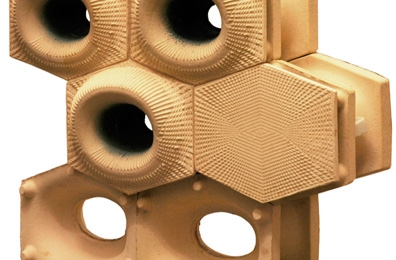
Jason Vollen and Kelly Winn of the Rensselaer Polytechnic Institute created hollow, honeycomb shaped bricks that use small ridges on the outside to create "self-shading": the ridges ensure that, throughout the day, different parts of the brick absorb the sun's heat, while others cool. The air pockets inside the bricks can be sealed off, so that they serve as reservoirs of warm or cool air for winter and summer — but they can also be left open, creating a beautiful open-brick wall with a latticework effect. These strategies are used in cactuses and termite mounds, too.

The New 99-Cent Store

A couple days ago, Joe Konrath, a bestselling e-book author, admitted:

Eighteen days ago, I dropped the price of my ebook, The List, from $2.99 to 99 cents on Amazon. I was selling 40 copies a day prior to that. Currently, The List is #37 in the Top 100 Bestsellers on the Kindle. It's selling 620 copies a day on Amazon.

Kevin Kelly does the math:

2.99 x 40 = 119.60

.99 x 620 = 613.80

When Kelley factors in Amazon's cut on low-priced e-books, the profit drops dramatically for the author. Kelly clarifies:

I am not saying this is good news for authors. 99 cents is not. It is good news for READERS.

J.L. Wall adds his throughts.

(Hat tip: Mark Frauenfelder)

New Media Scares

Fallows takes stock of new media and their supposedly pernicious effects:

At an individual level, I think the “distracted Americans” scare will pass. Either people who manage to unplug, focus, and fully direct their attention will have an advantage over those constantly checking Facebook and their smart phone, in which case they’ll earn more money, get into better colleges, start more successful companies, and win more Nobel Prizes. Or they won’t, in which case distraction will be a trait of modern life but not necessarily a defect. At the level of national politics, America is badly distracted, but that problem long predates Facebook and requires more than a media solution.

He's optimistic:

A major event in world history was covered more quickly, with more nuance, involving a greater range of voices and critical perspectives, than would have been conceivable even a few years ago. Within hours of the first protests in Egypt, American and world audiences read dispatches from professional correspondents—on Web sites, rather than waiting until the next day, as they had to during the fall of the Berlin Wall. They saw TV news footage—including Al Jazeera’s, which was carried by few U.S. broadcasters but was available on computers or mobile apps. Then the Twitter feeds from and about Egypt, the amateur YouTube videos from the streets, the commentary of contending analysts—all of it available as the story took place. We take this for granted, yet there has been nothing like it before.

The Definition Of “Educated”

Steven M. Teles reviews Rick Hess' new book on education reform:

The basic issues we fight over in education, [Hess] suggests, are not susceptible to definitive settlement. We will never agree on the question of what it means to be truly educated, because this is a matter of principle and preference rather than science. We will never be able to come up with a single model of schooling that works for everyone, because the needs and habits of students differ so dramatically. … “The frustrating truth,” Hess tells us, “is that there are no permanent solutions in schooling, only solutions that make sense in a given time and place.

Chart Of The Day

Unemployment

Rachel Ziemba captions:

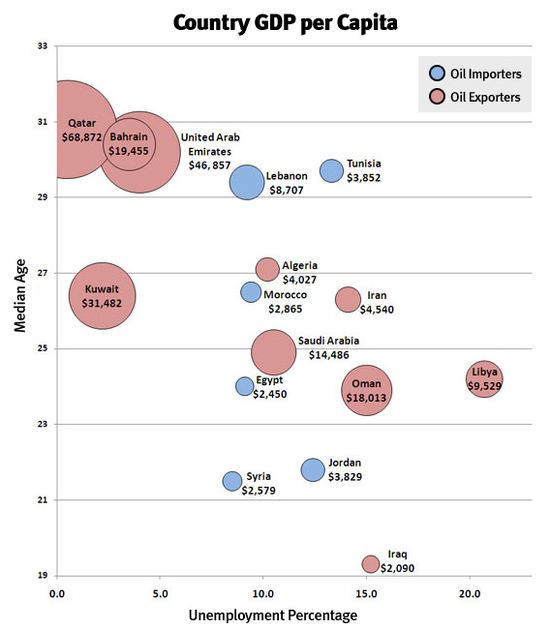
As we've seen recently, these three factors—low median age, low GDP, and high unemployment—combined can be a catalyst for popular uprisings and regime change. This chart shows median age on the vertical axis, unemployment rate on the horizontal axis, and the size of GDP by the size of the circle. Oil exporters appear as red circles, and oil importers as blue ones.