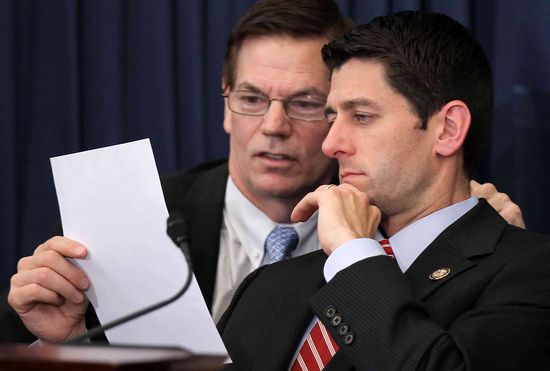
The in-tray is still bulging with fury over Paul Ryan. I find the arguments bracing – and in themselves evidence that Ryan's proposal has already helped move the debate to more earnest grounds. A reader writes:
One can understand Ryan's appeal in light of the failure of almost every other Republican to even look like he's putting in the work. But to call it courageous is simply wrong and, as others have pointed out, elevates Ryan to a status he doesn't deserve. Since when does it take political balls to place the burden for reducing the deficit on a constituency – the poor, the old – with relatively little power to exact retribution? It hardly seems worth the effort to point out that suggesting we raise taxes would be the truly courageous act – there'd actually be something at stake. But Ryan can't even bring himself to suggest we repeal some or all of the Bush tax cuts – cuts that were sold as temporary to begin with.
Anything that even hints at sacrifices from the elderly – increasingly a bulwark of Republican support – has a long history of being political death. That's why I think courage is not a misplaced term here. Another writes:
Count me as a long-time reader who isn't angry at you over your support of the Ryan plan, but simply perplexed.
Quite frankly, I don't know why you insist on calling this a "serious" proposal. If the Democrats had proposed a plan that was based on cooked-up numbers and ridiculous assumptions from a liberal thinktank, that catered to Democrat interests while attacking Republican sacred cows, and that increased the deficit over the next 10 years while pushing the highly-theoretical deficit reduction out past the 10-year horizon, I think you'd call such a proposal exactly what it would be – fundamentally unserious. Yet this is exactly what Ryan's plan does.
You keep bringing up the British experience as a comparison for Ryan's plan, but nothing could be further from the truth. The British are making their cuts TODAY. Call their plan what you want, but it's serious and it's immediate. Ryan's plan is just more of the sadly too-prevelant modern American way (one which both the Republicans and the Democrats buy into) – feast now, pay later. I believe that deficit reduction will appear under Ryan's plan about as much as I believe that Shake Weights are all that's holding me back from a rock-hard physique.
Another:
You claim the plan is “serious” except for the “refusal to add new taxation to the proposal.” The thing is, given Ryan’s ideology, taxation is the only available test of his seriousness, and he fails it spectacularly!
Let’s put it this way: let’s say the Obama administration had proposed a plan that repealed the Bush tax cuts, created a million-dollar tax bracket at 50%, cut military spending, instituted cap-and-trade, created a universal single-payer healthcare system, and provided massive funding for public schools in low-income areas. Let’s say that the plan claimed as much deficit reduction as Ryan’s plan does. Would you praise that plan as evidence that “we finally have a political party being honest about what it takes to avoid falling off a fiscal cliff?” I don’t think even I would say that, and that’s a plan I would like a lot.
Any truly serious Republican budget would have included tax increases, or at least revenue-positive reforms to the tax system. But the Ryan Plan is essentially a Grover Norquist wet dream, masquerading as fiscal responsibility.
Another:
By now you will of course have hundreds of e-mails on this subject. Still, I can't avoid weighing in: You've been had. You're very wrong that the Ryan budget "honestly reveals" anything. For its sheer dishonesty, it's breathtaking.
1. It raises the deficit right away, and for the next ten years (even given its dubious assumptions), by reducing taxes on the top 10% and especially top 1% of the income distribution. (And it does this while raising taxes on almost everyone else.) All the savings it posits depend on sharp benefit cutbacks to take place well in the future – cutbacks that some future Congress would likely reverse. That mix hardly seems likely to reassure our creditors.
2. The proposal's deficit and debt projections depends on economic assumptions that are fantastical. The reductions in the top marginal tax rates are supposed to unleash an economic boom with no historical precedent. (You're no doubt aware of the long-term unemployment rate projection of 2.8% imbedded in the original Heritage Foundation "study" underlying the proposal, since scrubbed from its website.) Given more realistic assumptions, and the mix of tax and spending changes in the plan increases the deficit and debt beyond the current policy baseline. This is pure snake oil.
3. The proposal assumes that Federal spending outside of Social Security and healthcare can be squeezed from 12% to 3 1/2% of GDP (and that including defense!), That's ultra pure snake oil.
4. The cost of the new tax cuts for the rich are very nearly the same size as the projected savings from reduced Medicare and Medicaid spending. All its "savings" come from fantastical economic assumptions (see 2) and even more fantastical assumptions about other Federal spending (see 3).
5. The proposal reverses all the cost containment measures in the Affordable Care Act, and increases costs by moving people from efficient and relatively low cost Medicare to a dysfunctional and higher cost private insurance system.
6. The proposal is politically cowardly. The benefits of the largely white elderly and near elderly will be entirely protected. That's the Republican base. The benefits of the poorest and most vulnerable will be cut. Meanwhile, most of the younger generation will pay higher taxes to support benefits for the elderly and near elderly far more generous than they will ever see.
7. The proposal is fiscally reckless. What happens after we explode the deficit via tax cuts for the rich over the next decade, and then today's 45 and 50 year olds demand benefits akin to what those slightly older have been getting?
The medical care and budget choices we face are fairly simple. We can do a mix of three things. 1) Implement the cost containment measures contemplated in the Affordable Care Act, and follow those up with much, much more. 2) Put hard caps on public support for medical care spending. 3) Raise taxes. Reversing 2) and going backwards on 3) hardly counts as a serious proposal.
Ryan's plan is a three card monty trick for cutting taxes for the rich. That's all it is.
Some responses. 1. The Bowles-Simpson type tax reform in Ryan's budget really does boost revenue, largely fom the rich who benefit disproportionately from the byzantine tax code. 2. Agreed. 3. Agreed. 4. As I understand it the lower tax rates for the successul are paid for by eliminating tax expenditures that largely benefit the wealthy. 5. I don't agree with repeal of Obamacare for precisely these reasons. 6. No possible reform of Medicare is going to dramatically alter benefits for those now receiving them. Suddenly yanking seniors into a different system than they bargained for would make any reform impossible. 7. My generation will have to suck it up. That's the price to be paid by both Democrats and Republicans failing to tackle this issue seriously in the past decade. and to my reader's final point: it amounts to crippling tax increases, crude government rationing and cost-control pilot schemes being expanded pronto. Another:
You seem to be giving the Ryan budget a lot of credit, not really for its substance, but because you think it opens a space for dialogue. But didn't the President's budget commission do this first? Yes, he ultimately walked away from it, but he ordered it, and he must have known what it would find. He is smarter than me, and I knew what it would find.
So, yes, the Democrats need to counter with a meaningful plan of their own, one that is much better than Ryan's. Hopefully, his regressive plan will be seen for what it is, and will be unconscionable to the American public. Give Ryan credit for furthering the conversation if you want, but give Obama credit for starting it.
But Obama started it and then walked briskly away. Another:
You make a fair point in wanting to see the next Democratic alternative proposal, but I would hope they at least get a few days’ grace period to put something together before you write off their criticism as “merely throw[ing] brickbats.” Van Hollen has promised a proposal next week, so let’s see what they bring to the table.
Indeed. I have lots of issues with Ryan's plan, but it's the first time a Republican has publicly stood up and said Medicare as it now is is unaffordable and Americans are going to have to get used to a less generous program if we have any hope of living within our means. That's more serious than the Democrats' simple denial of the problem and silence on how to address it.
(Photo: Alex Wong/Getty.)
 The Dish