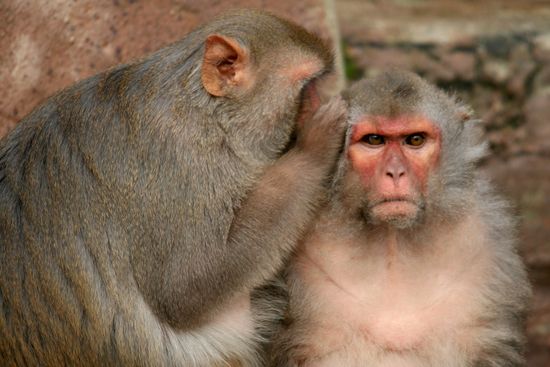
Daisy Grewal reports on a study of rhesus monkeys, who form social bonds within groups:
[T]he researchers paired the photos of insider and outsider monkeys with either good things, such as fruits, or bad things, such as spiders. When an insider face was paired with fruit, or an outsider face was paired with a spider, the monkeys quickly lost interest. But when an insider face was paired with a spider, the monkeys looked longer at the photographs. Presumably, the monkeys found it confusing when something good was paired with something bad. This suggests that monkeys not only distinguish between insiders and outsiders, they associate insiders with good things and outsiders with bad things. Overall, the results support an evolutionary basis for prejudice.
Some researchers believe prejudice is unique to humans, since it seems to depend on complex thought processes. For example, past studies have found that people are likely to display prejudice after being reminded of their mortality, or after receiving a blow to their self-esteem. Since only humans are capable of contemplating their deaths or their self-image, these studies reinforce the view that only humans are capable of prejudice. But the behavior of the rhesus monkeys implies that our basic tendency to see the world in terms of “us” and “them” has ancient origins.
(Photo by Flickr user jinterwas)
 The Dish