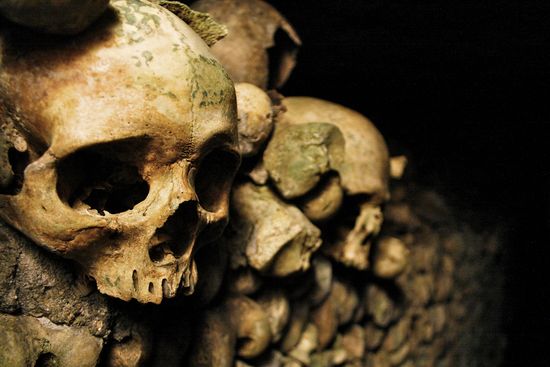
Mary Karmelek exhumes the story of the very popular Cemetery of the Innocents in Paris, in high demand for Christian burials between the 12th and 18th centuries:
While many couldn’t afford an actual plot, the majority of corpses ended up in mass graves that held around 1,500 people in each. As the corpse count climbed, several problems arose such as over crowding, putrid odors, and the supposed ability of the air in the cemetery to change the color of fabric and rot meat before one’s eyes. Further, the bodies were not decomposing as expected. For a body to fully decompose, oxygen must be present. In the case of the bodies from the Cemetery of the Innocents, the lack of enough oxygen left the bodies as mounds of fat.
The French turned them into candles and soap.
(Photo of the Catacombs of Paris which now houses the bones from the cemetary, by Flickr user Ian Wilson)
 The Dish