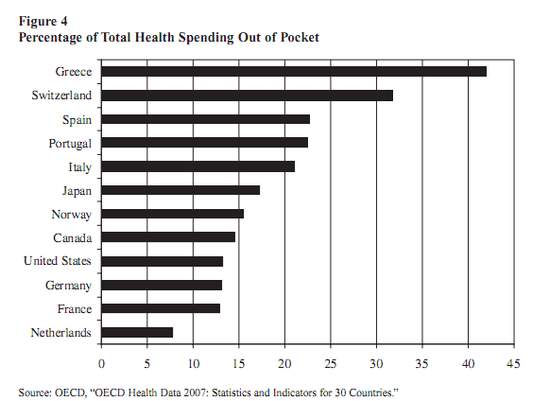
On Friday, the Dish pointed to problems with consumer-based healthcare. Karl Smith notes that people aren't very good at making healthcare decisions. Yglesias repurposes Smith's argument:
[T]here’s very little reason to think that when human beings act like health care consumers they behave like rational health-maximizing agents. People do not appear to be interested in pursuing cost-effective improvements in health outcomes, so there’s little reason to think that giving individuals more autonomous choices would result in that end. The most cost-effective systems out there appear to be highly statist systems that become stingy due to tax-aversion and then ration the provision of care.
Megan McArdle, who provides the above chart, holds a different view:
[W]hile consumers may be stupid, rules are often stupid too. Evidence-based medicine is certainly a good idea, but we are nowhere near being able to generate solid rules that a) cover all major possibilities and b) provide the highest chance of survival for the money. People are incredibly complicated. This makes outcomes hard to measure–and solid guidelines hard to develop.
Tyler Cowen collects more commentary. Aaron Carroll repeats that American out-of-pocket costs are not especially low.
 The Dish