Now We’re Talking

GT_PAULRYAN_04042011 Tomorrow, we are told that Congressman Paul Ryan will unveil the first serious plan for long-term debt reduction. I’ll wait to see it before I comment. But the leaked outlines are highly encouraging. Medicare would become Obamacare for seniors, with competing private insurance options, rather than a single payer; Medicaid would be turned into block grants for the states to finance healthcare for the poor. For good measure, there appears to be serious tax reform, elimination of tax shelters and tax breaks in order to bring down the rate of income tax, while not losing revenue. This $4 trillion bite into long term debt passes the credibility gap for me. But here’s where I go squishy.

I think there needs to be some revenue increases as well – and a return to Clinton era rates for the super-rich. I’d also favor a gas tax to recoup the expense for the unfunded wars, and make that tax directly linked to the costs of war in the future. By the same principle, bank bonuses should become subject to a new tax, to help recoup the lost revenue caused by the banks’ recklessness. This is called shared sacrifice. To balance the budget entirely on the backs of the poor will not and should not fly.

But this Ryan plan is an obvious first offer. The Dems, in my view, should neither dismiss nor demonize it. The fiscal crisis is real. But the Dems can suggest tax increases, like the ones above, as well as spending cuts, as the Tories have done in Britain. It’s a win-win if that happens.

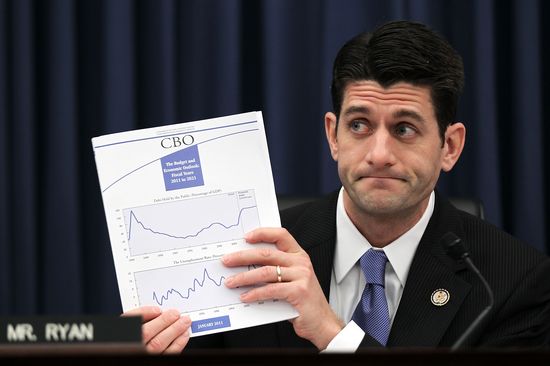
(Photo: Committee Chairman Rep. Paul Ryan (R-WI) holds up a copy of Congressional Budget Office’s ‘The Budget and Economic Outlook: Fiscal Years 2011 to 2021’ during a hearing before the House Budget Committee February 10, 2011 on Capitol Hill in Washington, DC. By Alex Wong/Getty Images)

The Bugs Or Mickey Debate, Ctd

A reader writes:

Mickey is cuter.  And he's more relaxing to be around.  Bugs is better at vanquishing enemies (that's pretty much all he does) but you get the feeling he might practice some of his in-your-face tactics on you if he got bored.

Another:

Your reader wrote: "Mickey is happy, while Bugs is cynical. Happiness beats cynicism every time."

This charge cannot stand. Either your reader is unfamiliar with Bugs Bunny or does not understand what cynicism is. Bugs is NOT cynical; he has moxie. There's a difference.

He is not world-weary or bitter; he is wildly enthusiastic and in love with life, no matter where life takes him. Bugs cannot even walk down a dirt road in the middle of nowhere without entertaining himself with a folk song. He's Br'er Rabbit … if Br'er Rabbit grew up in Brooklyn. He is the Trickster, perfected. And he's also the only character I can think of who would consistently beat Superman in a fight (by using kryptonite boxing gloves, natch).

Mickey, on the other hand, can fairly be described as happy, but it is the happiness of the lobotomized. He's never happy about anything in particular; he just grins mildly like an idiot. Nothing is ever fantastic or awful to him, and all things are merely nice. 

Another:

I've always loved this short but sweet Louis CK bit on why Bugs is way better than Mickey.

Another:

Bugs Bunny holds a special niche in the American psyche and his humor was often far more topical and language-driven than Micky Mouse. My ex, who was raised in Puerto Rico, said she always liked Bugs Bunny, but did not always understand the humor. In a classic bit, he asks Elmer Fudd if he'd like "one lump or two" for his coffee, then delivers two blows to the head with a hammer. She told me that until she saw it in English, she had no idea what was happening in that conversation. The Spanish, "Uno o dos," leaves one wondering, one or two *what*?

Mickey Mouse is readily accessible to anyone. With the exception of the war propaganda churned out in the 1940s, the humor is mostly self-contained. Even if you don't understand the appliances they use, the stories are pretty light and the shorts are self-contained pieces of entertainment. Bugs Bunny, on the other hand, often plays off the power of insider humor. Like today's ubiquitous animation for kids with a different level of humor for adults (see: Shrek), there's a constant poke in the ribs that asks the adult viewer, "Get it?" The trouble is, not everyone can, otherwise it loses its edginess. And as your recent post on the short shelf life of topical humor explored, it often doesn't translate well across the generations, either.

Dissent Of The Day: Popping The Qaddafi Zit

A reader writes:

I want to look at Meghan O'Sullivan's piece in more detail later, but while the dangers in Libya are manifold, her analogy is flawed in many respects. Most notably, "you break it you own it" does not apply fully to Libya, because we didn't break it. That doesn't mean that extricating ourselves from a postwar mess will be easy, but we won't have the same level of engagement or responsibility, e.g., boots on the ground.

Also, while Obama's two-tier goals – preventing murder of civilians by military intervention, and ousting Gaddafi by other means – may be too intricate to work, it's not a "recipe for confusion." It's a recipe for keeping options, or exits, open. If swift military action doesn't cause Gaddafi's overthrow or negotiated departure, there's a fallback strategy – contain and cut off. Obama has in effect put in place several disengagement levers. He's a trimmer, as you once said. For better and worse.

Trusting Obama, For Now, Ctd

Last week Kevin Drum confessed that he trusts Obama’s judgement. I agreed. In response, Glenn Greenwald compared Drum to, yes, Britney Spears. Drum follows up:

I think pretty highly of Barack Obama’s judgment. But what does it mean to say that? Just this: that I think highly of his judgment even when I disagree with him.

… To make this more concrete, I also think highly of Glenn Greenwald’s judgment on issues of civil liberties and the national security state. This means that when he takes a different position than mine, it makes me stop and think. After all, we’re on roughly the same wavelength on these subjects, and they’re subjects that he’s often thought about longer and more deeply than me. This doesn’t mean that I’ve outsourced my brain to Glenn, but it does mean that he influences my judgment, and that’s especially true on issues that I’m unsure of.

Ditto for Obama. Unlike Glenn, perhaps, I’m unsure about the wisdom of our Libya intervention, and the fact that I’m unsure makes me more open to giving Obama’s judgment a fair amount of weight in this matter.

This largely pacifies Greenwald:

It’s absolutely true in general that any rational person would pause to examine their convictions if someone whose judgment they respect disagrees with them, and it’s also wise — I’d say necessary — to seek out the input of people who know more than you do on any particular issue. But that is a fundamentally different exercise than substituting someone else’s judgment for one’s own, particularly a political leader’s.

Popping The Qaddafi Zit

GT_GATESMULLEN_040411

There are obvious differences between the Iraq war and the Libyan clusterfuck. George W Bush never got a definitive UN Resolution, pushed for the war on false pretenses, got a Congressional vote beforehand, argued for it for well over a year, and sent tens of thousands of troops to invade and occupy the country. Obama went via the UN, never got a Congressional vote, orchestrated an air-campaign "on the fly", as Bob Gates tartly put it, and vowed that there would never be US military boots on the ground. The casus belli – an imminent mass slaughter in Benghazi – is far more open and transparent than Bush's empirically-challenged logic about Iraq's WMDs.

And yet, my own instant worry is that the long term consequences could be as disastrous as they are unknowable. By directly preventing a bloody resolution of the Libyan fight for power, the US has assumed responsibility in many ways for the outcome and has simultaneously made a long civil war possible. As weeks, not days, pass by, the temptation to actively intervene on one side will be enormous.

It appears that I am not the only one with Iraq flashbacks:

For those of us who were deeply engaged in the Iraq war, it is hard not to hear the echoes and recognize the potential pitfalls in America’s new military intervention… The Bush administration went into Iraq with a multitude of objectives, from finding and destroying weapons of mass destruction to building a new democratic country in the heart of the Middle East. But even at the highest levels, U.S. officials disagreed over how central the creation of a democratic Iraq was to American ambitions and interests.

This ambiguity of purpose helped create a serious dilemma: The United States undertook a complicated, multifaceted occupation and nation-building project without the planning and resources required for it to succeed. Yet, even after Obama’s speech Monday at the National Defense University, it remains unclear what the president considers an acceptable outcome in Libya.

Engaging in military action and claiming a desire for regime change, yet expressing unwillingness to use force to achieve that aim, even while providing support to those seeking to oust Gaddafi — this is a recipe for confusion, both within the administration and among the public.

It sure is. My concern is that this war was begun without any serious, far-ranging discussion of what should happen after the massacre was prevented. White House sources tell me there will never be boots on the ground, and that the no-fly zone will be NATO's responsibility, not just America's. They also tell me there will be no arms funneled to the rebels. The next phase will, apparently, be like Iraq between the first and second wars against Saddam: a no-fly zone, and an economic, diplomatic squeeze until Qaddafi pops out of Libya like the pus in a ripe zit.

But the Iraq experience surely shows the severe limits to this pop-the-zit strategy.

The sanctions and a decade-long no-fly zone were, after all, not sufficient to force Saddam from power. Dictators have learned the art of hanging on the hard way, and Qaddafi is not the type to give up. We've already seen the massive superiority of Qaddafi's armed forces, despite the successful targeting of munition sites and tanks. We are also now witnessing the classic asymmetrical response to a super-power. Qaddafi's forces are now in the white pick-up trucks used by the rebels, making it harder and harder to target them from the skies. He is arming those civilians loyal to him with rifles. If the struggle for power ends up within major cities, like Tripoli and Benghazi, the allies will be toothless. Bombing densely populated areas would inevitably lead to large civilian casualties, and the US is not Israel in this regard. It is not acting in self-defense; it is acting in an attempt at long-range social and political engineering. And, of course, the last thing the US wants is to kill Libyan civilians in order to save them.

We also learn from yesterday's NYT that the Libyan intervention is designed to impress the Iranian coup regime. But what if the no-fly zone and the highly accurate bombing campaign leave Qaddafi in power? Does anyone think that would scare Khamenei? Wouldn't it actually do the opposite – by showing, as dramatically as in Iraq and Afghanistan, how Western military superiority is highly limited in its potential to affect the internal affairs of foreign countries?

And that's where the fear comes in. If Qaddafi survives and even regains control of much of the country, the temptation will be to ratchet up military pressure. Reflexive war mongers like McCain and Lieberman will always fight for another war in the name of good versus evil. And have no doubt that a man like Romney will cite Qaddafi's survival as part of a critique of Obama's "weakness". That political dynamic can often lead to the temptation of a covert war, surreptitiously arming the rebels via Egypt and training them with Special Forces or the CIA. And there is, alas, evidence that this has already happened.

This is how many wars start – by initiating relatively minor interference with good, even noble intentions, before getting sucked into a far deeper role in an intractable conflict. Resisting that temptation will be the real test of Obama's strength. He is, after all, only president because he opposed a dumb war in Iraq. He surely doesn't want history recording that he started another one.

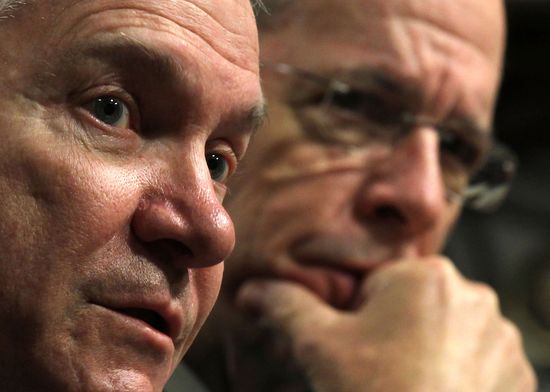
(Photo: U.S. Secretary of Defense Robert Gates (L) and Chairman of the Joint Chiefs of Staff Admiral Mike Mullen (R) testify during a hearing before the Senate Armed Services Committee March 31, 2011 on Capitol Hill in Washington, DC. The hearing was to examine the ongoing military operation in Libya. By Alex Wong/Getty Images.)
We Made A Profit On TARP! Ctd

Several readers have pointed out that TARP and the auto bailouts were initiated by president Bush. True and to his credit in retrospect. But my point was that the Obama administration had to manage these vast projects over the following two turbulent years, and did so effectively – certainly more effectively than I expected.

The Dish’s New Home

David Gura of American Public Media did a short Marketplace segment on The Dish's move from The Atlantic to The Daily Beast. You can listen to it or read the transcript here. If you're reading this, your bookmarks should have automatically redirected you. In the transition there are obviously some hiccups. My bookmark was dead for half an hour or so. It's a bit like climbing from out of the window of one fast car and trying to get into another fast car alongside it.

Please let us know if you come across glitches that might need to be fixed.

Stalemate Watch

Al Jazeera updates:

For the fourth straight day, rebel troops have fought and failed to take the strategic eastern town of Brega from forces loyal to Muammar Gaddafi, the Libyan leader. On Monday, columns of opposition fighters drove up the main coastal highway, regaining ground they had given up the day before, but the effective use of artillery and landmines by Gaddafi's troops kept them at bay. … The regime's troops seem better able to hold onto ground than the untrained and undisciplined rebels; they dig entrenchments and have not retreated from Brega, even after another night of coalition air strikes on their positions on Sunday.

In other developments:

NATO officials confirm that the US will be withdrawing its aerial firepower from the military campaign in Libya later today. The US has so far conducted about half of the 70 daily air bombing missions on Gaddafi's tanks and other ground forces. Other NATO countries will move to fill the gap left by the US, the alliance says. …

Don't "shut the door" on arming the rebels, says former US President Bill Clinton. In remarks to ABC News, Clinton said he'd need to know more – presumably about the rebel makeup – before arming them, but wouldn't eliminate the possibility. 

AJE's top story at the moment details a Libyan envoy in Turkey negotiating a possible ceasefire with rebel forces.