The Dish Voting Booth: Chart Of The Year

The Daily Dish Awards Glossary

Click here to vote for the 2011 Malkin Award!

Click here to vote for the 2011 Hathos Alert!

Click here to vote for the 2011 Moore Award!

Click here to vote for the 2011 Von Hoffmann Award!

Click here to vote for the 2011 Yglesias Award!

Click here to vote for the 2011 Face Of The Year!

Click here to vote for the 2011 Mental Health Break Of The Year!

The Dish Awards

Throughout the year, the Dish and its readers nominate various writers, politicians, pundits, celebrities for various awards. At the end of the year, winners and runners up are announced. In the past, a blue ribbon panel has selected the winners. Its membership has been kept secret. As of 2007, the winners are picked by Dish readers in a poll.

The Malkin Award – named after blogger, Michelle Malkin, is for shrill, hyperbolic, divisive and intemperate right-wing rhetoric. Ann Coulter is ineligible – to give others a chance.

The Yglesias Award – for writers, politicians, columnists or pundits who actually criticize their own side, make enemies among political allies, and generally risk something for the sake of saying what they believe.

The Moore Award – named after film-maker, Michael Moore, is for divisive, bitter and intemperate left-wing rhetoric.

The Hewitt Award – named after the absurd partisan fanatic, Hugh Hewitt, is given for the most egregious attempts to label Barack Obama as un-American, alien, treasonous, and far out of the mainstream of American life and politics.

The Dick Morris Award (originally the Von Hoffman Award, until readers pushed for a name-change) is given for stunningly wrong political, social and cultural predictions.

The Poseur Alert – awarded for passages of prose that stand out for pretension, vanity and really bad writing designed to look like profundity.

The Hathos Alert – for moments when you want to look away but cannot. Hathos is the attraction to something you really can’t stand; it’s the compulsion of revulsion.

Andrew’s Bio

Andrew Sullivan was born in August 1963 in a small town in Southern England, South Godstone, and grew up in a neighboring town, East Grinstead, in West Sussex. He attended Reigate Grammar School, and Magdalen College, Oxford, where he took a First in Modern History and Modern Languages. He was also President of the Oxford Union in his Second Year at college, and spent his summer vacations as an actor in the National Youth Theatre of Great Britain.

In 1984, he won a Harkness Fellowship to Harvard’s John F. Kennedy School of Government, and earned a Masters degree in Public Administration in 1986. In his summers, he interned as an editorial writer at The Daily Telegraph in London, and at the Centre For Policy Studies, Margaret Thatcher’s informal think-tank, where he wrote a policy paper on the environment, called ‘Greening The Tories.’ At Harvard, he was best known for acting, appearing as Hamlet, Alan in Peter Shaffer’s ‘Equus,’ and Mozart in Shaffer’s ‘Amadeus.’ In the summer of 1985, he travelled through thirty of the United States.

In the summer of 1986, he applied for internships at the New York Times, the National Review, and The New Republic. The New Republic accepted him, and he wrote his first article for the magazine on the cult of bodybuilding. He then returned to Harvard to start a PhD in Political Science. He finished his General Exams in 1987, and taught moral and political theory in the Government Department for several semesters. He subsequently took a break from academia, and worked as an associate editor at The New Republic, editing and writing for both the political and literary sections of the magazine, while free-lancing for the Wall Street Journal, the Washington Post, the Daily Telegraph, Esquire, and the short-lived New York magazine, Seven Days. In January 1989, he returned to Harvard to complete his doctorate, ‘Intimations Pursued: The Voice of Practice in the Conversation of Michael Oakeshott.’ The thesis won the Government Department Prize for a dissertation in political science.

In 1990, he returned to Washington, D.C., where he free-lanced for the Telegraph and started a monthly column for Esquire. He was soon back at The New Republic as deputy editor under Hendrik Hertzberg, and in June of 1991 was appointed acting editor, at the age of 27. In October, he took over as editor, and presided over 250 issues of The New Republic, resigning in May 1996. In those years, The New Republic’s circulation grew to well over 100,000 and its advertising revenues grew by 76 percent. The magazine also won three National Magazine Awards for General Excellence, Reporting, and Public Interest. The first two awards overlapped with Rick Hertzberg’s tenure at the magazine.

Sullivan’s tenure at TNR was often turbulent, controversial and pioneering. The magazine expanded its remit beyond politics to cover such topics as the future of hip-hop, same-sex marriage, and affirmative action in the newsroom. Writers such as Douglas Coupland and Camille Paglia supplemented more traditional political writing by authors such as Michael Kinsley, Mickey Kaus and John Judis. Under Sullivan, the magazine campaigned for early intervention in Bosnia, for homosexual equality, and against affirmative action. TNR also published the first airing of ‘The Bell Curve,’ the explosive 1995 book on IQ, and ‘No Exit,’ an equally controversial essay that was widely credited with helping to torpedo the Clinton administration’s plans for universal health coverage. In 1996, Sullivan was named Editor of the Year by Adweek magazine.

In the early 1990s, Sullivan became known for being openly homosexual, and for pioneering such issues as gays in the military and same-sex marriage. His 1993 TNR essay, ‘The Politics of Homosexuality,’ was credited by the Nation magazine as the most influential article of the decade in gay rights. His 1995 book, ‘Virtually Normal: An Argument About Homosexuality,’ was published to positive reviews, became one of the best-selling books on gay rights, and was translated into five languages. He followed it with a reader, ‘Same-Sex Marriage: Pro and Con,’ and testified before Congress on the Defense of Marriage Act in 1996. His second book, ‘Love Undetectable: Notes on Friendship, Sex, and Survival,’ was published in 1998 in the United States and Britain. It was a synthesis of three essays on the plague of AIDS, homosexuality and psycho-therapy, and the virtue of friendship. Sullivan tested positive for HIV in 1993, and remains in good health.

In the late 1990s, Sullivan worked as a contributing writer and columnist for the New York Times Magazine, a regular contributor to the New York Times Book Review, and a weekly columnist for the Sunday Times of London. His New York Times cover stories, ‘When Plagues End,’ a description of the changing AIDS epidemic in 1996, and ‘The Scolds,’ an analysis of the decline of American conservatism in 1998, became national talking points. His 1999 essay, ‘What’s So Bad About Hate,’ is included in the ‘Best American Essays of 1999.’ His 2000 cover story on testosterone, ‘Why Men Are Different,’ provoked a flurry of controversy, as well as a cover-story in Time, and a documentary on the Discovery channel. Since 2002, Sullivan has been a columnist for Time Magazine, and a regular guest on HBO’s “Real Time with Bill Maher” and NBC’s “Chris Matthews’ Show.”

In the summer of 2000, Sullivan became one of the first mainstream journalists to experiment with blogging, and soon developed a large online readership with andrewsullivan.com’s Daily Dish. Andrew has blogged independently, for Time.com and for The Atlantic Online. In April 2011, Andrew moved his blog to The Daily Beast where he now writes daily.

Sullivan has spoken at many universities and colleges, including Harvard, Yale, Boston University, Boston College, Northwestern, the University of Washington in Seattle, the University of Wisconsin Eau Claire, Georgetown, Notre Dame, Emory, the University of Michigan, the University of Texas at Austin, Oxford University, and Milton Academy. He has appeared on over 100 radio shows across the United States, as well as on Nightline, Face The Nation, Meet The Press, Crossfire, Hardball, The O’Reilly Factor, The Larry King Show, Reliable Sources, Hannity and Colmes, and many others. He remains a senior editor at The New Republic, and his book “The Conservative Soul” was published by HarperCollins in 2006.

“If I Had Known Then … “

GT_GAZACHILD_04042011 Richard Goldstone’s op-ed in the Washington Post was a highly unusual thing. A public figure, responding to new facts unavailable before, essentially says that one core aspect of his report has turned out to be only partially true – and he takes personal responsibility for it. Yes, a man in public life took to the most hostile imaginable environment, the Washington Post op-ed page, to say he has been partially proven wrong. There were indeed 400 separate alleged incidents of IDF war crimes that Israel has been investigating, which is a hell of a lot of smoke for no fire. But to infer that most civilian deaths in Gaza were therefore calculated and intentional, rather than mistaken and collateral, was a step too far. The reason for Goldstone’s reassessment, he tells us, is the evidence found by Israel’s internal investigations – and the very existence of Israel’s extensive investigations. Hamas has done nothing equivalent because they were obviously targeting civilians and couldn’t care less. Ill-targeted random rockets into Southern Israel were – and are – ipso facto war crimes directed at civilians. The deaths of 400 children by Israeli firepower? Not quite so clear-cut given the density of the population in Gaza, the ubiquity of Hamas throughout, and Israel’s legitimate right to self-defense.  Two points stand out to me. The first is the integrity of Goldstone. His report stuck to what it could find but was stymied by the Israeli government’s refusal to cooperate:

Israel’s lack of cooperation with our investigation meant that we were not able to corroborate how many Gazans killed were civilians and how many were combatants. The Israeli military’s numbers have turned out to be similar to those recently furnished by Hamas (although Hamas may have reason to inflate the number of its combatants). As I indicated from the very beginning, I would have welcomed Israel’s cooperation. The purpose of the Goldstone Report was never to prove a foregone conclusion against Israel.

The op-ed, I think, makes his defense of his report’s original attempt to get at the truth within the evidence available more plausible. A man with an anti-Israel or anti-Semitic agenda would never go public with this partial retraction in the face of new evidence, would he? He would dig in, as the necons always do. And the fundamental reason he reached his inference of war crimes from such appalling casualties in the first place was because the Israelis refused to provide him with their full side of the story. In some cases, those details, withheld from Goldstone by the Jewish state, make all the difference:

The most serious attack the Goldstone Report focused on was the killing of some 29 members of the al-Simouni family in their home. The shelling of the home was apparently the consequence of an Israeli commander’s erroneous interpretation of a drone image, and an Israeli officer is under investigation for having ordered the attack. While the length of this investigation is frustrating, it appears that an appropriate process is underway, and I am confident that if the officer is found to have been negligent, Israel will respond accordingly.

I don’t know how Goldstone could have known these exculpatory details without Israeli cooperation. Telepathy? And he must know that both his report and his acknowledgment of new evidence will not defuse the vile rhetoric levied against him by the neocon media machine. Here’s JPod, once again pouring oil on troubled waters:

He is a dupe, a fool, a clown, and a worldwide embarrassment. Not to mention a special kind of reprehensible and appalling figure of inglorious, hideous shame to his own people through the delivery and promulgation of a false document that helped anti-Semites everywhere feel themselves justified.

Beneath the extreme rhetoric, the implication is that Goldstone should have presumed that the awful human toll of the Gaza war – almost entirely on one side – was not a deliberate targeting of civilians to put pressure on Hamas. But his job was to find facts and precisely not to presume anything. And it remains a fact that he also insisted on calling Hamas’ clear war crimes what they were – and are.

The second point worth making is that there is a thin line between deliberately targeting civilians and being indifferent to mass civilian casualties in a war in which they were inevitable. As Bernard Avishai puts it:

Israel’s military strategists had made it plain that the operation was meant to “reestablish deterrence” (“lekasaich et ha’deshe” or “mow the lawn,” as the phrase du jour had it); that the way to handle Hamas missile attacks was through destruction of Hamas “infrastructure,” which could lead to only one result.

That infrastructure included a factory whose sole purpose was to make flour, and whose owner was given fair warning to evacuate before the place was bombed. That’s obviously not designed to kill civilians; but it is designed to create misery for civilians. And in so far as the message of Cast Lead was clearly designed to punish and deter Hamas by making Gazans’ life as miserable as possible, it was an act of collective retaliation.

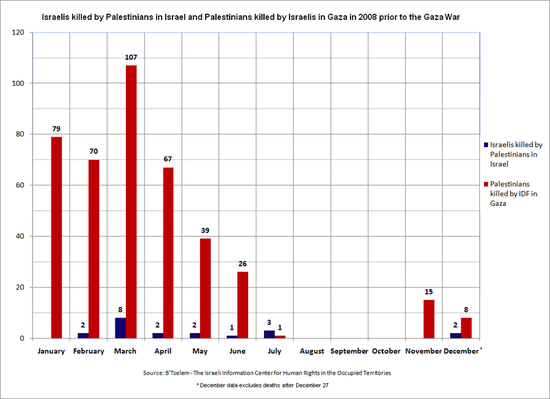
It’s worth remembering a key statistic: Palestinian casualties were a hundred times the number of Israeli casualties. Of the 1400 or so civilian deaths in Gaza, around 300 were children. Civilian casualties accounted for half of the deaths in Gaza. Only three Israeli citizens were killed. This was also the pattern that had held for the year before:

800px-Israelis_killed_by_Palestinians_in_Israel_and_Palestinians_killed_by_Israelis_in_Gaza_-_2008_prior_to_Gaza_War

Now imagine a scenario in which Jihadist terrorists killed 300 Israeli children in rockets targeted at Israeli infrastructure. Under what circumstances would Israel not call that a war crime?

(Photo: Farah Abu Halima cries after having a splint removed from her thumb to maintain a skin graft for her burns, at an MSF (Medecins Sans Frontieres) clinic, June 8, 2009, in Gaza City, Gaza Strip. Farah received horrific burns after a white phosphrous shell burst through the roof of her family home, killing her mother and seven other members of her family, while two others were shot dead while trying to evacuate the wounded. Not since Fallujah or Grozny has white phosphorus been used so extensively in a civilian area. By Warrick Page/Getty Images.)

Obama Enters The Race

Josh Green analyzes Obama's 2012 campaign launch video:

To me, the most important character here is Ed from North Carolina, the older white man who rationalizes his support for Obama even though he "doesn't agree with him on everything." I suspect the thrust of Obama's campaign will be geared toward winning over the Eds of the country, people who aren't rapturous about Obama, or even sure they like him, but are nonetheless open to supporting him, especially if they can be prompted, or led, to engage in the same sort of dispassionate analysis we see Ed making here. In that way–passion versus dispassion–I think we're probably getting a glimpse of how the upcoming campaign will differ from the last one.

Dave Weigel likewise notes the new campaign's restrained rhetoric in a post titled, "Obama 2012: Eh, Why Not?"

He Aims To Please, Ctd

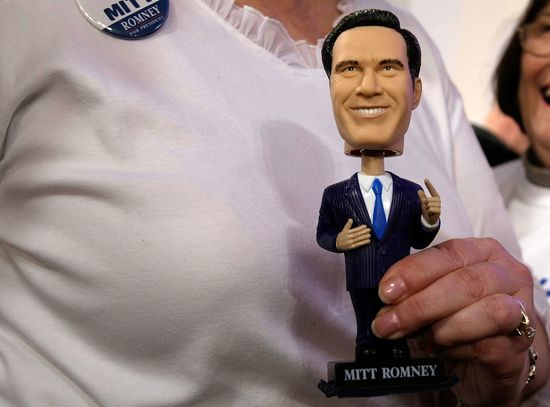
GT_ROMNEY_BOBBLEHEAD_CROP_04042011 Daniel Larison skewers Romney for being “unable to stake out a foreign policy position until after the Republican consensus has formed”:

Libya is a contentious issue, and the party is evidently split over which position to take, so Romney predictably cannot take one. For someone who is so fond of mocking Obama’s leadership or lack thereof, it is revealing that when Romney has to stake out a position one way or the other on a controversial question he is unable to show any leadership at all.

David Frum tries to put a positive spin on Romney’s ideological, er, flexibility:

Again and again, Romney would salt statements that his audience wanted to hear with little mental asterisks noting that maybe what they wanted to hear was not exactly accurate, or wise, or in accordance with his own private opinions. Ironically it is this unwillingness to do the full 100% pander that creates the impression of “inauthenticity.” A less honest man would seem more authentic, at least for the moment.

(Photo: Alex Wong/Getty.)

We Made A Profit On TARP!

Annie Lowrey offers a final assessment:

On the one hand, TARP did stabilize financial institutions, helping—along with the Federal Reserve's emergency-lending programs, the stimulus bill, and other Treasury programs—to avoid economic catastrophe. Moreover, it did so at no cost.

When TARP first arrived on the scene, the Congressional Budget Office anticipated its price tag at $300 billion. This week, TARP's bank programs actually moved into the black. When all is said and done, taxpayers stand to make about $20 billion. But that hardly means everyone likes it. There is the failure to stem the foreclosure crisis. There is the worry that by aiding failing institutions, Treasury reduced moral hazard and left too-big-to-fail companies standing. There is the concern that the government ended up bolstering the companies responsible for the crisis, rather than people caught in it.

Point taken. But two years ago, I sure didn't expect the government to make a profit from TARP. And I sure didn't expect the auto bailouts to become such huge successes.

What's surprising to me is how pallid is the Obama administration's spin has been on this. I never hear them bragging about how they managed to pull us out of the economic nose-dive we were facing. I know why: the recession isn't over, even if TARP was a success, no one wants to hear about it, etc. But it's one of the strongest and least valued part of Obama's record – along with the cost control innovations in health insurance reform.

At some point, you have to stand up and defend your record. No doubt Obama is biding his time on this. But count me as surprised as I am impressed.

I Wanna Hold Your Hand

Here's a video from an Irish campaign against the bullying of gay students. It's a little corny but I have to say it brought back a flood of feelings. I was never bullied for being a homo in high school, but that's because I covered it up as best I could. Maybe it's the school uniforms and the dank surroundings in the PSA that took me back, but you didn't have to be kicked in the balls to know the lines you couldn't cross:

The next gay generation gives me hope. But my own generation bore the brunt of the breakthrough, even as the generation older than us was almost completely wiped out. Every now and again, one takes the measure of the change. It's staggering. It's difficult to understand the depths of private, psychic pain this civil rights movement has helped alleviate.

(Hat tip: Video Sift)

The Constant Threat Of Awkwardness

Matthew Wollin captures it. I love this piece of writing:

Something of awkwardness pervades urban life in general, underwriting the briefest of glances and interactions with worlds of potential mishaps and misunderstandings. Subways in particular: Hi, I don’t know you, but that pole you’re holding for stability? Well, I need it too, and if I move at all I’m going to jump to second base with three strangers simultaneously, so can I just reach around you like we’re cuddling on the couch instead?

And no, I’m not checking you out, I promise, I’m actually trying to check out the person next to me by looking at the reflection in the window, which is why I’m going to super-casually look in the other direction at that mom with her kid—oh God, eye contact—and then look back quickly, and now we just made eye contact again because of course you’ve been watching me this whole time because you’re not an IDIOT like me, and now there’s no way you don’t think I’m checking you out, and now the person next to me also thinks that I’m checking you out so there’s no chance there, and that mom with the stroller that I stared at also thinks I’m a creepster, and oh, all of you just got off the train and I’m never going to see any of you in my life again and here I am alone.