A Modest Proposal On Healthcare Costs, Ctd

Ezra Klein tweaks my proposal:

What if, to be eligible for Medicare, you had to give someone power of attorney and sign a living will? You could tell your attorney, and write in your will, that you want every possible measure employed to keep you alive. You could say cost is no object, and neither is pain or quality of life. You could make whatever choice, and offer whatever instructions, you want. You just have to do it. You have to make the decision.

Right now, of course, heroic measures are the default. The simple act of making that choice would cut costs, as I suspect many, many people would prefer something besides maximal treatment, and would ensure fewer people suffered needlessly because their health deteriorated before they made their wishes clear. And although Sarah Palin managed to rechristen medical counseling about end-of-life options “death panels,” I choose to believe that that sort of childishness isn’t inevitable and that this country can make adult decisions about adult problems.

Me too. Happy to endorse Ezra's proposal. As for Palin's rhetorical grenades: ask her how she would cut costs for healthcare.

“The Gay Version Of The Booger Dance”

A reader writes:

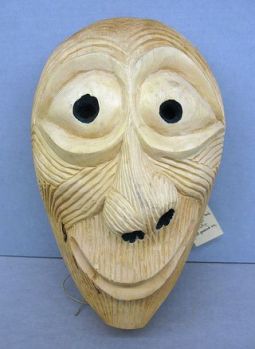
Yes, the Booger-maskhas in the U.S. has been besieged and slandered as gay people have by Christians.   They fight every right and spread lies about us.  The use of religious satire and even base humor helps diffuse gay anger at the religions that still persecute gays. 

The Hunky Jesus and the Sisters of Perpetual Indulgence remind me of my tribe's Booger Dances.

When white men came into Cherokee territory, they didn't follow Cherokee cultural and religious mores.  It caused major upheaval to have women poked, leered at and sexually assaulted.  Young warriors wanted to kill white men for their disrespect.  In a society of ultimate freedom where no man could bind the beliefs or actions of another, there had to be a way to diffuse anger at white men or war would break out.  Whatever its earlier religious meaning, Booger Dances were employed to ease tensions within the tribe against the non-Indian interlopers and laugh at their lewd, boorish behavior.

During Booger Dances, Cherokee men would dress in blankets and wear Booger masks, gross depictions of Europeans, and act badly, breaking all the cultural and religious mores.  They'd poke and chase women and act shamefully, but Cherokees were given a vent to laugh at the misbehavior, instead of getting angry and seeking vengeance.

The very actions you deplore could be why gay men don't seek vengeance on churches in more tangible ways.  We're given ways to laugh and even mock our enemies letting us blow off steam against them.  The disrespect and base humor used against religion is the gay version of the Booger Dance.

I can certainly understand the venting as a form of therapy – but not all therapy is funny or constructive, when its boundaries are not just within a community but Youtube and a public park.

What I worry about in this context is the premise that "Christians" are all anti-gay. They're not. As the polls show, Catholics are among the most supportive groups for gay equality. Lumping all Christians together as entirely bigots, and then mocking their faith in public, is no way to persuade anyone. If your therapy is actually likely to promote more hostility, it actually works against itself.

(Photo by Deborah Harding)

Gatekeeping Rules

Ezra Klein sees a "theory of gatekeeping embedded" in my argument against gatekeeping. The principle Klein says I'm advocating:

If fringe individuals and outlets, or opportunistic demagogues and showmen, can whip people up about something, then the media gatekeepers must agree to treat that as a story and dig deep and fast no matter how absurd the story is, and no matter whether giving the story coverage will make the audience think there are real doubts about something that isn’t actually in doubt. I guess there’s an argument for that approach. But let’s call it what it is: a rule for deciding what to cover, not a way to avoid having to make decisions about what to cover.

The trouble is, in the age of Google and the blogosphere, the gatekeepers are building a chain-link fence under water. It may matter less and less what they say or do. And so this debate can get rather abstract pretty quickly, and requires the MSM to constantly interact with what is beyond it.

My view is that the press should investigate stories that in its own judgment require nailing down. If someone claims that the president is from another planet – and I haven't read WND lately so I'm not sure if this is a live question on the right – of course you do not expend resources.

In many cases, like birth certificates, there is no way to do this without the subject's consent. But the press can, at least, ask, and not be embarrassed to do so. This has to be done on a case-by-case basis. And, even given limited resources, the emphasis should be on not dismissing stories just because they are odd or unlikely or embarrassing. There's nowt so queer as folk. You think it was easy to believe Watergate before it was proven? Or the DNA on Lewinsky's dress?

And I'm not sure I like the term "fringe individuals" as if that's a bad thing. Fringe individuals can be onto something. What I worry about is press interests weighing against investigation of some stories because of a concern about reputation or political blowback. So I think the MSM missed the John Edwards story and the Iraq WMD story in ways that do not make them look good. When journalists move in a pack not to inveistgate something – when they discuss on a private list-serv what the political repercussions are of a story before looking into it – I worry. Justin Elliott, by the way, is on the same page as Ezra.
Cracks In Assad’s Army, Ctd

Civil servants are breaking ranks as well:

At least 233 members of President Bashar al-Assad's ruling Ba'ath party have resigned en masse, according to Insan blogger Wissam Tarif. … Tarif tweeted that the army even opened live bullets on members of the Syrian parliament that tried to access the city of Dar'aa, currently under siege. Tarif's sources on the ground say the checkpoints are attempting to isolate the city as homes are being raided, shooting is reported in suburbs, and 87 young men were just arbitrarily detained.

More from AJE:

On Monday the Christian Science Monitor reported opposition activists claiming the Syrian intelligence services executed the general, his sons and nephew because they were showing signs of sympathy for the protesters.

Abdullah, who arrived in Damascus from Deraa on Wednesday, confirmed exchanges of fire were still taking place. "The army is fighting with some armed groups because there was heavy shooting from two sides," he said. "I cannot say who the other side is, but I can say now that it is so hard for civilians."

Abdullah said the military assault on Deraa appeared to be escalating. Even as he left the border city to return to work in Damascus, Abdullah said he saw lines of tank-carrying lorries steaming south. "They are preparing for a big operation. It is not finished yet."

The above footage was shot in Homs.

“May The Foreskin Be With You”

The San Francisco ballot measure that would ban male genital mutilation moves forward. It seems dumb to me that there isn't a religious exception. Practically and constitutionally, you can protect the religious right of Muslims and Jews to mutilate their infant children, while reducing the number of mutilated infants overall. I know it doesn't make total sense, but religious practices, even when inflicting pain on the helpless, do seem to me to fall within constitutional protection – and rightly so.

Torturing In The Name Of Humanity, Ctd

A reader writes:

What the torture apologists don't give people credit for is that most people will break the law when they deem it to be the last-resort, unavoidablw, least worst thing to do. If one of the ticking time-bomb scenarios that Harris describes does arise, the interrogator always has the option to break the law and commit torture to save lives. However, it is not institutionally condoned and I think this shifts the consent line to exactly the right point. A torturer would have to justify putting their own ass on the line in order to torture someone. If they were right and foiled some extreme scenario, there are mechanisms by which they could get out of trouble (presidential pardon, etc.) But for our government to condone torture as appropriate under the law makes it way too easy for the horrible situations we saw in Abu Ghraib and Gitmo.

Another writes:

You omitted what I think is a relevant comment that Sam Harris makes later in the interview:

…if you ask me what our policy on torture should be, I think it should be illegal. I think we should say we don't torture, it's illegal, there are good reasons never to do it. Yet I can well imagine an interrogator being in a situation where clearly the ethical thing to do is to make someone uncomfortable until they talk.

This is a somewhat more nuanced and thoughtful position than what I gathered from your post.

Another:

Reading the interview you link to, I don't quite see in Harris' words what you see.  He does not appear to be making a case for legalizing torture or for justifying the Bush regime's use of torture. What he is clearly saying is that blind doctrine about torture – in which its use can never be discussed, its relative value never weighed – is hypocritical in light of our apathy over collateral damage.  He wonders if our issue with torture isn't more a cognitive issue than a moral one – we tend to react more strongly when the person we are hurting is identifiable than when lots of people are killed at once. But wondering these things and calling out the hypocrisy is hardly shilling for torture.

Another:

I find your criticisms of Harris's logic on torture to be hollow. For years you have conceded that in the highly improbable "ticking time bomb" scenario, torture is justified:

In extremis, a rough parallel can be drawn for a president faced with the kind of horrendous decision on which Krauthammer rests his entire case. What should a president do? The answer is simple: He may have to break the law.

Despite all of the extreme caveats that you attach to your conclusion, you still admit that torture may be an acceptable or even necessary decision. A truly courageous stance, and I believe the correct one, is that torture is always and everywhere wrong. It should never be done under any circumstances. But such unequivocal morality may smell too much like fundamentalism for your tastes.

One of your peculiar characteristics in moral reasoning is that you always leave a little wiggle room in which you can casuistically maneuver to your desired conclusion (see: abortion). In this case, it just feels wrong to conclude that the president should sacrifice New York rather than torture one individual. By opening up a crack in the logical foundation, you undermine the whole moral edifice. If there is a difference between you and Harris, it is merely where each of you is willing to draw a line that should never be drawn.

Yes. And yes. Practically speaking there is little daylight between us. But in the interview, Sam conflated the rare theoretical act of torture with the routine torture techniques of the Bush administration. It seemed to me to go too far in justifying what they did. And there is an approach to torture which seems to me to give too much credit to its practical effect and too blithe in its treatment. But in the entire context of the interview – and of his other writing on the subject – it's clear he does not defend the war crimes of the recent past. And there are nuances and care in his written prose that can sometimes be lost in conversation.