Voting Red With Your Feet?

Using data from the new census, Walter Russell Mead considers black flight to the south:

The failure of blue social policy to create an environment which works for Blacks is the most devastating possible indictment of the 20th century liberal enterprise in the United States. 

Helping Blacks achieve the kind of equality and opportunity long denied them was more than one of many justifications for blue social policy: it was the defining moral task that has challenged and shaped American liberalism for the last fifty years. The Census tells us that in the eyes of those who know best, these well intentioned efforts failed.  Instead of heaven, we have hell across America’s inner cities. 

Yglesias differed earlier this month:

[T]he basic dynamic of weak job opportunities in the midwest and no affordable housing in the northeast applies regardless of skin color. What’s more, this is really not a reversal of the Great Migration in any meaningful sense. Texas wasn’t a major historic African-American population center and it strains credulity to describe Miami as part of the south. If black people start leaving Chicago to move to rural Mississippi that be a reversal, but this is the same sun/permit-driven migration that everyone’s doing.

But these two explanations are not mutually exclusive, are they?

 

The Bugs Or Mickey Debate, Ctd

4 kop min snuitje

A reader writes:

Mickey Mouse is more iconic because he was created over a decade before Bugs Bunny, and several of the cartoons he appeared in represented real technological breakthroughs – milestones in the development of sync sound and color and multiplane animation etc. By the time Bugs came around in the late 1930s, the idea of anthropomorphized talking animals appearing in colorful sync-sound cartoons was fairly commonplace, and Mickey typified the form.

Also, Mickey was the first Disney character to catch on, so he became a symbol of Disney as a whole. Meanwhile, the animation studio at Warner Bros was kind of the red-headed stepchild of the operation. You couldn’t mention Disney without mentioning Mickey, but Warner Bros was much more interested in promoting its human stars. WB's flagship characters weren’t Bugs and Daffy; they were Bogart and Bacall and Bette Davis and Errol Flynn.  

Another reader provides further detail:

Cartoons were an adjunct to Warner Bros. vast studio operation – indeed, before the 1940s, they were actually produced by an outside company (Leon Schlesinger's outfit) and not even located on the Warner lot. Cartoons, on the other hand, were the raison d'etre of the Disney operation well into the 1950s. Warners sold off its pre-1948 animation library to a TV distributor in the early '50s, keeping only the increasingly inferior late product to itself. It only regained ownership of that material when it acquired Turner Broadcasting. Disney, again, maintained control, ownership, and usage of its cartoon library all along, using it on TV shows like "Disneyland", "The Wonderful World of Disney," and, of course, "The Mickey Mouse Club."

Bugs only became an important part of Warner Bros.' image when brand marketing became important in the 1970s; Mickey was Disney's "spokesmouse" all through the Baby Boomer era.

Another is more succinct:

Mickey Mouse may be more famous as a corporate icon, but he’s far less popular as a character. The McDonald’s arches or a Coca-Cola logo are more recognizable than Bugs Bunny as well. That doesn’t mean you’d want to watch them for half an hour.

Artist Wouter Klein Velderman is creating the above sculpture:

I decided to build a Mickey mouse in Moengo, [Suriname] completely made out of wood. It seems like the country of Surinam is in some sort of transition. … Mickey Mouse counts as a symbol for a certain kind of transition – the progression of Western society.

When Can We Leave Libya?

Gideon Rose opposes the war in Libya but thinks we can't simply cut our losses at this point:

[E]ven though I would have argued against intervening in Libya, at this point I wouldn’t counsel simply pulling out. I would be torn between staying the course and escalating to win (that is, toppling Qaddafi). I suppose I’d favor trying the former for a few more weeks, hoping to get lucky, then moving to the latter as support for it increased through everyone’s frustration with the stalemate. But I would insist on a multilateral, preferably U.N.-sanctioned post-conflict stabilization and reconstruction effort to handle post-Qaddafi Libya, so the U.S. could step back as much and as quickly as possible.

Does this sound familiar to you? Yes, there are still 50,000 US troops in Iraq. Wars are like spending programs. Once started, they're bloody hard to end.

Visiting A Virtual Version Of A Real Library, Ctd

Screen shot 2011-04-04 at 12.15.49 AM

A reader writes:

In response to your query as to whether museums can do a similar project, they already are!  Check out the Google Art Project.  So far it has virtual versions of 17 major world museums, including the Tate Britain, the State Hermitage Museum in St. Petersberg, the Van Gogh Museum and Rijksmuseum in Amsterdam, the Palace of Versailles, and the Met, MOMA, and Frick in New York.  You can tour the galleries using the same technology as Google Street View, and then there are pages for all the art with very high quality images and tons of information.

Another writes:

Here is a link to MOMA. I love to look at the Van Gogh Museum. The paint is so thick and the colors so rich, one can almost analyze stroke by stroke.

Blake Gopnik critiqued the project when it launched on February 1:

That’s one of the strange things about Google’s Art Project: It allows us, maybe even encourages us, to look at art as it was never meant to be seen. Van Gogh liked his heavy brushwork, but couldn’t have imagined it becoming fetishized online. In Giovanni Bellini’s 1480 Saint Francis in the Desert, the gigapixeled painting from the Frick Collection in New York, you can see such tiny details in the landscape background that you risk losing sight of the holy man the picture’s about. The techno-fun of zooming and panning and scrolling may distract from the sacred, subtle contemplative pleasures at the heart of the painting.

Thanks to Google and its Art Project, we may look closer than ever before, but it’s not at all clear that we’ll be looking better. At its best, the one-on-one, hours-long, in-the-flesh encounter with a work of art in a museum can be thought of as an antidote to the disembodied, Google-powered rush of laptop-life. The Art Project risks collapsing the two experiences.

(Image: Screenshot of "Self-Portrait in a Straw Hat" by Paul Cézanne)

Palin: Not Gone Yet

Mark Blumenthal notes that "a quarter of all Republicans [give] Sarah Palin a strongly favorable rating":

It means that should Palin choose to run, she begins with a relatively large and enthusiastic base of fans who can contribute funds, attend rallies and — perhaps most importantly — might be motivated to vote in a low-turnout caucus or primary. The fact some Republicans strongly dislike Palin does not negate that potential.

My feelings entirely.

“An Epidemic Of Not Watching” Ctd

More depressing news about Israel’s next generation:

A recent survey of the political opinion of Israeli youth shows a significant move to the right. More than sixty percent of 15 to 18 year olds and 21 to 24 year olds define themselves as rightwing; 60 percent of the first group prefers strong leaders to the rule of law; an overwhelming majority of the respondents do not believe that negotiations will lead to peace with Palestinians and prefer the status quo.

The picture that emerges is of a profoundly pessimistic group that sees little reason for optimism – a group that prefers power over freedom and whose values are nationalistic…

They grow up seeing a parliament that passes ever more nationalist and often outright racist laws; they hear a Prime Minister who keeps fanning fear of Israel’s imminent demise through Iranian attack, and are being told that the world hates Israel no matter what it does. The atmosphere in Israel has led to the point where a politician who takes a positive view toward peaceful coexistence becomes well-nigh unelectable: he or she would be accused of being hopelessly naive, selling out to the enemy and not caring for Israel’s citizens.

A Loony Writes

Daniel Kalder reviews Qaddafi's other book, 1993's Escape to Hell, a collection of short stories and essays:

In the title story – a truly unhinged free-form eruption of useless words – Gaddafi declares that it was an “Arab prince”, not Columbus, who discovered America. The rest is incoherent blather. In Death, he tackles the pressing question: is death a man, and thus to be fought, or a woman to whose tender embrace we must surrender? I won’t ruin the ending for you.

A Tiny Straw In The Wind, Ctd

Now for the truly chilling part – Michele Bachmann being groomed for the big time by the Washington Post's Jennifer Rubin:

If you thought George W. Bush was “misunderestimated,” spend some time with Bachmann.

Gulp. But it's hard to beat this kicker:

In part two of the interview, Bachmann talks about the Tea Party movement and her experience raising 28 children.

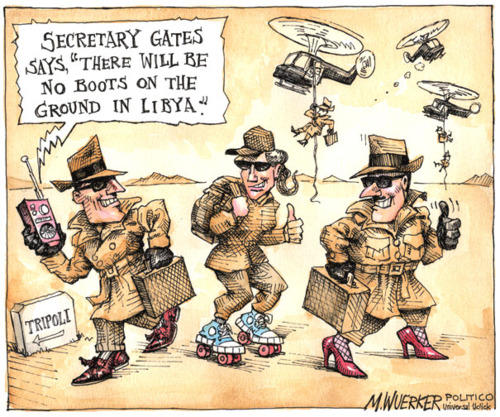
Boots On The Ground

Tumblr_lj4hyz4m9a1qdgl0ro1_500

Al Jazeera notes the following:

US and Egyptian special forces have reportedly been providing covert training to rebel fighters in the battle for Libya, Al Jazeera has been told. An unnamed rebel source related how he had undergone training in military techniques at a "secret facility" in eastern Libya. He told our correspondent Laurence Lee, reporting from the rebel-stronghold of Benghazi, that he was sent to fire Katyusha rockets but was given a simple, unguided version of the rocket instead.

"He told us that on Thursday night a new shipment of Katyusha rockets had been sent into eastern Libya from Egypt. He didn't say they were sourced from Egypt, but that was their route through," our correspondent said. "He said these were state-of-the-art, heat-seeking rockets and that they needed to be trained on how to use them, which was one of the things the American and Egyptian special forces were there to do."

Are special forces not military? And has the US already made a decision to arm and train the rebels, while saying in public that the question is still being debated? I'm told that only the CIA is involved and there is no arming of the rebels going on. And then you hear of a "secret facility" in Eastern Libya for training one side in a civil war.

I cannot verify it, but it seems pretty clear to me that the press needs to ask the president or his spokesman to give a clear yes or no to the question of whether there are any US forces on the gound in Libya – and whether weapons are being secretly funneled to the rebels. If Obama has done that, and told us the opposite, he has a serious credibility problem. So let's clear it up, can we?