“Free Speech Is A Great Idea, But …”

Harry Reid's comment that "we'll look into" the despicable Christianism of Terry Jones unnerved me. Butters unnerved me some more:

Sen. Lindsey Graham said Congress might need to explore the need to limit some forms of freedom of speech, in light of Tennessee pastor Terry Jones’ Quran burning, and how such actions result in enabling U.S. enemies.

"I wish we could find a way to hold people accountable. Free speech is a great idea, but we're in a war," Graham told CBS' Bob Schieffer on “Face the Nation” Sunday.

And there you have a classic example of how warfare abroad can curtail liberties at home. Koran burning is obviously a disgusting act of disrespect and incivility. But that very kind of act is what the First Amendment is designed to protect. And we should also remember that this war has no end, and that therefore the liberties taken away by wartime are permanently taken away.

Which Revolutions Matter Most?

Rothkopf concentrates on China's advances in science and research:

It is an axiom of history that the silent revolutions — like those that periodically come in science and technology — are far more important than the noisier, bloodier and more publicized political kinds. That's why these subtle indicators of their progress can be even more momentous than the round-the-clock coverage of upheaval that seems to be dominating our attentions at the moment.

It is a certainty that the future of the world be far more greatly influenced by what is happening in a Chinese laboratory than what is happening in the Arab street.

Internet Mind Meld

Michael Chorost uses the brain's own structure to imagine the future:

Without a corpus callosum, the right and left halves of the brain would feel like, and be, separate entities. For any kind of unified consciousness to emerge from disparate parts, it needs fast and massively parallel communication. This is exactly what humans and the Internet lack. We are Paleolithics poking away at Pentiums. But what if we built an electronic corpus callosum to bind us together? 

What if we eliminated the interface problem—the slow keyboards, the sore fingers, the tiny screens, the clumsiness of point-and-click—by directly linking the Internet to the human brain? It would become seamlessly part of us, as natural and simple to use as our own hands.

A Tiny Straw In The Wind

Yes, there were only 152 ballots counted in South Carolina's York County Republican straw poll. But Huckabee's easy win must surely be good news for him. Another interesting note: Bachmann easily beat Palin, and was neck-and-neck with Gingrich. I wonder if Bachmann really is a force to be reckoned with. Most non-wingnuts regard her as an absurd candidate. But as Iowa's GOP remains dominated by Christianists, it could vault her into the credible zone. If Huckabee doesn't run, Iowa could make Bachmann a leader in the ranks of the ignorant and the extreme.

The Manner Of Their Death

Peter Stothard recounts the life of a Roman slave, and what the arena really symbolized:

This was blood sport, but it was also sophisticated theater. An individual gladiator might play many parts in a single season; a successful name, that of a gladiatorial star like Spartacus, might be attached to many players. A well drilled troupe of killer slaves could recreate a sea battle, packed on ships in flooded amphitheaters, or they might show more individual prowess in the face of the death that for Romans was not only a human necessity but a definer of human life. The manner of his death was the making of a man—and the slaves who filled the arenas showed all the many ways that the end might come.

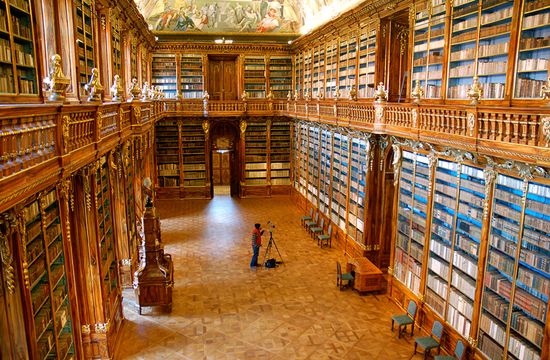
Visiting A Virtual Version Of A Real Library

Prague_library

Evan Rail explains photographer Jeffrey Martin’s panoramic project of the Strahov monastery’s Philosophical Hall in Prague:

The finished Strahov library panorama, released Tuesday on Martin’s website, is a zoomable, high-resolution peek inside one of Prague’s most beautiful halls, a repository of rare books that is usually off-limits to tourists (a few of whom can be seen standing behind the velvet rope at the room’s normal viewing station).

Martin’s panorama lets you examine the spines of the works in the Philosophical Hall’s 42,000 volumes, part of the monastery’s stunning collection of just about every important book available in central Europe at the end of the 18th century — more or less the sum total of human knowledge at the time.

I wonder if art museums could do the same thing, and allow virtual visitors to browse at will.