"Jesus was followed by St. Paul, Socrates by Plato, Confucius by Mencius, and Laotse by Chuangtse. In all four cases, the first was the real teacher and either wrote no books or wrote very little, and the second began to develop the doctrines and wrote long and profound discourses," – Lin Yutang.
Month: April 2011
Taking The High Road
David A. Schroeder explores a set of new studies:
Building on research showing the power of metaphors to shape our thinking, Sanna and his colleagues noted that height is often used as a metaphor for virtue: moral high ground, God on high, looking up to good people, etc. If people were primed to think about height, they wondered, might people be more virtuous?
… In the first study they found that twice as many mall shoppers who had just ridden an up escalator contributed to the Salvation Army than shoppers who had just ridden the down escalator. In a second study, participants who had been taken up a short flight of stairs to an auditorium stage to complete a series of questionnaires volunteered more than 50 percent more of their time than participants who had been led down to the orchestra pit.
A Poem For Sunday
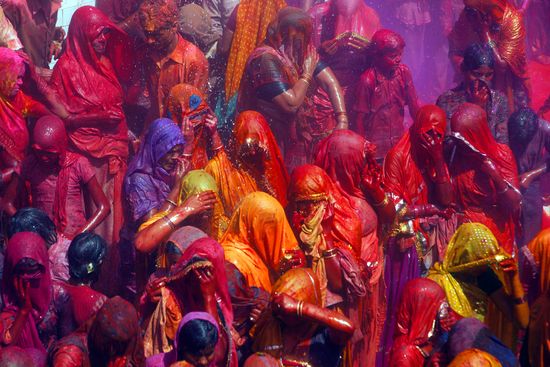
"Brother, I’ve seen some" by Kabir, appeared in the March issue of Poetry, and is translated from the Hindi by Arvind Krishna Mehrotra:
Brother, I’ve seen someAstonishing sights:A lion keeping watchOver pasturing cows;A mother deliveredAfter her son was;A guru prostratedBefore his disciple; …
You can read the full poem, with the enlightening payoff at the end, here.
(Photo: Hindu devotees play with coloured powders during Holi celebrations at the Bankey Bihari Temple on March 21, 2011 in Vrindavan, India. Holi, the spring festival of colours, is celebrated by Hindus around the world in an explosion of colour to mark the end of the winter. By Majid Saeedi/Getty Images)
Politics And Human Nature
Peter Wehner riffs on Yural Levin's new essay, “Beyond the Welfare State":
Walter Lippmann wrote that at the core of every social, political, and economic system is a picture of human nature. The premises we assume shape almost everything we do. The reason that the Founder’s conception of the American political system and Adam Smith’s vision of capitalism succeeded is that their understanding of the human person was essentially right; the systems they argued for conformed to basic human truths (men are not angels but are capable of virtue, people are driven by self-interest more than altruism, et cetera).
As we undertake the difficult task of self-government, lawmakers and citizens should from time to time step back and reflect on some of these deeper questions about human nature. This exercise isn’t a luxury, a diversion, or a distraction; it is absolutely central to the type of society we are and aspire to be. Public policy cannot be separated from political philosophy.
Is Love A Choice?
Building off David Foster Wallace's philosophy, Leland de la Durantaye contemplates the nature of love:
Are we free to love? Doubtless. Are we free in love? We don’t know. Being in love is either freedom itself, or its opposite. Am I, for instance, free to love dogs? Because my first memories are of dogs, because I confided in them when I was confused and frightened, because mine licked away my earliest tears, am I free in my affection? The reason this sounds silly is that it is silly. The obvious point is that I don’t care. Stated philosophically, I have a marked preference for the belief that I actually love dogs. Stated more simply, conditional love is no love at all. And so I love what I love with all the fierceness I can, with every beat of my heart, or not at all.
Wallace’s conclusion is simple. “Whether there’s ‘choice’ involved is, at a certain point, of no interest … since it’s the very surrender of choice and self that informs the love in the first place.” This is radical and right and ultimately his last word on free will and choice. Whatever love is, we do not choose it.
But friendship? That we choose.
A Video Game Or The Circus?
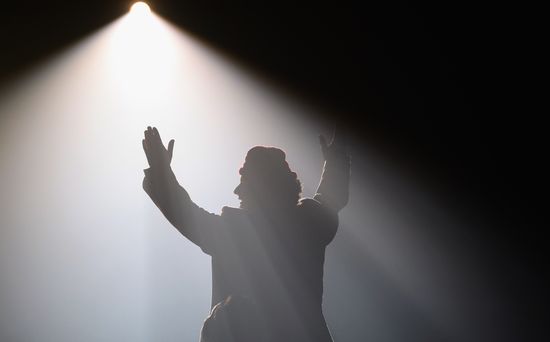
Stefany Anne Golberg eulogizes live performances, whose numbers have dropped by 61 percent over the last five years:
The death of stage performing isn’t just the loss of a profession—it is the loss of an entire form of experience. Nothing else has the feeling of standing on that precipice between failure and success — the puddle of sweat at the small of the back, the fluttering heartbeat, the tingling knees; to experience that moment when everything just might fall apart and probably should and you know it will, but then it doesn’t. The magic enchants, the joke is funny, the song is transcendent. Nothing else feels like that embarrassing, thrilling freefall into disaster, the old roar of the greasepaint and smell of the crowd, a tragedy or comedy that could happen anywhere, at any moment, for anyone, because all a play really needs is a player.
(Photo: Bobbo the clown takes the applause in the ring at Bobby Roberts Circus on Knutsford Common on March 30, 2011 in Knutsford, England. Bobby Roberts Circus has had to erect a security fence around it's giant tent for the first time in it's history in the wake of a video showing Anne one of its retired elephants being abused. By Christopher Furlong/Getty Images)
Micro Charity
James Altucher explains why he doesn't donate to big charities:
The American Cancer Association might be a great charity. But what will my dollars do for them? Nothing. Warren Buffett and Bill Gates are spending $100 billion on eradicating cancer, AIDS, malaria. … What I like to do is direct donations into what I call “micro-causes.” Specifically, pick up the local paper and see who needs help RIGHT NOW, where a small amount of money can immediately make a significant difference in someone’s life. For instance, if the NY Post writes about a house burning down in Brooklyn and a now-homeless family — put them up in a hotel. Simple. Easy. Cheap. Makes their lives better while they deal with the loss of their home and all of their belongings. And probably nobody else thought of it.
Sex And Death
Vinnie Rotondaro reports on the shifting landscape for female funeral workers:
Before the 1860s, caring for the dead was viewed as a woman's role. Death care tended to take place in the home, and the cultural perception of women as more intuitive and
emotional made them an obvious choice for the job. Additionally, because women were the ones who helped deliver infants, and the infant mortality rate was high—in 1850 it was 216.8 for every 1,000 live births among whites and 340 for every 1,000 live births among blacks—dealing with deaths was seen as part of the birthing process. … All this changed during the Civil War.
With thousands of American men dying far away from home, families began requesting that their loved ones be embalmed and shipped from the battlefields. Up until then, most Americans viewed the practice with suspicion. It was seen as unnatural, something that took place in medical schools. But the realities of war helped to soften attitudes about what would be acceptable to do to bodies for the sake of a ceremonial goodbye. And then, crucially, on April 15, 1865, when President Abraham Lincoln died, top advisers decided that he be embalmed and toured on a funeral train. It proved embalming's shining moment.
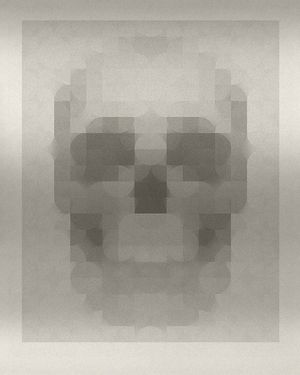
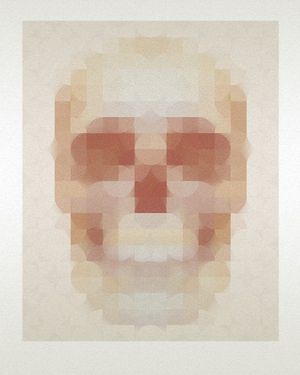
(Image: Portrait of the Viewer (left) and Portrait of the Artist (right) by Rafa Jenn)
His Last View From His Window

Greenland, New Hampshire, 6.50 am.
Our reader writes:
This was my husband's last view when he died at home last week.
On the last day before he fell into a coma, from which he did not again open his eyes, he sat up in bed and walked to this window. It was snowing on the first day of spring, and he wanted to see it for himself. You can see the bird feeders to which he tended, and the hammock which we desperately hoped he would have a chance to use to this spring.
He was the one who introduced me to The Dish, which was a daily feature in both our lives. At his memorial service this weekend, a dear friend read R.T. Smith?s “Sourwood,” which I had read while my young husband – the father of our four children and beloved master to two rescue beagles – was undergoing aggressive treatment for pancreatic cancer.
My husband?s last gift was of his own body, to Tufts Medical School, in honor of “Max” – his own first-year medical school gross anatomy donor – and all the others who have given themselves to enable physicians like my husband to learn their craft.
A Virtual Vacation
A wedding photographer records one:
Phuket Breathing // Thailand from artisland on Vimeo.
 The Dish