The Bugs Or Mickey Debate, Ctd

A reader writes:

The real question is not why was Mickey more popular than Bugs, which pretty much follows the early American cultural preference for mischievous but safe Tom Sawyer types over the "All right, I'll go to hell" Huck Finn types.

The real question is: Why did Mickey have to wear pants but Donald Duck didn't?

Another:

I know I'm probably not original in this, but when I was growing up I saw Bugs Bunny a symbol of immense power. Here was a guy who could do anything. I admired him greatly.

When I got older and studied a little mythology in more depth, I realized that Bugs Bunny was Pan, another little guy who was really, well, everything ("pan" means "everything" in Greek). He made fools of bullies and blowhards, and that suited me just fine. You knew just at the moment when the fools thought they had captured him or humiliated him he could produce a lit stick of dynamite.

I wanted to do that.

Another:

There's a simple explanation for why Mickey Mouse is more popular than Bugs Bunny. Mickey is happy, while Bugs is cynical. Happiness beats cynicism every time.


The World Via Airport Carpeting

Bahamas

George Pendle admires airport decor: 

Witness the carpet at Singapore's Changi Airport, a vertiginous monochrome wonder that seems to mimic what one would see if you fell out of a window in the city's brightly lit Downtown Core. At the other extreme, sits tiny Rogue Valley International-Medford Airport in Oregon, whose carpet sports a Prince of Wales check, referring to the secret visit to the small town by Edward VIII in the late 1930s to open a Girl Scout camp.

Occasionally airport carpets can be too candid. The torn, gum-covered, sub-neo-constructivist carpet at London's Heathrow immediately suggests one is entering a city of delays and obstructions, while the carpet in Murmansk Airport in Northern Russia, with its unforgiving pallid grey colour scheme and aggressively thick tufts, ominously alludes to the icy tundra that surrounds it.

(Photo: Lynden Pindling International Airport, Bahamas by George Pendle)

Drafting In Ink

Witold Rybczynski considers architecture before computers:

Rigor was equally a part of the Renaissance architect's working method. This period not only lacked Xeroxes and blueprint machines; it even lacked pencils. All drawings, including rough sketches, were done in ink. A finished architectural drawing required two steps. First, a stylus was used to impress an outline on thick, hand-laid paper. (There was no tracing paper.) Once the barely perceptible ghost drawing was complete, it was inked in. No wonder that Renaissance architectural treatises often seem cerebral; architects spent a lot of time thinking before they started drawing.

Is The GOP Getting Fiscally Serious?

Pete Wehner predicts:

Next week Representative Paul Ryan, Chairman of the House Budget Committee, will release the GOP House budget for FY 2012. It’s likely to include far-reaching tax and entitlement reforms, significant cuts in domestic discretionary spending, spending caps, the rollback of injurious laws, and more. We’re talking about savings of more than $2 trillion over the next decade. If that’s the case – and we’ll know by early next week – it will rank as arguably the best, most important policy document produced by any Congress in our lifetime.

Well, let's not get carried away, shall we? But if Ryan's plan has credible long term cuts in Medicare, Medicaid, social security and defense, he will deserve a real hearing. But somehow I doubt it. If the entire burden rests on Medicaid – and there is no net revenue increase – it's unserious. But putting middle class entitlements and defense on the table will nonetheless be a step forward.

The View From Your Window Contest

Vfyw-contest-4-2

You have until noon on Tuesday to guess it. City and/or state first, then country. Please put the location in the subject heading, along with any description within the email. If no one guesses the exact location, proximity counts.  Be sure to email entries to VFYWcontest@theatlantic.com. Winner gets a free The View From Your Window book. Have at it.

Sparks From A Book Burning

On March 20th, Pastor Terry Jones held a Koran burning in Florida. On Thursday Afghanistan’s President, Hamid Karzai, condemned the burning and called for the arrest of Jones. Yesterday, Afghans protested the Koran burning by killing UN workers. And today the deadly protests have spread to Kandahar. Una Moore, located in Kabul, Afghanistan, puts the killings in context:

This is not the beginning of the end for the international community in Afghanistan. This is the end. Terry Jones and others will continue to pull anti-Islam stunts and opportunistic extremists here will use those actions to incite attacks against foreigners. Unless we, the internationals, want our guards to fire on unarmed protesters from now on, the day has come for us to leave Afghanistan.

The interaction between Christianism and Islamism could take us all back to the dark ages. Both acts are, to my mind, egregiously unhinged. What on earth does it achieve to burn a holy book? And how screwed up is a religion which responds to this by murdering UN workers? Both mindsets are sick versions of religious fanaticism.

My fear of a Huckabee or Palin as president is precisely their ability to inflame this kind of thing still further, and identify the the entire United States as representative of Christianist excess. The current GOP no longer includes in its leadership even someone like George W. Bush who kept insisting that Islam itself was not the problem, Islamism is.

The Bugs Or Mickey Debate

Rob Long explains:

For decades, comedy writers have puzzled over a mystery: Why is Mickey Mouse more famous than Bugs Bunny? Mickey isn’t funny or interesting. He cannot produce an anvil or a Carmen Miranda hat out of the air. All in all, his “good mouse” act is a toothless, nice-guy bore. … And yet Mickey is the superstar, while Bugs is the comic character actor. Mickey is nice. Bugs is funny. You cannot, obviously, be both. … A truly great parody—in the grand Bugs Bunny tradition—is an arrow aimed straight at the puffed-up and smug, gently but firmly mean-spirited.

What about Mickey's awesome corporate power?

Antibiotics: From Your Food To You

Maryn McKenna summarizes a recent study about the dangers of antiobiotic resistance in farm animals:

Chickens, chicken meat and humans in the Netherlands are carrying identical, highly drug-resistant E. coli — resistance that is apparently moving from poultry raised with antibiotics, to humans, via food. … The first observation that giving antibiotics to animals spreads antibiotic-resistant bacteria to humans was made in 1976, and there has been a steady accumulation of evidence since. Nevertheless, the argument keeps being made that the connection is not water-tight , and that antibiotic use outside agriculture — in human medicine, perhaps — can be blamed for the vast rise in antibiotic resistance.

Denmark quit giving antibiotics to their pigs, poultry and other livestock. Scientific American argues their example "has shown that it is possible to protect human health without hurting farmers":

Although the transition unfolded smoothly in the poultry industry, the average weight of pigs fell in the first year. But after Danish farmers started leaving sows and piglets together a few weeks longer to bolster the littermates’ immune systems naturally, the animals’ weights jumped back up, and the number of pigs per litter increased as well. The lesson is that improving animal husbandry—making sure that pens, stalls and cages are properly cleaned and giving animals more room or time to mature—offsets the initial negative impact of limiting antibiotic use. Today Danish industry reports that productivity is higher than before.

Gandhi Too, Ctd

A reader writes:

You ask, "Why would Gandhi destroy letters from someone he clearly loved?"

My deepest friendship in college was an intense relationship with another man. Over the course of two years, we became inseparable. We talked. We touched. He read aloud to me. He wrote poetry to me. It was very, very Romantic – the period that is. Some people thought we were sleeping together. They were certain that I had corrupted him. (This was in the mid '70s, so you can imagine how popular that made me.)

One evening, as we lay on his bed, my head resting on his chest as he read aloud, I looked up into his eyes. He looked down into mine. I raised my lips to kiss him. He continued to look down, but with a puzzled look. I confessed my love, the nature of my love, well, the nature of one aspect of my love. He said he loved me, too – my heart leapt – "but not that way". Young love dashed. You can only imagine the crying that ensued. He cried with – and for – me. It hurt him to see me hurt. He thought about it for a couple days and we had another talk.

He couldn't do it. Just didn't have it in him. But he was kind and sympathetic and supportive. I was wounded, but our friendship wasn't. Two weeks later, he went home for Spring Break to his fundamentalist, Republican parents. He came back. When I went to his place to welcome him home, he said, "Get out of here." He never spoke to me again.

Was he in denial of his own emotions? Had his parents explained how close the Devil had come to snagging his soul? I have no idea.

Do you think he kept my letters? I still have his poems.

This is not a rare story. It happened to me in college – and when it ended abruptly for the same reasons my writer cites, I cried for days on end. But in Gandhi's case, he destroyed the letters long before he and Kallenbach split up.

Saving To Spend

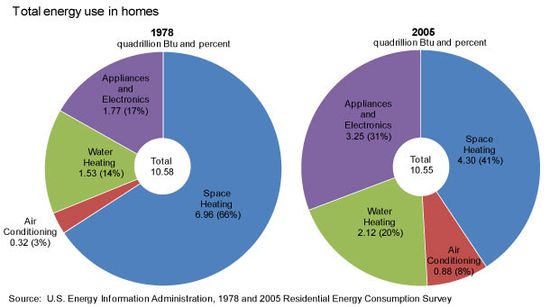
Household_energyuse_pie-lg

Michael Mechanic interprets the latest figures from the Energy Information Administration's Residential Energy Consumption Survey:

Since 1978, household appliances have gotten way better. Most notablly, heating used to account for 66 percent of our collective residential energy use. Nowadays, thanks to cleaner-burning furnaces and energy-efficient construction and window design, that number is closer to 40 percent. Not only that, the total energy devoted to heating houses has dropped by 38 percent, even though we have 45 percent more houses to heat. Hey, impressive!

Yeeeeah, but the thing is, we're now buying so many of these very-efficient appliances that we suck up as much power as we used to. In other words, we're channeling all that efficiency into better lifestyles.