
Bullies In The Gay Rights Movement, Ctd

Like The Dish, Margaret Talbot argues that DOMA deserves a lawyer. Jonathan Rauch joins the chorus:

So maybe HRC et al. have succeeded in making the point that being anti-gay in today’s America comes at a cost, so think twice? That may be the lesson our side thinks it’s teaching, but the lesson a lot of lawyers may hear is: Don’t represent unpopular or controversial clients—including, next time around, gay ones. Obviously, the other side can use the same tactics against us; that is why minorities, especially, have a stake in a system where unpopular and controversial people can get top-flight legal representation.

Egypt’s Fundamentalism

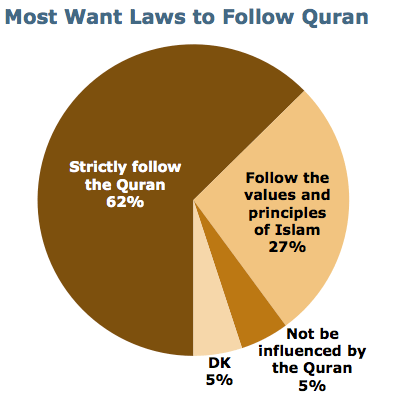
Quran_Law_Pew

An earlier poll found little appetite among Egyptians for Islamism or scrapping Egypt's peace treaty with Israel. Pew's latest poll differs:

Egyptians hold diverse views about religion. About six-in-ten (62%) think laws should strictly follow the teachings of the Quran. However, only 31% of Egyptian Muslims say they sympathize with Islamic fundamentalists, while nearly the same number (30%) say they sympathize with those who disagree with the fundamentalists, and 26% have mixed views on this question. Those who disagree with fundamentalists are almost evenly divided on whether the treaty with Israel should be annulled, while others favor ending the pact by a goodly margin.

Adam Serwer is puzzled by the dueling polls:

Both polls had a similar sample size and polled Egyptians of varying ages and economic means, which makes me wonder how much question phrasing may have had an impact on the disparate results.

The Politics Of Protest

Ian Johnson questions the end result of Chinese dissident artist Ai Weiwei's provocations:

When I’ve described him to people outside the cocoon of China’s cosmopolitan elite, they usually ask me what he wanted. If it was just to show that the government could be a bully, no one thought that was news. Such a response may imply a lack of consciousness about individual rights and civil disobedience, and so partly validates Ai’s pessimistic view of China. But it also reveals a pragmatic sensibility among many ordinary Chinese: many of them seem to see their country as more than the corrupt police state that Ai was trying to expose with such vitriol, or at least think that there are better ways of channeling the frustrations about the government that they may well share with Ai.

Isaac Stone Fish looks at the forms of protest that do make news in China. He reports on animal rights activists saving a truckload of dogs from slaughter:

This burgeoning animal-rights activism, aided by the ease of Weibo communication, coexists not only with the braised dog stew found on menus across China but also with China's "take many prisoners" attitude toward human-rights activists. Over the past few months, dozens of outspoken lawyers, artists, and underground church pastors have been harassed, detained, or arrested; some activists say it's the most stifling environment since the Tiananmen Square massacre in 1989. These arrests rarely make it into China's muzzled media. The dog saving, however, has been a very big story.

“Doctors” At Gitmo

6a00d83451c45669e2012876eb40a0970c-500wi

Steel yourself. If you were a doctor and had a patient showing up with symptoms like this, what would you do?

contusions (2), bone fractures (3), lacerations (2), peripheral nerve damage (1), and sciatica (2).

I'd ask how these occurred, wouldn't you? But the Gitmo doctors were remarkably incurious. These injuries just "happened." Ditto the following psychological symptoms in prisoners with no previous record of mental or psychological illness:

nightmares (5), suicidal ideation (4), depression (2), audiovisual hallucinations (3), suicide attempts (2), anxiety/claustrophobia (2), memory and concentration difficulties (1), and dissociative states (2).

The doctors never asked why prisoners were showing up bruised and with bone fractures or exhibiting classic symptoms of PTSD. One was actually told

‘‘[You]…need to relax when guards are being more aggressive.’’

The report is sickening. Just one incident:

At one point, the detainee was observed by an interrogator to be having auditory hallucinations in response to extreme sleep deprivation and other abuses. Case documents indicate that a BSCT psychologist was informed of the hallucinations and did nothing to mitigate obvious and profound psychological harm that he/she was made aware of.

Because the psychologists were part of the torture. What did the prisoners say was done to them, prompting these symptoms? You know the answer:

The detainees reported being exposed to an average of eight different forms of EITs (range: five to 11 forms of abuse) including sleep deprivation, temperature extremes, serious threats, forced positions, beating, and forced nudity. In addition to the use of authorized EITs, each of the nine detainees reported being subjected to ‘‘unauthorized’’ acts or torture including: severe beatings, often associated with loss of consciousness and or bone fractures, sexual assault and/or the threat of rape, mock execution, mock disappearance, and near asphyxiation from water (i.e., hose forced into the detainee’s mouth) or being choked.

Other allegations included forcing the detainee’s head into the toilet, being used as a human sponge to wipe the floor, and desecration of the Quran (e.g., writing profane words in the Quran, stepping on the Quran, and placing it on the floor near the trash). Five of the detainees reported loss of consciousness during interrogation.

I believe the prisoners. I also believe that the evidence Scott Horton has assembled – in an essay nominated for a National Magazine Award – strongly indicates that some alleged "suicides" at Gitmo were actually brutal torture sessions gone wrong. When five out of nine prisoners in this report testify to loss of consciousness as they were brutally tortured, how much of a stretch is it to think that some might have accidentally been killed? The Pentagon has already conceded that some prisoners in the war on terror "died during interrogation", a nice term for "tortured to death."

Notice also that none of this comes anywhere near the ticking time bomb exception that allowed torture to become the rule. These prisoners were destroyed – physically, psychologically, mentally – over a period of years. The report asks president Obama to set up a bipartisan blue-ribbon commission to investigate this evil, and to invite the UN rapporteur on torture to visit Gitmo freely to assemble the facts.

I'm sorry to say I think that has a snowball's chance in hell – to the eternal shame of this president. But I believe with every bone in my body that those who did this, cooperated with it and authorized it should be prosecuted and jailed.

Either there is a rule of law or there isn't. Either we are a civilized country or we are not.

(Photo: a mysterious building in the Gitmo compound.)
The Science Of Close-Mindedness

The Dish linked to Chris Mooney's defense of his new article but overlooked the article itself. Mooney delves in to the reasons why we find it hard to believe things we don't already know to be true:

Evolution required us to react very quickly to stimuli in our environment. It's a "basic human survival skill," explains political scientist Arthur Lupia of the University of Michigan. We push threatening information away; we pull friendly information close. We apply fight-or-flight reflexes not only to predators, but to data itself.

Amanda Marcotte connects Mooney's article to the Trig question:

At its heart, I think the conspiracy theory reflects the belief that Sarah Palin is a phony. Some conspiracy theories are people rolling up what they know or suspect about a person or a system and making unproven links: 9/11 Truther theories are a manifestation of the suspicion that Bush is an opportunist and a liar.  Global warming denialists believe that environmentalists are more anti-capitalism than pro-environment.  Believing Sarah Palin made up an entire pregnancy is a way to "prove" to yourself your suspicions about a woman who has done a remarkable job of breezing through life by faking it.  To my mind, the evidence against Palin on the record should be enough to satisfy a dislike of her–everything from her pretending she reads newspapers to using Alaska's proximity to Russia as evidence of her foreign policy qualifications to her embrace of reality television—but some people just need to believe something more dramatic.

Or maybe they just look at the countless pointless lies she has told and wonder if she couldn't also lie about something else. You have two moves here, not one. The first is to infer from Palin's general character that she's capable of almost anything; the second is to note that we have massive evidence that she has lied about countless things, even when there is empirical evidence that she is simply wrong (close to 50 odd lies in this category alone). So why not this as well?

The Tired, Lame Bigotry Of Some Homosexuals

I am a First Amendment absolutist, as readers know. And I'm also a solid defender of the right to blasphemy. But there are smart ways of doing this, ways that illuminate broader issues – think of 'The Book Of Mormon' or any South Park episode. And then there are smug, cheap and unfunny shots at the faith of other people. Really, this makes me feel like Bill Donohue.

You want to grow some balls? Hold a Hunky Mohammed Contest on Ramadan. And, by the way, thanks for doing your bit to empower every religious right prejudice about gays.

Hating Congress, An American Tradition

Jonathan Bernstein provides a reality check:

Trying to connect the American people's deep and long-standing contempt for their Congress with any particular set or arrangements or procedures is a mug's game.

Doug Mataconis connects hate for Congress to the growing power of the executive branch:

Even when Congress might want to assert its Constitutional prerogatives in the face of Presidential power grabs, the relative contempt with which Congress is held in the public eye usually gives the President a distinct advantage in the battle for public opinion. The consequence then of the fact that everybody hates Congress, is that Congress becomes weaker, the Presidency becomes stronger, and liberty becomes less secure.

A Billion Empty Bellies?

Abhijit Banerjee and Esther Duflo have an enlightening article on global hunger:

What we've found is that the story of hunger, and of poverty more broadly, is far more complex than any one statistic or grand theory; it is a world where those without enough to eat may save up to buy a TV instead, where more money doesn't necessarily translate into more food, and where making rice cheaper can sometimes even lead people to buy less rice.

(Hat tip: Cowen)