Government Bookies, Ctd

Dice

A reader writes:

You wrote, "No one is forced to play the lottery." True. Nor is anyone ever forced to take that first hit of heroin. Direct narcotics sales by the government could go a long way toward resolving our state and federal budgetary issues – hell, you yourself support decriminalization of at least some drugs – so why not get the government involved in those businesses too?

As a former professional card counter (I've been turfed from over 100 casinos in 16 states and wrote a recent book on the subject), I know more than I wish I knew about the psyche of gamblers and the spirit in which gambling revenues are generated. The business is dirty almost beyond conception.

Yes, blackjack professionals get a tad bitter because we're treated like criminals for the simple act of playing, with an objectionably high skill level, the sole beatable game. But when you find yourself surrounded by armed guards for the non-crime of gambling in a gambling hall, you begin to see that casino management has not even the least of shred of interest in a fair and balanced gaming environment. Their job is to beat fish out of the money, period.

And then you start looking around to the fish. You see the midnight zombies with their waning stores of cash and the anguish in their postures and faces. One way to get in trouble as a card counter is to inadvertently exchange one of these "ah-ha" smirks with the bosses when a compulsive sits down at the table. The bosses all know something about their little industry. They laugh about it – perhaps because to consider it seriously and with compassion would make them either crazy or out of a job. But spend the time in casinos that I've spent, observe the amazing frequency of clearly unhinged people steaming on, desperately toward ruin, with no one to help them – in fact with all their supposed buddies on the casino staff conspiring to assure their continued destructive behavior – and you won't be able to help yourself. You'll loathe this fucking industry.

Not to say that it ought to be outlawed. But when the Oregon state lottery is shown to derive over half its profits from a troubled minority of citizens spending $500 or more each month, when the government-run casinos in Ontario are shown to depend on gambling-related mental illness for fully a third of their revenues, I find it difficult to ignore that predation is essential to the industry.

And that's why as a citizen I refuse to have any part of it. I don't want my government turning fellow Americans into fish. Keep the industry private. Let the scum deal in scum.

(Photo by Dave Gough)

Quote For The Day

“We cannot challenge the government. They’re armed, and we’re unarmed. If they want to kill us, they can kill us. If they want to arrest us, they can arrest us. But no matter how much blood gets spilled and how violent it gets, this is our country, and we’re not giving it up,” – an opposition leader in Syria.

Assad’s forces have now stormed a mosque in Dera’a.

Who’s Laughing Now?

Laura Turner Garrison studies a survey of international humor that “suggests perhaps what unites us in humor is not what we all find ‘funny,’ but rather what we all find ‘not funny'”:

Gelotophobia is the fear of being laughed at, and apparently we’re all a little gelotophobic to varying degrees. Seems like a fairly obvious fact, but the degrees can be quite telling about what makes individual cultures feel uncomfortable. And if The Office is any indication, it is playing with these levels of discomfort that make for some of the best comedy.

To my mind there are three reliable forms of crude comedy: someone falling over; someone’s pants falling down accidentally; or someone farting in public. They are forms of humiliation, right? And there’s nothing we laugh more at than the humiliation of others. One mark of civilization is the ability to rise above this and laugh at ourselves when the same thing happens to us.

Romney Bombs

Not an auspicious election preview:

Romney remains an exceptionally unnatural public speaker. To convey passion and excitement, he raises the pitch of his voice and imbues it with urgency. But it never quite clicks. His tone and affect are like that of an adult doing a dramatic reading of a pirate story to a wide-eyed three year old. It doesn’t help that he speaks too quickly and often trips over his lines. At points during his speech, Romney seemed to slip into a frenzy and start madly free associating economic buzzwords.

His verbal slip about a black president – “we’re going to hang him with that” – was obviously unintentional. But it’s the kind of thing you don’t really want to have to explain afterward. Josh Green’s account of the debate’s dynamics makes it sound like a series of almost comic one-up-manship to see how loopy they can all be.

Bring back Alan Keyes. We need some calm, moderation and careful speech.

Kid Tech

Kevin Kelly chronicles children interacting with technology:

Another friend had a barely-speaking toddler take over his iPad. She could paint and handle complicated tasks on apps with ease and grace almost before she could walk. It is now sort of her iPad. One day he printed out a high resolution image on photo paper and left it on the coffee table. He noticed his toddler come up to up and try to unpinch the photo to make it larger, like you do on an iPad. She tried it a few times, without success, and looked over to him and said "broken."

Kelly concludes:

[I]f something is not interactive, with mouse or gestures, it is broken.

Alan Jacobs counters:

[I]s Picasso’s “Guernica” broken? Is an old leather-bound copy of Shakespeare’s sonnets broken?

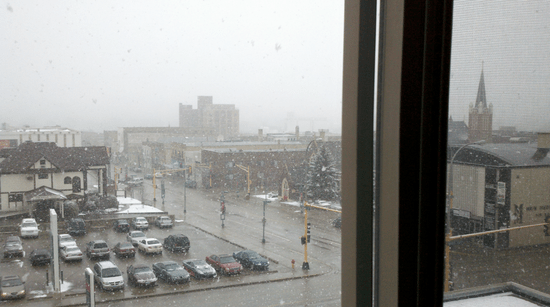
The View From Your Window Contest

Vfyw-contest_4-30

This photo was taken on April 17.

You have until noon on Tuesday to guess it. City and/or state first, then country. Please put the location in the subject heading, along with any description within the email. If no one guesses the exact location, proximity counts.  Be sure to email entries to VFYWcontest@gmail.com. Winner gets a free The View From Your Window book. Have at it.

The Oilman’s Next Frontier

Scott Johnson gets the dirt on Angola:

In 2004 China extended $2 billion in open credit to Angola for a series of infrastructure and development projects. By 2007, the credit lines had quintupled, to $10 billion, and Angola was fast becoming China’s biggest advocate, touting its superiority over the standard Western donors like the World Bank and the IMF, whose bureaucratic restrictions had angered the government and, in their view, only hobbled Angola further. Angola opted for the simpler and quicker Chinese solution.

The Fat We Notice

David Sirota bemoans a double standard:

According to the Kaiser Family Foundation, almost 70 percent of men are overweight, compared with 52 percent of women. Yet, somehow, 90 percent of the commercial weight-loss industry's clients are female, and somehow, this industry hasn't seen males as a viable business. … The real explanation for the gender disparity is found in a chauvinist culture whose double standards demand physical perfection from women while simultaneously celebrating male corpulence.