Jonathan (not John) Derbyshire interviews Sam Harris. Sam stands by what he has written about torture:
I think the reason to be against torture – and this is the reason to be against any patently unethical behaviour – is based on its consequences in the lives of human beings. You can make the argument that tolerating torture in any instance – even if we have a law which says, "we'll only torture someone we know to be a terrorist, who claims to be a terrorist, and who claims to have current knowledge of some coming atrocity" – even in that case, performing torture, knowing that there are people you are delegating to do this, is so corrosive of what we value in our society that it's not worth doing in any circumstance. Now, I think that the truth is that's probably untrue, given that something like nuclear terrorism is possible.
He continues later:
I say somewhere in The End of Faith that if you can't imagine any situation in which depriving someone of sleep, playing loud music, water-boarding them – doing something which leaves no lasting physical damage other than making them exquisitely uncomfortable for the moment so that they talk – if you can't imagine a situation in which you'd be willing to do that or sanction that, then you're just not thinking hard enough. There are people who are intending to destroy the lives of millions, render cities uninhabitable – that's what's scary, frankly.
I find the way Sam phrases this to be revealing. Note how he minimizes what torture is.
What the Bush administration did against mere suspects was not making anyone "uncomfortable for the moment". Try being deprived for sleep for weeks. Or subjected to deafening noise day and night where there is not even day or night. Or being waterboarded 183 times – that's a lot of "moments." Then this from later in the transcript:
If you get someone who you know is a member of al-Qaeda, and you know they have nuclear materials, and and they claim to have knowledge, then you have the perfect ticking time bomb situation. The idea there that you have a moral duty to keep this person perfectly comfortable with three meals a day and adequate sleep etc …
This is an extremly loaded piece of rhetoric. There is always the perfect case of the ticking time bomb in theory. In practice, as Derbyshire puts it, the likelihood of this never-happened scenario hapening in the future is "vanishingly small." But notice how he switched from torturing an individual to not "keeping this person perfectly comfortable with three meals a day and adequate sleep." That's a bait and switch – and a mockery of those of us committed to the principle of human dignity.
And try finding any evidence that torturing people gives us solid, actionable, reliable intelligence. Does Sam believe that John McCain really opposed America's actions in Vietnam? Why not? He said so after being tortured.
“If you have mandatory carbon caps combined with a trading system, much like we did with sulfur . . . it’s something I would strongly support,” – Newt Gingrich, 2007.
It's from a post by Ezra Klein arguing that it's a shocking revelation that Obama is, in policy terms, like a centrist Republican from the early 1990s. Since I've been essentially making this case for a few years now, this does not shock me. I remain of the view that president Obama is the best conservative president since Bill Clinton.
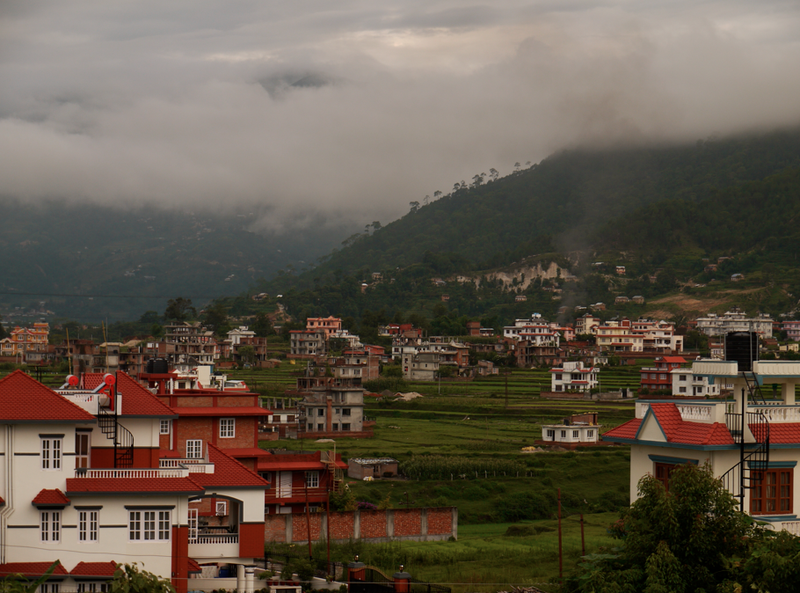
The area suggests tropical or semi-tropical. The tall hills are also interesting, and the one in the center is very tall (mountain perhaps?). Strange though – no people, no cars, what gives? The housing suggests European influences and the verandas on the roof tops indicate areas people go for entertainment. The spiral staircases are metal. I’ve never been to Australia, but I have found a great deal of photos of red tiled homes there, so that’s my guess. Queensland is as close as I can come.
I gotta get out more in the world.
Another:
Construction and lush greenery is definitely of the Balkans. Brightly colored houses suggest an Albanian population. The mountains don’t suggest the Mediterranean climate of coastal Albania, and the interior of the country is far too poor for that much new construction. So I’ll go with an Albanian town in Macedonia, where the Albanian population is wealthy, and likes to show it off. I could pick Gostivar or Kicevo, but I’ll go with Tetovo.
Another:
The building on the right is clearly a Pizza Hut. So I googled for a picture of Pizza Hut and the first one that came up is in Frostburg, MD, which I took to be a sign. However, when I kept googling, I found out that they have Pizza Huts in Costa Rica. And that background looks Costa Rica-ish. So it might be in Costa Rica. But I notice that there are a lot of buildings that have the red roof thing going on, so it occurred to me that this might be the corporate headquarters for Pizza Hut, which is in Dallas, TX.
I didn’t win, did I?
Another:
Probably not even close, but it feels like Da Lat, Viet Nam. The mountains, the mist, the terraced farms. Throw in what looks like old restored French villas, and that is my final guess.
Almost married a beautiful girl from there when I was a young idealistic fool. I would pick her up from school and we’d go for strolls along those very same fields when she got out of class. Could not have been a more romantic city. It’s currently a hot spot for Vietnamese honeymooners, though it was “discovered” by Alexander Yersin, the French/Swiss immunologist who also discovered the bubonic plague, yersinia pestis. Yersin popularized Da Lat as a retreat destination, and in its heyday was quite chic with French vacationers.
Another:
Is this Dalat, the Swiss Alps of Southeast Asia? Everything about the scene screams Vietnam to me. The brick wall is very typical, as is everything about the buildings, from the bamboo supporting the drying concrete to the water tanks on the roofs. The white buildings with red roofs is particularly popular in Dalat:
Another:
The solar hot water heaters on the roofs of the buildings are popular in both China and Taiwan. The fog and mountains appear more Taiwan than China. Also, all flat land is used in Taiwan. The country is 80% mountains so the country’s 22 million people and their agriculture must squeeze into an area much smaller than Los Angeles. As for the city, Taipei is too dense for such an area, so I’ll guess Jhongli City.
Another:
This one was one of the most puzzling, ever!
I’ve always, at least, gotten the right continent, but this time I’m not even sure of that. Very fertile, lush, new expensive construction with strange water handlers atop the buildings. Looks like new money coming into a place with not a lot of infrastructure. So with that, I’m going with China. Maybe around HK or Schenzen. But it’s a big country and I’m outta time.
Another:
I’m sure there will be plenty of guesses in China for this week’s contest, with the distinctive looking buildings. I’m guessing Kunming, Yunnan, because the larger buildings suggest a wealthy suburb, and Kunming is the only city in Yunnan that generates that kind of wealth, and the geography looks sub-tropical, like that of Yunnan province. But I’m also guessing Kunming because it’s centrally located in the province and has a good chance of being close if I’m wrong.
Another:
This just screams China. The solar panels are a dead giveaway, and the worn-down buildings alongside pristine megamansions probably means this view is from one of the hundreds of developments shooting up in the exurbs of major cities. Here’s an excellent Aussie news segment on the China housing bubble that likely resulted in this neighborhood:
But like I said, this kind of neighborhood can be found all around China. All I could figure was that the lush vegetation pointed to somewhere southern. Fortunately I have a bit of an advantage, as I’m currently living in China. I just moved into an apartment a couple days ago, so I called over my still-somewhat-reserved roommates and asked if they had any ideas. We’ve spent the last hour using our collective Google/Baidu skills trying to locate somewhere environmentally similar to this locale. We settled on Longyan City in Fujian province, China. Specifically, we’re going with Huodekeng village in Yanshan county, though that part’s a complete shot in the dark.
Though we’re probably way off, thanks for a great roomie bonding session! Our apartment was just furnished yesterday, so if we win we’ll have our very first coffee table book.
Another:
This one reminds me of a story I heard about overseas Chinese sending money back to their home villages that is used to build elaborate houses in the Fujian area opposite Taiwan. These houses end up sitting mostly empty as those who found success to pay for them stay overseas and there is little extended family left back home. I pick Huatingzhen because it looks like a valley with plenty of red tiled roofs with lots new development just southest of Xiamen. (I’m a previous winner, so it was just fun to post a guess based on a hunch.)
Another:
There’s tons of places in the Himalayas, and tons of places that aren’t in the Himalayas, that look like this, so this is basically a wild guess. I think those buildings in the foreground are a brewery/distillery. That would explain the big black tank atop one of them, and the other vaguely industrial stuff atop the other. That might make this nearer Kasauli, India, but I like Gangtok better.
Other countries that this could be: China, Philippines, Vietnam, Laos, Myanmar, Bangladesh, maybe even Nepal (although Nepal seems mostly drier and colder than this).
Another:
This is a view of Kathmandu, Nepal. The geography is exactly like Kathmandu Valley. The houses are very colorful, which is a cultural theme of Nepal. There is no urban planning in Nepal, and this picture shows houses constructed in haphazard way. This is definitely Kathmandu.
Another:
Kathmandu with 98% certainty. I would know this view – odd narrow houses with multiple levels, separated by diverse small crop plots, surrounded by misty mountains – anywhere. But where in the outskirts of Kathmandu? I’d guess the western Chhauni neighborhood. I wish I could vigorously search out the exact window, but it’s Easter and I have already been gone from my girlfriend’s family for too long.
Another:
I know someone else is going to give you the exact ward and chowk (probably not the street address, since those are seldom in Nepal), but if I had to guess it looks like the slightly posher western edge of the city. Maybe I’ll get extra credit as my fiancee and I are headed there for our wedding next week! Thanks for the reminder to pack a raincoat.
Another:
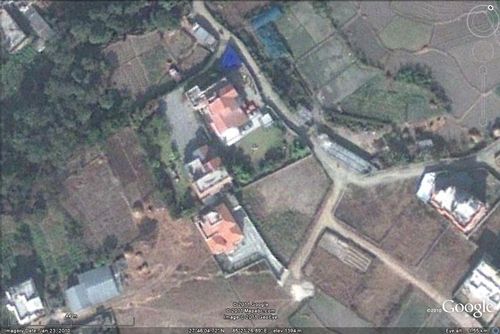
While perusing Google Earth to look at the suburban/rural area north of the city of Kathmandu, I stumbled across a Panoramio photo that looks like it captures some of the same ridge during the dry season. It calls the village Bhudanilkhanta. Since your other readers are unbelievably precise with locations, I’m going to gamble on trying to get close and guess it’s near the center of the attached Google Earth screen grab, at the coordinates 27?-46’-04.72”N, 85?-21’-26.89”W:
A down-to-the-wire entry:
Finally, the picture I have been waiting for. I have followed the contest since its very inception but haven’t sent in a single entry because I usually haven’t the slightest clue where the pictures are from. I am not very well traveled, so I don’t usually have the “this reminds me of the time I went to ____” reactions and I haven’t really had the time to put my internet sleuthing skills to test. But this one – I would be shocked if I weren’t right about this.
This is Kathmandu, Nepal. The Kathmandu nouveau riche architecture, black water tanks on top of the houses, the terraced rice fields, the chalky hills – all point to the fact that this was photograph was taken on the outer edge of Kathmandu. More specifically it is the northern part of the valley, outside the Ring Roads (a set of concentric road ways that circumscribe the denser center of the valley. The neighborhood is either Budhanilkantha or Narayanthan but is definitely north of Bansbari. The hill in the background is part of the Shivapuri hills and the white scar on the hill in the background is most likely a road that links Narayanthan to a town neigborhood/town named Tokha.
Now I am sure that many of your readers will send in correct entries with maps and even a picture of the window it was taken from. But know this – I went to boarding school not 500 metres from here from ages 10-18. It has been eight years since I have been to Kathmandu and the place didn’t look like this when I was there. It was all rice fields. I might have even planted the trees in the background for one of our schools reforestation outings.
Okay, that was it. It is Tuesday 8:57 out here in California. I hope I made it by your deadline of noon your time.
Such a wonderful and precise guess, and so close to winning, but we have to award the prize this week to the only Kathmandu guesser who just barely lost in the past:
I came so closelast week I couldn’t resist trying again. Solar hot water on the roof, but no satellite dishes. High altitute hill fog. Hot money inflows going to big houses. Chalk scar on the hillside. Poor urban planning and control. British style windows. Rice paddies …
I struggled. Then my son glanced at it and said “Nepal”. He’s never been there; he just said it.
I went rooting around images of Nepal, finding similar British windows, and recent housing developments in deep valleys floored with fertile rice paddies. At first I thought it would be Sundarijal, but I couldn’t get the hills to match. Finally I came across Budhanilkantha.
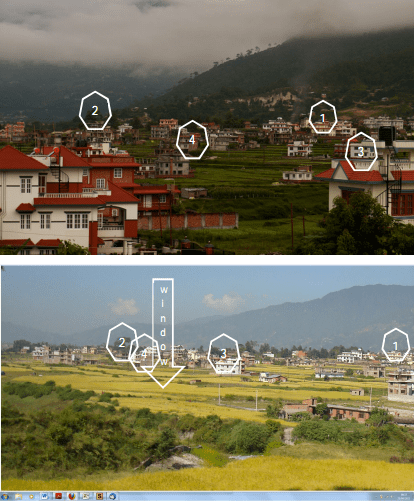
I found the hill with the two different tree heights on the slope, and then the yellow building with the red rectangle between the two white buildings. I won’t be able to find the window that took the photo this week. I suspect that where the window is now was rice paddy a year back. Attached is a picture of the same scene with some of the details, before development of the VFYW foreground buildings. I’ve put an arrow in the rice paddy where the window should be:
Someone on the ground can do better, but this is as good as it gets from my laptop. Thanks for the great contest. Better than an Easter egg hunt.
Tom Jensen doesn't think Ron Paul will win the GOP nomination. But Paul isn't polling all that badly:
On our 'main' ballot test in Iowa Paul gets 6%, tying Pawlenty and slightly edging Michele Bachmann's 5%. In a field without Donald Trump, Mike Huckabee, and Sarah Palin – something entirely plausible- Paul gets 16%, putting him in third place in the state.
But the point of his candidacy is not necessarily to win, but to open up the foreign policy debate. And when you look at the move of the GOP in the last few years away from big government conservatism to a more Paulite view of the role of the state, I think his importance is under-stated. Most of all, he has integrity, even if you think he's way off the map ideologically. Very few of his rivals have that kind of character. Some of them seem to have had careers and lives that scream out against it. Palin, Gingrich, Trump, and Romney are all obvious liars, positioners and, to a greater or lesser extent, frauds. I'd put Huntsman, Daniels, Santorum, and Johnson in a group as exceptions to this rule. But Ron Paul heads the pack – in consistency, integrity and sincerity. Rigid consistency isn't always an advantage. But sincerity and integrity should be.
A wedding card is delivered to the about-to-be-wed royal couple. It's so great to see Brit gay activist Peter Tatchell so strongly behind marriage equality. When I took Virtually Normal to Britain in the mid-1990s he strongly opposed the idea.
Ezra Klein wonders why the progressive budget proposal isn’t getting much coverage:
One recurrent theme in the commentary over the House Progressive Caucus’s budget proposal is that it’s not getting much attention because it’s too liberal, or it raises taxes too much, or it doesn’t cause seniors enough pain. I don’t buy it. The answer, I think, is more boring, and perhaps, more depressing. The focus is on what might pass — or at least what might be relevant in the upcoming argument over what might pass. It’s not on what might work.
I share Ezra’s puzzlement (although I think it’s as much a function of the liberal MSM over-compensating as their focusing on what might pass in the near future). What makes the media’s indifference to this plan so striking is that in its emphasis on raising taxes on the wealthy and slashing defense as the primary spending reduction, the plan is actually the closest out there to what the polls say is public opinion. And I don’t think that public opinion is that off.
If you take a few steps back and look at the current fiscal mess, you notice a few obvious things. Defense and entitlements are the biggies. Healthcare entitlements are very hard to cut and their costs devilishly hard to constrain (which is why the Ryan plan simply ends them as entitlements). But the defense budget is massively beyond any conceivable, rational notion of “defense” and could be cut with ease outside of politically charged base-closing in the US.
I mean, seriously, does sending drones into Libya have anything even faintly to do with defense? Power projection maybe. Humanitarian good maybe (and a big maybe). But defense of the nation? Please.
Given the exploded WMD premise, the same could be said of a trillion dollar war in Iraq. As for fighting al Qaeda, it’s now clear we should have had a massive troop surge in Pakistan, not Afghanistan (but it would be massively counter-productive and impossible), and seem to be in an open-ended military holding pattern largely to save face, or because we have decided not to cut a political deal.
Bottom line: If we did not have this kind of global reach, maybe all those nails wouldn’t look as if they needed a hammer.
When you are as broke as the US is, and when there is no rival military hegemon able and willing to do us harm, the military-industrial complex is an obvious place for massive cuts. If the US were a corporation that needed to make a profit, the Pentagon building would be a shopping mall by now. But to make these cuts as a government would require conceding that America’s sixty years of global domination are no longer affordable, or even relevant. It would require owning the relative decline of the US. No leading politician can do that. And many, like Romney, will run on the dangerous delusion that we should still act in the world as if it were 1963.
Which is how all empires eventually collapse: in a welter of debt, denial and over-reach.
In your response to David Brooks’ review of The Book of Mormon musical, you characterize the literal doctrines of Mormonism as “manifestly untrue,” but I don’t understand how by the same standards you apply to Mormonism, the doctrines of mainline Christianity and Catholicism are not also obviously false. Yes, you disavow certain doctrinal ideas that have been scientifically disproved or make no literal sense (such as The Garden of Eden or a 6000 year old Earth), but I don’t think I understand what that leaves you with.
You say we cannot know what happened in the final moments of Christ’s life or what his resurrection entailed because of textual inconsistencies between the books of the Bible, that in the space between these inconsistencies lies a mystery. If I understand you correctly, you are willing to put your faith in that mystery, to believe that something miraculous happened (even if you don’t know exactly what) and proclaim that in some capacity you are unwilling to totally define, Christ is risen from his grave.
Andrew, with all due respect to you (and I do respect you a great deal), I do not think that you are putting your own beliefs on this subject up to the same harsh judgment that leads you to contemptuously dismiss Mormon doctrine. Reason says that Native Americans are not descended from Jewish forefathers, that stones aren’t used to translate metal books, and that precocious fourteen year old boys are not visited by God in upstate New York. That same reason should tell you that textual inconsistencies between the different accounts of Christ’s death and resurrection point to only one “reasonable” explanation, that Christ did not rise (because people don’t do that, neither literally or in any more vague, mysterious, or undefined ways) and that differences in the accounts are due to them being fabricated.
You say God exists and loves us, that he came to Earth as a man, sacrificed himself, and that He is risen. Fine, but in doing so you greatly diminish your standing to scoff at the stupid believers from other faiths because none of these things you say you believe pass the test of “reason” as you have applied it to others. You are unwilling to say how exactly Christ is risen, how God exists, I would suggest that at least part of why you won’t commit to specifics is that when people get too definite about these things they start to sound ridiculous. This unwillingness to commit to the details does not make you more reasonable than fundamentalists (which term I would be careful about using in reference to Mormons, as a people they tend to be far more complicated than they appear at first blush), because if I understand you correctly, you still believe in something that is (from the perspective of the pure rationalist) manifestly untrue.
Or maybe you don’t; I’m not really sure what you believe, given the enormous rhetorical wiggle room you have allowed yourself. You don’t believe in the Garden of Eden, but do you believe that Jesus Christ was dead and then later walked around as a risen being interacting with people? You believe that he was God come to Earth, but do you not believe that he performed miracles, healed the sick, and raised the dead? If you believe in some of these premises, then what keeps you from believing in all of them? They’re all unreasonable.
Conversely, if reason stops you from believing in some of these things, how does it allow you to believe in any of them? And if you don’t believe in any of them, how are you really a Christian in a religious sense? You don’t owe me any of the answers to these questions, but I think you should grapple with them a bit more before unloading on others with the reason bazooka.
There’s one key phrase in my reader’s comment – “from the perspective of the pure rationalist.” I have never defended pure rationalism, and am epistemologically emphatically not a rationalist. It is clear that Joseph Smith meant to be taken literally in every respect, and cannot be by standards of empirical evidence. It’s clear to me that the Gospels were not written from the same 19th Century mindset. And therefore treating them as such is bound to misread them. Another writes:
I have no desire to enter into a religious debate, but I don’t really understand this statement: “And The Book Of Mormon rather deftly shows that, by any rational perspective, the literal doctrines of Mormonism are manifestly untrue – perhaps because they are more easily exposed because they are so recently concocted.”
Granted, I cannot convince you or anyone else by rational means that the doctrines of Mormonism are true, but can you or a Broadway show really say that by ANY rational perspective they are manifestly untrue? How exactly do you manifest that?
I even admit that my faith is irrational. That seems to be the nature of faith. But how can you discount any rational acceptance of faith or even agnostic, rational, possibility without knowing the ultimate answers? I can’t prove or disprove Catholicism, Hiduism, Islam or any religion any more than you can. I also can’t discount by rational means the truth of any other religion. In fact, they rather rationally and fairly are encompassed in Mormonism, one if the doctrines of which holds that all men and women, and whatever their nature of sin and error are heirs of eternal glory unless they commit some unpardonable sin denying the spirit when they have full knowledge (which we don’t even know how to define ourselves since none of us apparently have that full knowledge). We don’t condemn anyone to a straight up or down heaven or hell. But I didn’t mean to get into doctrinal issues.
I know you have serious personal, political and even moral differences with official Mormonism. My faith is such that all those things can be eventually worked out. And I know that “belief” ultimately comes down to a question of choice – as does rationality for the most part. But can you really dismiss my and any other religion by saying its doctrines are “manifestly untrue?”
Not all of them. But I added the qualifier: “perhaps because they are more easily exposed because they are so recently concocted.” The story of the golden plates is so obviously a fraud it beggars belief. Theories about racial difference based on God’s intervention are empirically refuted by Darwin. The idea that God may literally live on a planet is, er, contrary to what we know to be true:
The literal interpretation of Kolob as an actual star or planet has significant formative impact on Mormon belief and criticism, leading to conceptions such as that God dwells within this universe, and that the Biblical creation is a creation of the local earth, solar system, or galaxy, rather than the entire known physical reality.
Yes, some Mormons interpret these doctrines as metaphors. But we know that Smith meant them to be literal truths, derived from his misreading of ancient plates and papyri, placing him smack-dab in the middle of nineteenth century historicism. I do not doubt David Brooks’ empirical thesis that requiring people to believe facts they know to be untrue is such a leap of faith that the religions they adhere to have great power and strength. But that doesn’t make them true, which is the only criterion that matters for religion, in my view.
It makes contemporary fundamentalism a form of postmodernism. Which in so many ways, it is.
Another Republican has been throwing stones from what looks like a very glass house. Still, he vehemently rebuts the charges and deserves his day in court.
Like a junkie huffing his own glue, Donald Trump throws in the affirmative action card to pump up the GOP base even more. This one really stretches credulity: the man who edited the Harvard Law Review was not qualified to get into Columbia or Harvard. And then a totally fabricated notion that the president's long-form birth certificate is missing.
We can and should dismiss this man as a clown. But what's so riveting is that he is testing just how powerful a clown can be when pressing every populist, racist button the GOP has deployed for years – and doing it with a crudeness that Karl Rove would never quite deploy.
My fear is the following: that by merely trumpeting these claims and stirring these fears, Trump gets more and more media platforms to promote them. And they slowly penetrate the culture, delegitimizing the president even more deeply among the Fox News base. And we might as well concede it: these are racist smears, based on fear of the cultural "other". And the reason why Trump isn't Al Sharpton, pace Charles Krauthammer, is that he's white, and therefore commands much more immediate attention from the ageing, white GOP base than Sharpton ever could with the Democrats.
I don't think Trump will last very long. I do think he makes other shameless candidates more acceptable. Do you know what I am saying?
Under Purchasing Power Parities, the Chinese economy will expand from $11.2 trillion this year to $19 trillion in 2016. Meanwhile the size of the U.S. economy will rise from $15.2 trillion to $18.8 trillion. That would take America’s share of the world output down to 17.7%, the lowest in modern times. China’s would reach 18%, and rising.
Just 10 years ago, the U.S. economy was three times the size of China’s… This is more than a statistical story. It is the end of the Age of America. As a bond strategist in Europe told me two weeks ago, “We are witnessing the end of America’s economic hegemony.”
Yes, all sorts of things could mess this timing up. But the direction is unmistakable and predictable.
China's rise is also abetted by the US still pretending it can run the entire planet with a bigger military than everybody else's put together. It cannot do this much longer without hollowing itself out from within. And slashing funds for infrastructure because we refuse to raise any taxes or seriously means-test Medicare and social security is not exactly the way to go about stabilizing this.
This dynamic is also a reason to worry about the debt sooner rather than later. The only reason America has gotten away with such rank profligacy is because of the dollar as the world's reserve currency. If China surpasses American GDP, that may soon become as much a historical fact as the pound sterling's global domination. What historians may see when they look at America's relative decline is a country that couldn't really acknowledge reality and went out in a blaze of unfunded spending and bloat, and ludicrously over-reaching experiments in war-as-social-engineering as its political leaders squabbled over pathetic ideological remnants from the 198os.
(Photo: People visit Chinese artist Huang Yongping's installation art work named 'Leviathanation' at Tang Contemporary Art of 798 Art District on March 29, 2011 in Beijing, China. The exhibition named 'Tracing The Milky Way' will be last until May 14. By Feng Li/Getty Images.)

 A reader writes: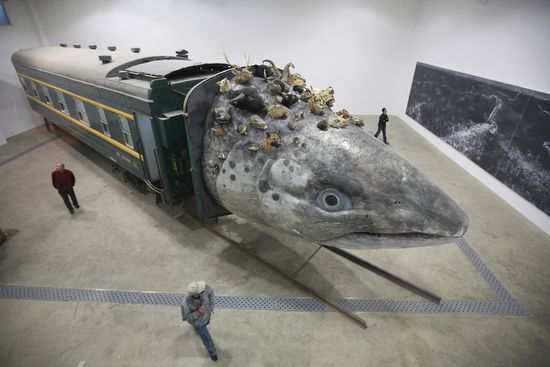
 The Dish