An Anti-War President?

E.D. Kain considers supporting Gary Johnson. Kain's disagrees with Johnson "on education, taxes, stimulus and a whole host of other policies." However:

[I]f you’re president it’s really hard to enact the domestic legislation you had in mind, but it’s really easy – almost effortless – to start dropping bombs half a world away. And this is exactly why I can imagine myself supporting Gary Johnson. I don’t think he’d have much luck at all with his domestic spending agenda, except at the margins.

Daniel Larison is less impressed by Johnson's anti-war record:

Johnson has previously opened the door to launching a war of choice in which no American interest is at stake, and he has done so by making a misguided and absurd claim that this is “what we have always been about,” which isn’t significantly different from the insipid notion that the U.S. has to meddle in other nations’ internal affairs because “America is different.”

Vaccine Denial: Left Or Right? Ctd

104037418

A reader writes:

I have been following this discussion because I am generally interested in the interaction between people and professionals with varying levels of expertise. Patients are often treated as if they have no capacity to make health decisions for their children, and that begins with the state of birth across this nation – highly medicalized and often traumatic for mothers. I wonder whether the vaccine denial is a sort of backlash.

All that being said, I strongly advocate immunizations because they obviously work, and I think it's irresponsible of parents to forgo them entirely. However, I have seen absolutely no discussion of the optimal schedule for vaccines.

With my first child, I followed the schedule dutifully, and I could tell from observation that the vaccines were hard on his immune system, sometimes causing fevers and cold-like symptoms. He also had a series of ear infections as a toddler and several rounds of antibiotics. With my second and third child, I was frank with doctors that I intended to adjust the sequence of vaccinations. I refused to begin before 6 months and refused more than two vaccinations per visit. My younger children were still on track with the required immunizations by age two. However, they have never experienced ear infections and have never needed antibiotics, even into adulthood. Their immune systems are robust. (I should also mention that breastfeeding was part of my equation for developing a healthy immune system in each child.)

In all of the discussion, what I am seeing is a polarized for or against on vaccines. I have no idea if my anecdote and personal choices had any impact on the immune responses my children have had, but it made sense to me that the infant immune system is too immature to handle the onslaught of vaccines in the first six months (approx. 15), and as long as children are breastfed, they could very safely begin their vaccination schedule at 6 months when the immune system is more mature.

Has anyone studied the efficacy of a delayed and gradual schedule of immunizations? The parent form from the CDC web site, p. 2 specifically [pdf], offers a table of horrible symptoms and complications and offers no room for parental discretion in this process. Just do what we tell you or suffer the consequences is the attitude their document projects.

Update: Another writes:

As I understand it, there is no such thing as "vaccine overload," so your reader is mistaken in the belief that "the infant immune system is too immature to handle the onslaught of vaccines in the first six months." From the multe-cited Wiki section:

The idea of vaccine overload is flawed, for several reasons. First, vaccines do not overwhelm the immune system; in fact, conservative estimates predict that the immune system can respond to thousands of viruses simultaneously.[44] Moreover, despite the increase in the number of vaccines over recent decades, improvements in vaccine design have reduced the immunologic load from vaccines, such that the number of immunological components in the fourteen vaccines administered to U.S. children in 2009 is less than 10% of what it was in the seven vaccines given in 1980.[44] Furthermore, vaccines constitute only a tiny fraction of the pathogens naturally encountered by a child in a typical year[44] and common childhood conditions such as fevers and middle ear infections pose a much greater challenge to the immune system than vaccines do.[48] Second, studies have shown that vaccinations, and even multiple concurrent vaccinations, do not weaken the immune system[44] or compromise overall immunity.[49]

Another:

Liberals will take issues like evolution and global warming seriously, but when bringing up the same scientific analysis regarding the suggested link between autism and vaccinations they will sometimes fall prey of "Mommy Instinct". I think that Jenny McCarthy sums it up the best:

PR.com: What has been your greatest lesson in this whole experience, dealing with Evan’s autism?
Jenny McCarthy: My greatest lesson is always to trust the mommy instinct. Always trust yourself. Always trust the gut instinct. It will never let you down.

My wife still has a very negative opinion on Oprah for allowing McCarthy on her show to spew her theories because you cannot defend against the "Mommy Instinct". It's like a Birther. They are not going to stand for reason or science.

Another:

I just wanted to weigh in on this subject as someone who was not vaccinated as a child.  I'm now almost 30.  My parents chose not to vaccinate me and my siblings because they generally don't trust the medical establishment (despite being fairly conservative socially, they have always leaned toward hippy, cruchy, granola, etc.).

I spent several days in the hospital with the measels (which I caught from another child in my class who wasn't vaccinated), and my brother got very sick with the mumps.  Both episodes were extremely unpleasant, and in my case very nearly life threatening.  When my sister unexpectedly got pregnant, she realized that, having never been vaccinated, she was at risk of getting rubella, which can cause birth defects if contracted during pregnancy.  She held her breath throughout the pregnancy.  My husband and I are now thinking about getting pregnant, so my doctor says that I should think about going through the whole course of vaccines.  Not something I'm looking forward to.

Vaccinating your kid is a risk, since we know that occasionally – very rarely – a child is legitimately harmed by the treatment.  But kids are occasionally harmed by tainted meat and the monkey bars.  It's terrible, but it doesn't mean that we should all stop feeding our kids meat or letting them play on the jungle gym.

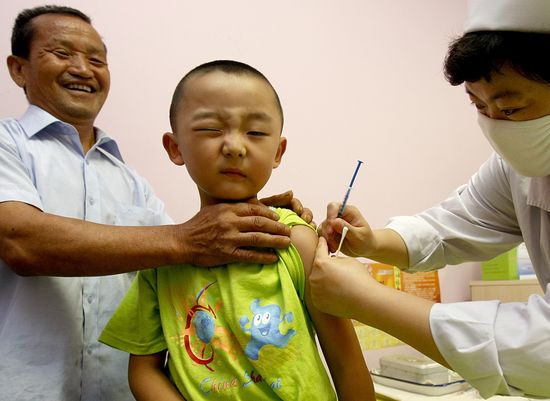
(Photo: A child cries while receiving a measles vaccination injection at a vaccination site on September 11, 2010 in Changchun, China. A measles vaccination plan, mainly targeting children in the age bracket from eight months to four years, was carried out for nearly 100 million children across China from September 11 to 20. By ChinaFotoPress/Getty Images)

Everyday Emergencies

Aaron Carroll and Austin Frakt separate emergency care from necessary care:

Emergency care is important, but it’s not the same thing as health care. We know that people with depression require treatment, but in an emergency room we can’t do anything about it until they are ready to commit suicide. We may know that you would benefit from a hip replacement, but until it fractures, there’s not much that will be done in an emergency department. We may know you  have arthritis, or ulcerative colitis, or migraines, or lupus, or hypothyroidism, or any of a host of other disorders, but until they are life threatening – there’s not much we can do for you.

The consequences of this attitude are real and significant.  First, the emergency room is still not free; the hospital will likely bill even those will few resources, potentially bankrupting them. The costs to the system are prohibitive, since often the end-stage emergencies of chronic disease are significantly more costly than proper management. But most importantly, the suffering this “system” adds to those who are ill is inhumane, unnecessary, and hard to accept in the richest country in the world.

Polygamy Is Wrong

Elizabeth Abbott puts her foot down:

In our longing to ensure that everyone enjoys every possible right, we have been willing to stretch our imaginations, swallow our bile, and give polygamy a chance. That is no less than our values demand of us. But legalizing it is not ultimately in the same category as granting a pastor the right to express his loathing of homosexuality, or as legalizing gay marriage. … [Same-sex unions] brought people into an existing system of rights; [sanctioning polygamy] poses a significant threat to that system. And that’s probably our cue, as a liberal society, to hold our noses and draw the line.

The Future Of Mobile Forensics

3386035827_bc0da2d8df_b

Alexis Madrigal is freaked out by the iPhone's extensive tracking system:

The big deal about location data isn't the data itself; rather, the location data makes all the other information that can be extracted exponentially more useful. That's why mobile forensics is different, and why our devices may be where the bubbling privacy concerns of the last decade come to a head.

If our phones have become our outboard brains, we've actually put ourselves in a very difficult privacy position. Even searching a suspect's house could never yield a full inventory of that person's friends and acquaintances, the entire record of their voice and text communications — and all the web pages he'd ever looked at. Now, law enforcement or a government official can have all of that in two minutes and physical access to one's cell phone.

(Photo: "Mining For Information" by Flickr user JD Hancock)

Shantytown Counterinsurgency

Mac Margolis patrols Rio's slums with top crimefighter, José Mariano Beltrame:

“Rio’s strategy is nothing new, but it demands enormous resources,” says José Vicente da Silva, a former national safety secretary. “In one of the pacified favelas, there is one police officer for every 40 residents. There’s no police force in the world with that kind of manpower.”

The Man Who Won’t Be President

Haley Barbour declared today he won't run for president. Weigel says this "frees up a ton of money for [Barbour's] friend Mitch Daniels":

That's not to say that no Barbour = more Daniels. It's just to say that Daniels, who'd worked with Barbour during the Reagan administration, was extremely unlikely to run against his old friend. And now Daniels has one less excuse. He still has plenty of them.

Frum, on the other hand, thinks Barbour not running helps Romney. Earlier thoughts on Barbour here.

A $23,698,655.93 Book

If you haven't read it already, Michael Eisen's post on two Amazon bots driving up the price of an out-of-print book is worth a read. A teaser:

As I amusedly watched the price rise every day, I learned that Amazon retailers are increasingly using algorithmic pricing (something Amazon itself does on a large scale), with a number of companies offering pricing algorithms/services to retailers. Both profnath and bordeebook were clearly using automatic pricing – employing algorithms that didn’t have a built-in sanity check on the prices they produced. But the two retailers were clearly employing different strategies.

M.A.Orthofer at The Literary Saloon adds:

This is sort of amusing (especially since no one was obligated to buy at these prices) — until you start wondering about what else is getting priced in this way. Recall the 6 May 2010 'flash crash' 

The Validity Of Asking Empirical Questions

The New Yorker's Amy Davidson weighs in:

Andrew Sullivan, as usual, is on the case, and I don’t at all think he’s wrong to be, even though I do think that Trig is Palin’s son.

My feeling is that a lot of Palin’s baffling behavior—getting on a plane without telling flight attendants she might be in labor, for example—can be explained, simply, by a matchless level of reckless narcissism. That is relevant, too, and why I am glad to know all of the points in the narrative. The timeline is dismaying, not because a fake pregnancy would Explain It All, but because I don’t want someone who thinks that her own small drama is worth disrupting (or even endangering) the lives of a plane load of people to be my President. (In a way, it is charitable of Sullivan to think that there ought to be a better explanation, beyond a careless tendency to smash things up, for her behavior.) How would Palin act in the sort of drama that involved lives, here and abroad? Not well, is, perhaps, the too obvious answer, and it’s fair to say that I didn’t need to have ever heard of the Mat-Su Regional Health Care Center to decide that I didn’t admire Sarah Palin’s judgment. But it is good to know who she is.

That is one reason why the Trig controversy is not, despite the efforts of some commentators to make it so, a leftist version of Birtherism. 

I am grateful for the back-up, but sad it should be necessary. I urge you to read the latest data points on the story, specifically the eye-witness accounts of two journalists who, after two years of silence, are now saying they saw Palin's pregnant belly covered only by a thin layer of fabric before she gave birth. These are important new parts of this jigsaw puzzle, and they go alongside the handful of pictures we have of Palin pregnant in her one-month public pregnancy. They should be taken seriously and definitely buttress – powerfully – the case that this whole thing is a tempest in a spatula.

Does this long-delayed meta-story settle the matter? The key thing, it seems to me, is to look at all the facts we now have and try to get beyond the order and manner in which we found these things out. This is not easy. But having tried to do that over this weekend, I still believe that none of these new things, alas, prove the pregnancy the way simple medical records would. To me, however, they do strongly tip the balance toward establishing the pregnancy as fact. When you add in the date of Bristol's giving birth to Tripp (removing the likeliest alternative scenario, although there are others) and the odd, last-minute but clear doctor's letter on election eve, the balance of doubt shifts again. I don't see why Quinn or Loy would lie about this; and their accounts seem persuasive – although it is maddening they didn't report this before, and weird that they didn't. They get to an empirical nub: what did you see with your own eyes? It's almost the best empirical test we have. Almost.

A video still from an Israeli documentary film – lightened to show detail below – has also long told us what both Wesley Loy and Steve Quinn have now personally testified to:
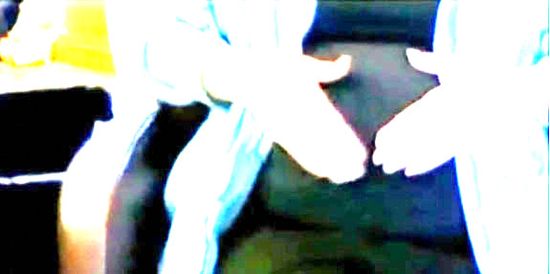
Square2

Is this what Loy and Quinn also saw firsthand? Whatever the answer, I remain grateful for Salon for doing more than most news organizations have seen fit to do, in putting this on the table and presenting new facts to rebut it. It's a start and I hope they follow up with more. My goal in all this has been simple: to find out the truth, whoever it might embarrass, including me.

I also urge you to read this interview with a pediatrician interviewed by blogger Laura Novak. It covers much of the ground the Dish covered two years ago in our discussions with leading teaching hospital obstetricians and pediatric specialists. But what's particularly helpful is the doctor's candor about the core issue here, especially with this new evidence in mind:

She’s weird in some ways. But she’s not that weird. To do things like fake a pregnancy. Those kinds of people don’t get through a nomination process because there would be too many flags. Because it’s not that they do one thing that’s weird. There would be a history. There’s politically weird and then there’s outrageous behavior. Did she baptize her kids in local stream in middle of winter?  Did she have the kid at home? No. Politically I don’t like her. But she’s not that weird.

Let's note something that even Salon would agree with here. There was no vetting of this rogue candidate. The usual mechanism to filter lunatics and hoaxers out of public life was missing. That's why, by the way, I stayed on the case. I knew no one knew. And I was not able to simply accept that Palin was so obviously sane this was impossible. This was a genuine belief and a real struggle. If I were not a blogger I could have ducked this. But I felt it was my duty not to.

And this is the thing dividing us, isn't it? If you think Palin isn't that weird, as the doctor puts it, then it seems simply loopy to even entertain the idea that she could have used a prosthetic belly to fake a pregnancy. If deep down you think she's so delusional, ambitious and weird that it's possible, even if unlikely, then you start asking questions that you would not usually ask.

And so, really, is this so different than the Birther stuff? Some believe that Obama is so strange that something must explain his rise to the top. Ditto the dream of having his entire presidency ended in one stroke. Palin-skeptics are also subject to this temptation – to over-dramatize her weirdness, to get attached to our own assumptions, and to be misled by the fantasy that her farcical presence in American political life could be ended in one expose.

But the difference remains obvious. Obama provided the salient empirical evidence – his birth certificate – one of those humiliations that public figures have to endure sometimes. Does Salon think it was reprehensible that he was even asked to do so? Was that a betrayal of journalism? Did they expend time explaining that, with contemporaneous birth notices in the papers, asking such a question was not exhibiting sufficient "deference" to the commander-in-chief? Notice how Politico erases this distinction in Ken Vogel's otherwise fair and helpful piece:

During the 2008 presidential campaign, FactCheck.org debunked the birth rumors about Obama (after its researchers were allowed by Obama’s campaign to physically examine the official copy of his birth certificate) and Trig Palin

Click the links and ask yourself: why did Factcheck use vastly different standards of evidence for both stories?

And it remains odd to me that a media enterprise openly seeking to "definitively debunk" a question should not simply seek the obvious avenue to do so: ask Palin for evidence she claims she's already produced anyway. That's the real Occam's razor here and it is directed at the media. We are told Palin has already been directly asked and showed no hesitation, even some amusement, in responding. We know that Loy's own editor, apparently aware of the limits of his own reporter's unpublished testimony, asked a month after the election. Why would Salon not follow up on their own? They've already proven they are on Palin's side in this instance, if not in any other, so it would be a perfect way for Palin to kill off these rumors by cooperating with a leftist source to knock them down for good. How much better could it be for both parties? (I have, by the way, asked Justin Elliott, whom I respect, this question and he assures me he will respond in due course on his site.)

But c'mon, Salon. Clinch this for good and all. You can do it. Just ask Palin's camp for medical records. And if she refuses, explain what her reasoning is, given her position on Obama's birth certificate?