“Shoot Me In The Head”

Julia Dahl reports on the disturbing reality of suicide by cop:

Most people who have studied the phenomenon will tell you that, typically, suicide-by-cop scenarios fall into two categories: the “fleeing felon” who tries to escape police and, once cornered, decides he’s going to go out in a blaze of glory; and the “emotionally disturbed person,” who … is looking for a way out of the pain of either mental illness or some kind of life failure.

The police encounter “emotionally disturbed persons” so regularly that, in cop lingo, they are called “EDPs.” Whether it’s a domestic call (a man with a history of depression has become violent because his ex won’t take him back), a workplace incident (an employee locks herself in a bathroom with a letter opener after being let go), or a schizophrenic homeless man screaming obscenities at shoppers at the local Dollar Store, police are often the first responders to problems involving our nation’s mentally ill. Situations involving the emotionally disturbed are volatile and can quickly spiral out of control, but most American police officers receive little specialized training on dealing with them.

By The Light Of The Dead

5144227794_044ac92508_b

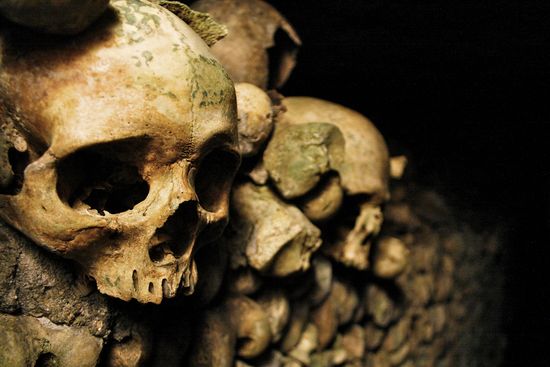
Mary Karmelek exhumes the story of the very popular Cemetery of the Innocents in Paris, in high demand for Christian burials between the 12th and 18th centuries:

While many couldn’t afford an actual plot, the majority of corpses ended up in mass graves that held around 1,500 people in each. As the corpse count climbed, several problems arose such as over crowding, putrid odors, and the supposed ability of the air in the cemetery to change the color of fabric and rot meat before one’s eyes. Further, the bodies were not decomposing as expected. For a body to fully decompose, oxygen must be present. In the case of the bodies from the Cemetery of the Innocents, the lack of enough oxygen left the bodies as mounds of fat.

The French turned them into candles and soap.

(Photo of the Catacombs of Paris which now houses the bones from the cemetary, by Flickr user Ian Wilson)

The Bible’s Many Contradicting Voices

Timothy Beal lends an ear:

Given how many hands have been involved in so many contexts over such a long time in the history of this literature, can we honestly imagine that no one noticed such glaring discrepancies? … That Gospel mix-ups concerning who saw what after Jesus's resurrection would have been left to stand? That Judas would have died twice, once by suicide and once by divine disgorge? And so on. Could all those many, many people involved in the development of biblical literature and the canon of Scriptures have been so blind, so stupid? It's modern arrogance to imagine so.

The Bible canonizes contradiction. It holds together a tense diversity of perspectives and voices, difference and argument—even, and especially, when it comes to the profoundest questions of faith, questions that inevitably outlive all their answers. The Bible interprets itself, argues with itself, and perpetually frustrates any desire to reduce it to univocality.

I'm not sure this can be deduced from a single authorial intent, because there is no single human author. If there is a Divine author, then humans will doubtless get things wrong. Moreover, we know this now for a fact. Biblical scholarship has now irrefutably shown the human forces, mistakes, politics and varying memories and interpretations that gave us the Gospels' account of the life of Jesus. It has also revealed to us many contemporaneous Gospels, of varying punch and power. We cannot pretend any more that there is one book which is inerrant and remain respectful of the Bible's deeper truths. We cannot pretend that, in the sense of nineteenth century history or twentieth centure science, Jesus is not, at some point, a mystery.

Does this mean the Bible is junk? Far from it. Does it mean we have to reject its Divine inspiration? Of course not. We just have to see it as a human document trying to convey truths and mysteries that are necessarily beyond our understanding. So the varying accounts of the Crucixion and Resurrection do not disprove either – but rather invite us to ponder the mysteries and nuances of both. Reading the Gospels in a literalist and empirical fashion is to mistake the form and the content. It is a category error, an ignoratio elenchi.

The Distraction Of Libya

Talleyrand makes some points that I wish were not true, because I know the intervention in Libya was well-intentioned, and because it is still too early to assess the result of the strategy. But I find it hard not to see the wisdom in this:

If events in Syria follow their logical course, we could see the Lebanonization of that country. A proxy war there between Iran and Saudi Arabia would most likely draw in Lebanon and Iraq and probably Israel. About the only force that could prevent or deter it would be a serious, collective threat of Western intervention, the vehicle for which would most surely have to be NATO.

Alas, NATO isn’t looking so mighty right now in this part of the world. Preventing a regional, sectarian war in the Middle East? Sorry. Too busy cataloguing tribes west of Cyrenaica. The West, if such a thing still exists, no longer does politics or strategy wholesale. No matter that, by some estimates, more Libyan civilians have already been killed or displaced throughout Libya than Barack Obama promised to save in Benghazi. Far higher numbers of casualties await further east. And Western credibility—thanks to its hasty and ill planned diversion against Col. Gaddafi—is much lower than it needs to be. Let us pray that the winds shift soon in the other direction.

Indeed. Let us pray.

Hell As Moral Compass

Kathryn Gin shines a light on why "Hell never stopped mattering in America"

[B]elievers in universal salvation did not become a majority after 1800. Instead, the Protestant orthodoxy found new ways to argue for hell’s relevance in the fledgling nation. It was a nation founded, after all, on the radical premise of republican virtue. Without a monarch to rule over the people, what would keep them in line? Hell.

Yglesias ruminates on folk hell for the American middle class:

Folk hell has two relevant features. One is that it’s really awful. The other is that being sent there is the act of a just and moral God not an arbitrary and capricious one. … [T]he rules of morality ought to be realistic and achievable. It can’t be that a just and moral God is sending 99.9 percent of the population to a fate of endless suffering in Hell. God is good, so he wants to punish the wicked. But by the same token, God is good so his definition of “wicked” must be something that most of us are able to steer clear of.

My worry is that hell in the afterlife distracts from the hell here and now. That hell, in Christian theology, is about rejecting the unconditional love of God, because we refuse to recognize it, because we feel unworthy of it, or because we are just too distracted by the passing sirens of happiness – money, fame, power, sex, the Internet – to turn to face it. This hell is now; it is why so many in such plenty are still miserable.

To my mind, withdrawing from God's unaccountable, unconditional love – and it is our choice – is what makes life hell. I know my many atheist readers will object to this, so let me state it as my belief, not as some kind of empirical fact. And if you live a life like that, why would your eternal soul be any different? The whole notion of hell as some distant, future rapping on the knuckles if you fail to observe certain rules now can work as theology and as practice. But it makes God into a recognizably human authority figure. And God, whatever else God is, is not human.

We choose to accept God's love. And that choice affects us now – and after we die. Because in Christianity, unlike Buddhism, we remain ourselves for ever.

Before The Disneyfication Of War

Jessa Crispin reviews a new edition of Eichmann in Jerusalem: A Report on the Banality of Evil by Hannah Arendt. Arendt's reporting for The New Yorker stirred controversy because she criticized  Jews for not revolting against the Nazis, while failing to acknowledge those who did. Crispin argues Arendt's faults make it essential reading today:

The Second World War has become Disneyfied into a battle of bad guys versus good guys with all nuance removed. Hell, you can’t even admit there is nuance to WWII without someone accusing you of being anti-Semitic, a Nazi apologist, or unpatriotic (after all, America single-handedly won WWII — never mind those Russian troops over there in the East). Arendt’s book is an account of someone struggling with the meaning, and lack of meaning, of Europe’s near-disintegration. Today you’d be hard pressed to find someone who thinks there is something to struggle with.

Allison Hoffman compares the New Yorker's edits to Arendt's original piece. Norman Geras has more on Eichmann.

A Poem For Sunday

Alfred, Lord Tennyson's poem, "The Dying Swan":

The plain was grassy, wild and bare,
Wide, wild, and open to the air,
Which had built up everywhere
An under-roof of doleful gray.
With an inner voice the river ran,
Adown it floated a dying swan,
And loudly did lament.
It was the middle of the day.
Ever the weary wind went on,
And took the reed-tops as it went.

The full poem is here. Josh Rothman remembers ballerina Anna Pavlova's signature dance, "The Dying Swan" from 1907:

[Pavlova] died, at 49, holding her costume from "The Dying Swan"; her last words were, "Play the last measure very softly." Following ballet tradition, the next day's show went on as scheduled, with a spotlight drifting around the stage where she would have danced during "The Dying Swan."

(Video above of Yo-Yo Ma and L.A. dancer Lil Buck performing "The Swan" by Camille Saint-Saëns, filmed by Spike Jonze. )