A Weak DOMA Defense?

This week the House Republicans announced the lawyer they've selected to defend DOMA on their behalf. David Link isn't anticipating much of a defense:

I’m not expecting a full-throated, or even croaking defense of DOMA, but rather a timid tiptoe through the caselaw that avoids as many political minefields as possible.  Speaker Boehner will be paying dearly for exactly that, making no one happy, and hopefully we’ll be rid of this troublesome piece of DOMA soon.  There won’t be much honor in winning this case against a waning, whining assailant that once commanded a majority.  But we will get one more piece of the equality we’re entitled to.  I’ll take that.

The Quiet End To Roe v. Wade?

 GT_ROEVWADE_110420

Dahlia Lithwick asserts that "for all practical purposes women can't get an abortion in Ohio, North Dakota, or Florida":

The conservatives on the [Supreme] court are much happier with the status quo, allowing abortion as a matter of federal law while the states effectively outlaw it as a matter of fact. If the states continue to hollow out Roe from the core, there will be no reason for the court to hear an abortion case ever again.

Ramesh Ponnuru is dumbfounded by this argument:

Ohio’s government reported 29,000 abortions in 2009, the last year for which data is available.

Ramesh is misreading, I think, a poorly constructed sentence. The full sentence, after detailing why the pro-choice movement has become leery of judicial challenges to state laws violating Roe, is:

The end result is that Roe remains on the books, while for all practical purposes women can't get an abortion in Ohio, North Dakota, or Florida.

My italics. The logic of the whole piece is that this is a likely future, not a present reality. But it's easy to misread. What's dismaying is that this sloppy sentence leads Ponnuru to dismiss Lithwick's entire body of work as fallacious. It's anything but.

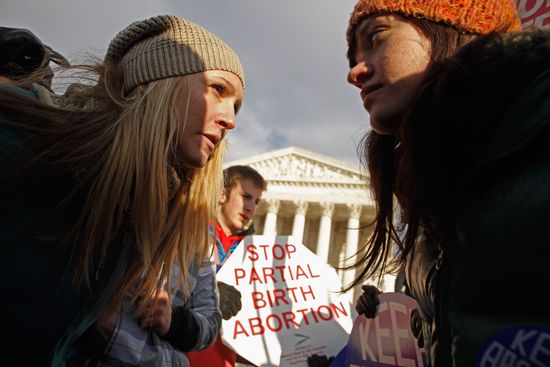
(Photo: Anti-abortion and pro-choice demonstrators argue in front of the Supreme Court during the March for Life January 24, 2011 in Washington, DC. The annual march marks the anniversary of the landmark Roe v. Wade decision by the court that made abortion legal in the United States. By Chip Somodevilla/Getty Images) 
By Tax Hikes Alone? Ctd

Megan McArdle found that balancing the budget through taxes alone "means that everyone's taxes go up by about a third." Kevin Drum argues that's no big deal:

Page 65 of this CBO document provides estimates for how much income tax various people pay. The median family gets dinged for 3% of its income. A one-third increase means their income taxes would go up by….1% of their income. That's not so much.

How about a family with twice the median income? That is, someone who's pretty well off. They pay 13% of their income. A one-third increase means their taxes would go by 4% of their income. Again, this is far from catastrophic, especially since we're talking about an increase phasing in over the course of many years.

But reading Megan closely, I'm not sure she simply meant federal income taxes alone. Perhaps the debate will clarify this some more in the future.

The GOP’s Growing Birther Problem

A new CBS/NYT poll finds that 47 percent of Republicans think Obama wasn't born in the US. Another 22 percent aren't sure. Steve Kornacki says this "doesn't mean they've thought things through and believe an elaborate plot has been carried out, and it doesn't mean that being told actual facts about Obama's birth will sway them":

Trump's message may be resonating with so many Republican voters simply because it represents the most blunt and unrelenting attack on Obama's "American-ness" that they've heard from a major Republican. In other words, it may not be the specifics of Obama's birth certificate and hospital records that excite them; it's more the idea that someone so prominent is willing to stand up and take so much heat for saying, essentially, "Barack Obama isn't one of us."

And culturally he isn't. But neither is more than half the country. And they're all citizens. Many thought America could not elect a non-white president. They were wrong. It turns out America could elect a non-white president, but only with a hefty segment of the country denying his legitimacy.

The Saga Of Lady Gaga And Weird Al Yankovich

Apparently Lady Gaga is the only one allowed to make pop derivatives. The Daily What summarizes the spat between her and Weird Al Yankovic, a sort of pop music version of Trump vs Palin:

[He] wanted to include a spoof of Lady Gaga’s “Born This Way” in his upcoming album — with all proceeds from the sale of the song and its subsequent music video going to benefit the Human Rights Campaign — but her management told him Ms. Germanotta would need to hear it first before final approval.

He sent her the lyrics, but was told she would need to hear an actual song. So Weird Al went to work producing a finished product for Lady Gaga to listen to. “Now, I never do that – never,” he writes in a blog post, “[b]ut because I was really excited about this parody, I decided I would faithfully jump through as many hoops as Gaga deemed necessary.” He cut his family vacation short and spent day and night in the studio in order to deliver the mixed and mastered track in a timely fashion to Gaga’s people.

A few days later he finally heard back: The answer was no.

So Weird Al released it on YouTube instead. Shortly thereafter, he got the go-ahead from Gaga:

Apparently the fact that she didn’t approve it was news to Lady Gaga herself! Gaga’s manager has now admitted that he never forwarded my parody to Gaga – she had no idea at all. Even though we assumed that Gaga herself was the one making the decision (because, well, that’s what we were TOLD), he apparently made the decision completely on his own. He’s sorry. And Gaga loves the song.

A Modest Proposal On Healthcare Costs

This popped into my mind last night, after reading Gregg Easterbrook's somewhat glib piece about why wealthy liberals should just voluntarily pay more to the government than the law requires them to. The more you try to figure out ways to square the healthcare costs circle – fiscally and morally – the harder it gets. But this option is easily grasped and needs no government action.

If everyone aged 40 or over simply made sure we appointed someone to be our power-of-attorney and instructed that person not to prolong our lives by extraordinary measures if we lost consciousness in a long, fatal illness or simply old age, then we'd immediately make a dent in some way on future healthcare costs. A remarkable proportion of healthcare costs go to the very last days or hours of our lives.

This seems to me particularly apposite for the boomers who, even if Paul Ryan got his way, would still be grandfathered into the most generous combination of personal prosperity and government support of any generation in history. Wouldn't a few fewer unconscious hours or days be a sacrifice worth making?

Of course, this would be entirely voluntary – and not even nudged (although, frankly, I see no reason why the government shouldn't nudge you to make arrangements ahead of time given that others will be forced to pay the costs). "Death panels!" Christianists would scream, revealing exactly how un-Christian they are. Christians, of all people, it seems to me, have nothing to fear from death, and a great deal to gain from giving a few of their own unconscious final days to make it feasible for others to have a few more conscious and healthy ones.

How about an easily reached website that makes such a legal process easier to accomplish?

How Change Really Happens

Pamela S. Karlan uses the example of Loving v. Virginia, on interracial marriage, to argue that marriage equality won't necessarily be decided in the Supreme Court:

Loving was the end point of a sustained assault on racial discrimination, and most of the troops in that campaign were not Supreme Court justices. … By the time the Court decided Loving, the vast majority of states had already repealed laws forbidding interracial marriage. Loving was decided a generation after the California Supreme Court, in Perez v. Sharpe, had used the Fourteenth Amendment to strike down California’s ban on interracial marriage. (In contrast to the California Court, the U.S. Supreme Court disingenuously dodged the marriage issue for a decade, apparently because it feared that a decision striking down bans on interracial marriage would imperil support for Brown.)

Rather than anticipating progressive social change, the Supreme Court most often reflects it.

This seems to me particularly true when the premise of certain arrangements genuinely shifts in the public consciousness. Once homosexuals became defined as people with a certain core identity rather than as people with a propensity for certain acts, a whole series of logical steps followed. My own view is that the law has largely followed this shift in underlying attitudes, and these attitudes have primarily changed simply because more straight people know more gay people. And unlike racial minorities, many of these gay people were those already known and embedded in existing families, communities and churches. How, one wonders, do fundamentalists really keep insisting that gay kids in their own churches and colleges are less aware of who they actually are than their preachers and politicians?

In one of the most tragic ironies in recent social history, this greater knowledge of gay people was accelerated by the AIDS epidemic. Our deaths remade our lives. I wonder if, without such a catastrophe – three times as many young Americans died of AIDS than died in Vietnam over a similar period of time – we would still be decades behind where we are.