If Gabby Giffords Was A Soldier …

… she might not be getting the same level of care. Peter J. Boyer underscores an injustice:

[I]n the important next phase of Giffords’ recovery—months of intensive rehabilitation aimed at maximizing her quality of life—Giffords is receiving a level of care unattainable by thousands of Americans who have been wounded on the actual battlefield. That’s because the costly treatment Giffords is receiving at The Institute for Rehabilitation and Research at Memorial-Herman is being paid for by the federal government, but such care for U.S. troops is not.

… Most military personnel … are covered by an insurance plan called TRICARE, which does not cover key elements of cognitive rehabilitation therapy. As revealed in a series of investigative reports by the non-profit news enterprise, ProPublica, TRICARE claims that the benefits of cognitive rehabilitation therapy are not well enough established to warrant providing it to troops. TRICARE bases this assertion on the findings of a study commissioned by TRICARE itself, and which ProPublica’s reporting has found to be “deeply flawed.”

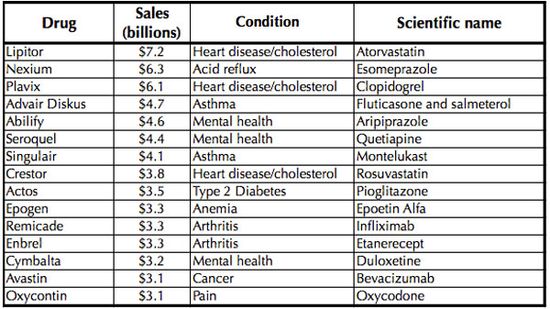
Inside Your Medicine Cabinet

Highest grossing drugs

A reader writes:

I'd like to make a couple comments about your post that I think bear correction. First, Seroquel XR has been available in the US for about four years now. Second, Seroquel XR is an antipsychotic. It's anything but an "upper". If you take one, you won't feel up in any way whatsoever. If it works at all for depression it will be because the user will not care enough to be depressed about anything.

Another writes:

This is hardly a drug that's designed to supplement an anti-depressant. It's an extended-release form of an existing anti-psychotic generally used to treat schizophrenia and acute episodes of mania and depression in bipolar disorder. While for some patients it may work to augment their existing anti-depressant regime, it's not a first-choice option and definitely does not work for everyone.

I was recently prescribed Seroquel XR to deal with a manic episode and it rendered me virtually catatonic.

I was hospitalized and switched to a different anti-psychotic that worked much better for me. It's precisely because everyone responds differently to psychiatric drugs that it's important for patients to have a good relationship with their doctors and a willingness to try various combinations to find the course of treatment that suits them best. It's no secret that drug companies try to find as many uses for their product as possible, but with mental health it's very much the responsibility of the patient to explore those options to ensure they get the best treatment.

Another:

Street Carnage doesn't know what the fuck he's talking about. I've been on anti-depressants for 8 1/2 years, requiring three hospitalizations during that time span. I have tried pretty much every anti-depressant drug you can think of, and through those years of trial and error I have experienced many peaks and valleys, but mostly valleys.

My doctor finally put me on Seroquel XR as an add-on to the Zoloft I was already taking last summer. The change was almost immediate, and in a very positive direction. It did not, as Street Carnage seems to imply, give me some sort of "high." It just provided a measure of emotional clarity and calm that I had not experienced in years. After going on the Seroquel XR last August, I became much more productive and started sleeping much better. It is now mid-April and the effect of the drug has by no means dissipated.

A psychiatrist writes:

As with many medications, Seroquel can have a wide range of effects, good and bad. For instance, it can treat tic disorders such as Tourette's Syndrome. There is some evidence that it can also work synergistically with an anti-depressant to treat severe depression that has not responded to an anti-depressant alone. Depression can be fatal, due to suicide, and so it is crucial to treat it in any way possible.

Pharmaceutical companies are notoriously deceptive when it comes to marketing their wares. However, in this particular case, I see nothing wrong with stating that Seroquel can be a useful adjunct to an anti-depressant.

Another reader:

The blog you link to about Seroquel probably has no idea that Seroquel can be used independently of other drugs, and that's it's prescribed for Alzheimer's patients.  My mother is one such case: it helps deal with her continous panic attacks.  It's not a complete cure, but using it means that, for instance, getting her to move from her favorite chair to the commode is merely slightly difficult rather than a continual fight to keep her from collapsing to the floor out of sheer fright.

A clinical professor of psychiatry writes:

The real controversy here is that Seroquel XR has been FDA-approved for new indications, instead of Seroquel.

The extended release XR has little if any added benefit for patients. It was created because the immediate release Seroquel goes generic next year (and is already generic in other countries – US law allowed the Seroquel patent to be extended because it was tested for pediatric use). The FDA should stop approving new indications for slightly modified versions of old drugs, when the purpose of the application is to provide a market for the brand name drug after the generic form is available. And we should stop granting patent extensions on the old drugs. These practices add billions to US drug costs every year without benefit to consumers.

Seroquel and Seroquel XR can be useful drugs for people who haven't responded to conventional antidepressants alone. However, they cause weight gain and can increase diabetes risk, so they shouldn't be prescribed unless multiple safer medications have failed.

Chart on the top-grossing prescription drugs in America via Alexis. 
The Daily Wrap

Today on the Dish, we kept an eye on the growing debt bubble, ideas for how much to raise taxes, and a possible turning point in Syria. We debated Trump's seriousness, Obama performed at Clinton's level, and Huckabee threw us for a loop on taxes. The Tea Party over taxes may be on the wane, and Obama's fate may be tied to gas prices. Mark Kleiman solved Mexico's drug war, Adam L. Silverman watched our withdrawal from Iraq, and BP definitely had its eye on Iraq's oil fields. The AP hounded the State Department on human rights for Wikileaks, Andrew questioned the lack of out gay arch conservatives, and reminded us this country won't be drug-free until it's people-free.

Readers assessed Harvard's value, and you can read the Harvard Magazine profile of Andrew here. We explored deafness as an ethnicity, Dave Weigel considered capitalism in all its messiness, short men gave us their dating horror stories, and a warning, don't check your device around Dish readers. Shakespeare played with our brains, Stephen Fry wanted more joy in language, babies pay attention to "uhs," and Andrew quenched his Palin thirst with some inspired fantasy blogging. Alexis dug up an amazing account of San Francisco's earthquake 150 years ago, Alex Massie celebrated name-calling in British tabloids, and Nige documented the world's adventures in bad filler. Glenn Greenwald mastered the age gap, gay marriage matters immensely for immigrants, Kate Sheppard stayed angry a year after the BP oil spill, and Linda Holmes reconciled the fact that we'll miss almost all the great art there is to experience.

Hathos alert here, endorsement of the day here, chart of the day here, quotes for the day here, here, here, and here, FOTD here, MHB here, VFYW here, and contest winner #46 here.

–Z.P.

Obama’s Slump And The Price Of Gas

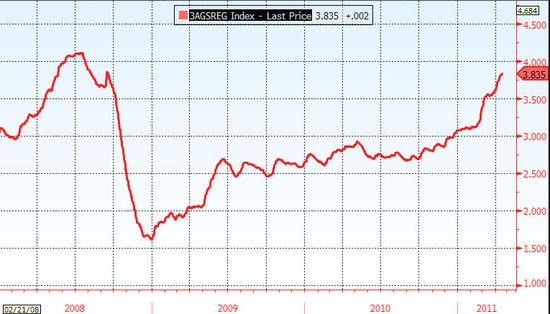
Retail unleaded

A reader writes:

I'm the chief economist of a large London hedge fund and long-time Dish reader (and proud former writer of a featured Dissent Of The Day). There's a very simple explanation for President Obama's nasty poll slump of the past month and it has nothing to do with his performance in the debate over US fiscal policy. Take a look at the attached chart of the US daily average pump price of unleaded gasoline — it's up about 70 cents a gallon, or 23%, since mid-February. At $3.84 a gallon it's just shy of the peak seen in the middle of 2008. Working Americans' disposable income has taken a very nasty hit over the past eight weeks, a hit so big it basically cancels out all the income boost from the December tax deal.

It's no mystery then that the US public's view of the economy has suddenly and sharply worsened (see today's Wapo/ABC poll, and the March drop in the University of Michigan consumer sentiment index), and Obama's approval rating with it. Depressingly, Obama is paying a political price for an economic development beyond his control, even though it is he, rather than his wing-nutty Republican opponents, who supports a rational energy policy to try to address this problem over the medium term. Given global demand and supply developments, gas prices will remain a real wild card for the 2012 election.

Missing Almost Everything

Linda Holmes reflects on an undeniable fact – that the "vast majority of the world's books, music, films, television and art, you will never see":

It's sad, but it's also … great, really. Imagine if you'd seen everything good, or if you knew about everything good. Imagine if you really got to all the recordings and books and movies you're "supposed to see." Imagine you got through everybody's list, until everything you hadn't read didn't really need reading. That would imply that all the cultural value the world has managed to produce since a glob of primordial ooze first picked up a violin is so tiny and insignificant that a single human being can gobble all of it in one lifetime. That would make us failures, I think.

Capitalism, Unvarnished

Dave Weigel reviews Mike Daisey's one-man show, "The Agony and the Ecstasy of Steve Jobs." Half the performance "is a history of Apple computers and Daisey's own appreciation of the company and its products." The other half "is an increasingly dark, increasingly painful retelling of Daisey's reporting in Shenzhen, China": 

Working undercover, Daisey saw the nets that had been erected to catch suicidal workers who jumped off the building. He met workers whose spines had started to fuse together from 12-hour or 16-hour shifts. He met 12-year-olds who assembled iPhones and iPads. As he talks, the realization grabs you — your beloved little phone was put together by a serf, and you didn't even care to find this out.

This is an unusually honest, un-cynical monologue. It is not propaganda; you don't leave it pumping your fist and calling for the end of capitalism. You leave it with a better and more honest understanding of capitalism, one that has no comfortable place in politics.

A Year After The Spill

To mark the anniversary of the BP disaster, Kate Sheppard lists ten reasons for continued fury:

Nearly three-quarters of Gulf coast residents that the Louisiana Bucket Brigade, an environmental justice group, polled this year reported health concerns that they believe are related to the spill. Of the 954 residents in seven coastal communities, almost half said they had experienced health problems like coughing, skin and eye irritation, or headaches that are consistent with common symptoms of chemical exposure. While the National Institute for Occupational Safety and Health (NIOSH) is conducting health monitoring for spill cleanup workers, residents in the areas closest to the spill are concerned that their own health problems have gone unattended.

Yglesias thinks it's interesting that "the harms are so localized, even while the benefits of increased fossil fuel production in terms of lower consumer prices are extremely diffuse."

Chart Of The Day

Chart

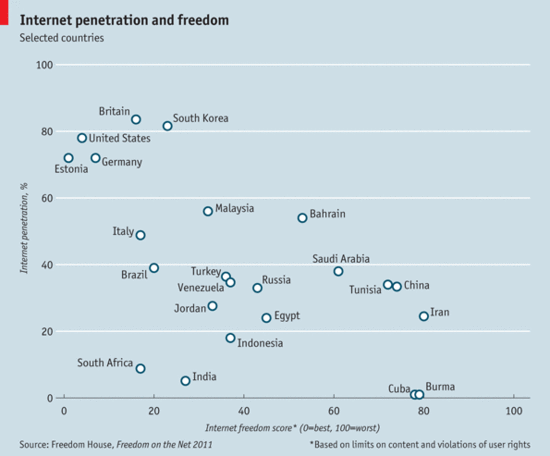
The Economist checks in on Internet freedom, via a new Freedom House report (pdf):

Nine of the 15 countries that the Washington-based think-tank assessed in 2009 fared worse this year, among them Iran, Tunisia and China. On the plus side, citizens are growing increasingly adept at sidestepping these threats to their internet freedoms, and the use of social media did much to galvanise political opposition across the Arab world in recent months. Indeed web-users in some countries, such as Georgia and Estonia, have more freedom now than they did two years ago.

I'm struck by the relatively high Internet penetration in Bahrain and Saudi Arabia. The United States' acquiescence in the brutal suppression of Bahrainian democracy is one of the least noted tragedies of the Arab Spring.