Raise Taxes. But How Much?

Kevin Drum and Jonathan Cohn want to raise taxes significantly. Ross Douthat is uneasy. He argues that "given that the last few decades have seen (as liberals never tire of pointing out) a significant increase in inequality and wage stagnation in the middle class, those relatively low [tax] rates [on the middle class] seem like pretty sensible policy to me." His bottom line: 

I think that conservatives need to accept that taxes will probably go up somewhat relative to the post-World War II average, and I have my share of problems with the Ryan budget vision. But to take Uncle Sam’s bite of G.D.P. from 18 percent to 23 percent (and beyond!) is a big, big deal, and not just a “modest increase” as Kevin Drum would have it. And if we’re going to talk about the costs of the conservative vision (as we should), we need to talk seriously about the potential costs of the liberal vision as well.

I'm kind of in the middle here. Would 21 percent do? With real defense cuts, that's doable. With dramatic tax reform, it's more doable still. Without either, I'm not so sure. The sheer scale of our healthcare commitments (and the political and moral difficulty in scaling them back) makes the choices all bad. But I'm relieved that in the reality-based community – which, sadly excludes Republican orthodoxy right now – the question of how much, rather than whether, is now out there.

A Turning Point In Syria?

Al Jazeera reports:

Syria's government has passed a bill lifting the country's emergency law, in place for 48 years, just hours after security forces fired on protesters. Tuesday's move is a key demand of pro-reform demonstrators who have been holding protests across the country for weeks.

A senior lawyer said Bashar al-Assad, Syria's president, was yet to sign the legislation, but that his signature was a formality. According to the country's official SANA news agency the government also abolished the state security court, which handled the trials of political prisoners, and approved a new law allowing the right to peaceful protests.

But it may be too little too late:

The BBC's Owen Bennett-Jones says the legal changes will be remarkable to most Syrians after decades of one-party rule, but it is unclear how much difference they will really make. The indications are that they will not be enough to satisfy the protesters, our correspondent adds. Anti-government demonstrations are reported to have begun in the north-western city of Baniyas after the repeal of the emergency law.

Brian Reis compiled many dramatic clips from the most recent round of violence. He captions the one above:

[T]wo protesters can be seen carrying the body of a third–in a blue shirt–as gunshots ring out in the background. The title explains the victim was killed in the Homs sit-in.

Drug Free, Up In Smoke

Pete Guither wants to retire the term "drug-free":

The U.S. 1986 crime bill said that we’d be drug-free by 1995. Newt Gingrich then said we’d be drug-free by 2001. And the U.N. was ultimately embarrassed by its bold claim that the world would be drug-free by 2008.

We'll be drug-free when we are people-free. Why is that so hard for utopians and Puritans to understand?

Deafness As An Ethnicity, Ctd

A reader writes:

Thank you so much for posting this link for other readers to become aware of this issue. I was hard of hearing growing up, but when I was 13 years old (with all the drama that implies of a teenage girl), I went to bed one night and woke up completely deaf. Just like that. Hearing aids no longer worked for me. What had previously been a disability for me – having to sit in front of the class at school so that I could better hear the nuns and priests, to the detriment of my social life – eventually became a whole new world that is a cultural and linguistic minority.

I attended Gallaudet University in Washington, DC, where I became fluent in American Sign Language (ASL) and learned about the "Deaf Way" and Deaf culture. I'm proud to be deaf. All of my friends are deaf. My social life revolves around deaf events and gatherings, deaf clubs, and a deaf church on Sundays. My husband is deaf. My entire career as a social worker has been focused on serving deaf clients and their family members.  It is the mainstream society that makes me feel disabled.

Another writes:

I shouldn't be pelting you with emails during a workday, but … "Being blind separates you from things, but being deaf separates you from people." The reason Deaf people marry other Deaf people?  They can communicate with them.

Capital D "Deaf Culture" is markedly closed to the non-deaf, but even more surprising is closed and in many cases actively hostile to anyone, hearing or deaf, who promotes communication in any way but ASL. There is nothing wrong with using ASL as a language, except for the fact that there is no written form. And Deaf people live and work and sign contracts in a world with written language and that written language is not ASL. Being fluent in ASL doesn't give one a command of English. Anyone using ASL to communicate must be bilingual to operate outside Deaf Culture.

Prelingually deafened children raised using ASL or another of the signed English systems (which keep trying to force ASL to be more like English) have roughly a 10% success rate at reading English (or any other traditionally spoken language) on grade level above the 4th grade. Reading the writing of the average Deaf adult is like reading an English paper written by a foreign student, as they are both writing in a foreign language. Imagine being raised speaking English and only ever learning to read in Spanish. Some do remarkably well, but the odds are stacked against them. It's extremely hard for them to succeed in standard high school and college courses when they are not fluent in English.

Some parents reject ASL to teach their kids aurally using coclear implants or hearing aids. While these help, they don't work at all in the bath, the swimming pool, or any other time the battery is dead or the device is off. For many kids it's still like watching a show when the signal is cutting out, and I don't know about you, but I give up on it after about two minutes. Now try learning a foreign language watching a TV that cuts in and out, or lipreading a language you don't know well.

Success rates with this method are dismal for profoundly deaf kids and those who don't respond to CIs, and they don't have the skills in ASL either – they're left semi-lingual, which is why Deaf Culture is (rightly) hostile to this method. The ones with residual hearing or good CI response do OK, but often you don't know for sure until after the major language learning years are over.

There's a middle way, however. A way that uses traditionally spoken languages, but incorporates a visual signal to "disambiguate" the message. It's called Cued Speech. Whereas Sign Language uses handshapes and movements to represent full words or concepts, CS is a method of using handshapes and placements around the mouth to make all phonemes of spoken language visible. It doesn't require any sound to work, just normal mouth movements coupled with one hand. It's like the difference between writing with pictograms and writing with an alphabet.

It was developed at Gallaudet in the 1960s to combat the severe problem of deaf literacy in English. Prelingually deafened children raised using Cued Speech have something closer to a 90% chance of reading on grade level. Even more, they often love to read. The young adult cuers I met back in Boston were attending MIT, BU, Brown, and Wellesley, as well as local community college – wherever their interests took them. Some used "transliterators", others the traditional CART reporting or notetakers. They needed accommodation, but not translation, in order to succeed.

The Deaf community has been quite hostile to the use of Cued Speech, which is one reason why it's only used by about 5% of deaf children in the United States, mostly on the East Coast. It is finally being included by name in disability legislation as of the last few years. The primary argument by the Deaf against Cued Speech is that it's an attempt to replace ASL and disband Deaf Culture. While that is not and never has been the goal of Cued Speech proponents, they're not wrong to suspect that it would, through no mal-intent at all, replace some or all of ASL usage because maintaining two languages is phenomenally hard work. (Although, somewhat ironically, CS allows for foreign language learning.) The other fear is that it is too much like the failed aural instruction, which has been disproven with research.

I absolutely understand the fear of losing one's language, especially one so hard fought. ASL is a beautiful language and we should work to maintain it. But the reality of using ASL to the exclusion of other methods like Cued Speech puts D/deaf children at a profound disadvantage in the larger world.
Home And Dry, Ctd

A reader writes:

I read your post about your green card with some jealousy. But today my partner, who is originally from Venezuela, received his permanent residency.  This is after years of being in limbo over the HIV immigration ban and the confusion over the new rules.  We couldn't sleep last night in anticipation of this morning's appointment with Homeland Security.  We went over his interview questions over and over: previous addresses, business history, etc.  His file is about 1.5 feet high and is very confusing.  We were worried that there might have been some mistake or detail we missed.  However, when he came out of the meeting with his passport stamped, we just cried and cried. 

We held each other and couldn't stop sobbing.  We were both so afraid that he would be denied and that we would be separated.  We've been together for years.  For anyone who thinks that the gay rights fight doesn't matter, I urge them to fall in love with someone of the same sex who is not a citizen.  There is no more profound difference of rights of committed couples than the different immigration policies for straights and gays.  I never would have anticipated the difficulty of my partner's path to becoming an American. 

But now I feel as if a giant weight was lifted off of our shoulders.  I am so thankful we will continue to be together and grateful that this is all over for us.

Blood For Oil!

This does not strike me as pertinent to the causes of the Iraq war, but it does show that the invasion was not conducted entirely obliviously to the interests of British oil companies:

Whereas BP was insisting in public that it had "no strategic interest" in Iraq, in private it told the Foreign Office that Iraq was "more important than anything we've seen for a long time".

BP was concerned that if Washington allowed TotalFinaElf's existing contact with Saddam Hussein to stand after the invasion it would make the French conglomerate the world's leading oil company. BP told the Government it was willing to take "big risks" to get a share of the Iraqi reserves, the second largest in the world.

Over 1,000 documents were obtained under Freedom of Information over five years by the oil campaigner Greg Muttitt. They reveal that at least five meetings were held between civil servants, ministers and BP and Shell in late 2002.

The View From My Blog Cave

MJ11S1

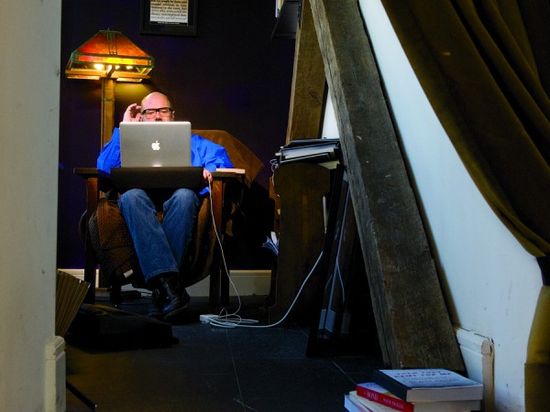
Jesse Kornbluth's Harvard Magazine profile of me is online. A taste:

Andrew Sullivan is an intellectual diva, prone to epic battles. He’s a showman; call what he does a show. But he performs in the open, without rehearsals, and he reveals everything to his readers, never sparing himself. And then, because he has an acute sense of pacing, he varies his posts with features that have nothing to do with politics, torture, or Palin.

I find these pieces hard to read, like watching oneself on TV. Jesse was a great interviewer, though. And a lovely writer.

(Photo: Jim Harrison.)