“Like Chris Christie In A Thong”

If you like da-da fantasy blogs by mordantly funny alleged 92-year-old grandmas, this account of being on the same flight as Sarah Palin is hilarious. Money quote:

She pouted for a while and then got up to go to the toilet up at the front of the plane. I pretended to be asleep, but I was wearing my sunglasses so my eyes were wide open. Just as she passed me, her entire baby-bulge moved directly downwards about eight inches and I saw the bottom of a bright green polyester cushion (with yellow flowers, no less) poke out from under the edge of her coat.

She grabbed at it and barely stopped it falling all the way out, then tried to shove it back in but only made it worse, looked around in panic and bolted for the toilet.

Todd didn’t notice and he only looked up from his game of Donkey Kong about twenty minutes later when she hadn’t come out and the steward had to knock on the door and make her come out because the plane was preparing to land.

The Donkey Kong and the "yellow flowers, no less" are pretty inspired. So is the blogger, whose post end thus:

This entry was posted in Cheap White Trash, Clean up in aisle four, Domestic Affairs, Small town life, Sullivan bait.

Taken. Kinda.

Look At Me When I’m Talking To You, Ctd

GT_RAHMONCELL_04192011

A reader writes:

Yay! Someone has said/written it: text-obsession while in the midst of social interaction is wildly rude! I've had a couple of friends and roommates who've snapped at me when I've asked them to stop texting while (1) driving, and (2) playing a game of chess. Granted, I am older than they are, and I about collapsed with laughter when one of them tried to justify his "need" to text by referencing text addiction, but I've been wondering how long it would be before someone posted on this matter. Thanks!

Another writes:

Hear-hear.  It bugs the crap out of me to speak to someone who seems to be so involved in somebody ELSE that they cannot put the blackberry away.  I've turned away from a conversation mid-sentence only to be called back as I nearly round the corner.  "It took that long for you to notice I wasn't speaking, jackass" is my usual comeback.

Another:

I work and socialize with mostly people in their 20s and, of course, the Blackberry/iPhone problem is reasonably pervasive among them. But many of them have learned to not use their phone when I'm talking with them. And it happened simply enough. All I did was stop talking as soon as they started looking at their phone. After a few seconds they'd realize what had happened and look at me again. And if they were typing on their phones I would just ask, "Are you transcribing this?"

Problem solved. Mostly.

Another:

In the nature of all backlashes, I think the backlash against checking one's smart phone is going too far. We have to distinguish between staring at a small screen and glancing. I am aware that both can be rude, but the latter is a necessity for me in two circumstances. Firstly, if my phone rings, I need to check to see who it is, as I have two young children in school, and the possibility of an emergency is very real (and has occurred, in fact). Secondly, if I have a schedule to keep, I need to periodically check the time if we're having a long conversation, as I no longer wear a watch. I try to keep this to a minimum, but it is unavoidable. Please bear these realities in mind.

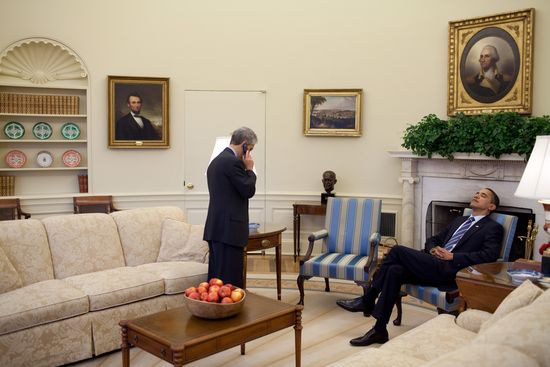
You get a pass to check the time or take a call from a child or spouse. And that's it. Last night, however, Aaron caught me in a moment of rank hypocrisy. A friend was over and I was eating some clam chowder for dinner and he was making pizza and Aaron was watching Judge Judy. As we all gathered to eat, I was hooked on one level of Angry Birds on my iPad – the Easter version! – and kept going as they started a conversation. My defense? The TV was on.  We live in a loft. No one was directly talking to me.

But I felt busted nonetheless.

(Photo: In this handout provide by the White House, U.S. President Barack Obama rests his head on his chair while Chief of Staff Rahm Emanuel talks on cell phone in the Oval Office of the White House on February 11, 2009 in Washington, DC. By Pete Souza/White House via Getty Images)

Adventures In Filler

The Great British Blogger, Nige, is engaged on a "tireless quest for soporific non-stories." A variation on Mike Kinsley's famous "Most Boring Headline Contest", it requires a smidgen more content. The latest is a fantastic effort by the BBC's Jenny Sims on the burning question "Cardboard boxes used to be free, so what happened?":

Now, I love cardboard boxes as much as the next man (or, occasionally, woman) – they are, in their way, perfect; if I was smaller, I'd happily set up home in one – but even I had difficulty reaching the foot of this piece. It comes good towards the end, though, when the burning question finally gets the obvious answer: People buy boxes online because it's easier – well I'll be darned!

Readers are invited to send in similar (non-Onion) examples if they come across them. Points will be awarded for hacks' herculean efforts to make these stories interesting.

Brit Tabloid Headlines

Alex Massie celebrates a three-fer. And one has to love the British press's way with words, especially when directed toward authority figures:

The newspaper The Observer once described Camilla as “an older woman with no dress sense and bird’s nest hair,” while other newspaper critics have said she “packs the stylistic punch of a Yorkshire pudding,” and have described her variously as an “old boiler,” “old trout,” “hatchet face” and “frump.”

S&P Reax

GT_S&P_110419

The blogosphere has had a day to digest the news. Here's Bruce Bartlett on how waiting helps the left:

[I]f interest payments as a share of revenues is the key measure of debt sustainability, then waiting until the last minute to act absolutely guarantees that only tax increases will calm financial markets. It will be too late at that point to cut spending quickly enough to reduce interest on the debt. Indeed, it would require a very large surplus to accomplish that in the absence of any rise in revenues.

Felix Salmon:

Now that the US is on negative outlook, there’s at least a one-in-three chance that the US will lose its triple-A credit rating in the next two years. Or that’s what S&P is saying, anyway. I’m not convinced: the entire S&P business model is based on the idea that creditworthiness is a one-dimensional spectrum which ranges from risk-free, at one end, to defaulted debt, at the other. If US Treasury bonds aren’t risk-free, then nothing is risk-free, and the triple-A bedrock on which the S&P ratings apparatus is built crumbles away.

Karl Smith agrees:

Anyone holding any credit is facing enormous risk from a US implosion. You can’t run away from the risk.  It may sound all hippie-like but the math supports the following assertion: a risk that is everywhere is nowhere.

 Ryan Avent:

[T]he fundamentals of the American fiscal situation haven't changed, and I'd be surprised if traders actually found themselves feeling more bearish on the prospects for American government debt as a result of the S&P's action. Eventually they will, and at that point yields will rise, and at that point Congress wil probably do something meaningful about the debt. But I see S&P as describing this process rather than influencing it.

Stephen Bainbridge nods:

This is, of course, exactly what one would expect in efficient capital markets. The fundamentals of the US financial system and its feckless political system are all well known and have long since been priced into the markets. Only new information–such as the political system suddenly becoming even more feckless, if such a thing is possible–should affect prices.

Matt Yglesias yawns:

There are two metrics to keep an eye on when assessing American debt. One is the interest rate the Treasury has to offer to get people to buy the debt. Currently that number is low. The other is the “spread” between bonds that are indexed for inflation and bonds that aren’t indexed for inflation which serves, among other things, as a gauge of market assessment of the risk that we’ll have no choice but to inflate the debt away. Currently that number, too, is low.

Krugman is on the same page. Kevin Drum is more concerned:

One of the reasons I take our medium and long-term deficit fairly seriously, even though current financial indicators suggest the market is unconcerned, is that financial indicators can turn around in a flash. There are limits to how far a big country like the United States can get from fundamentals, but we're still susceptible to the kinds of mob emotion that power both bubbles and bank runs.

Exactly. At some point, several feet ahead of the edge of the cliff, you look down and the denial disappears.

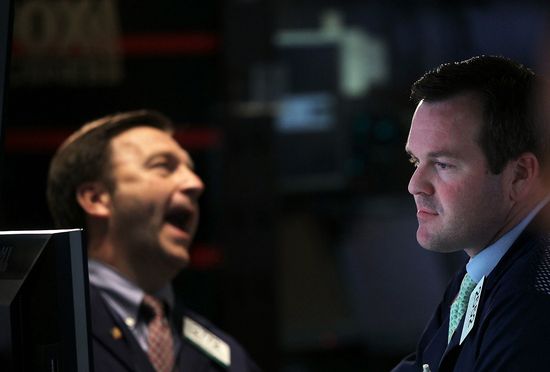
(Photo: Traders work on the floor on the New York Stock Exchange on April 18, 2011 in New York City. By Spencer Platt/Getty Images)

Will Iraq Kick Us Out?

Here's hoping. Adam L. Silverman expects the withdrawal to continue as scheduled:

I appreciate that [former US ambassador to Iraq Ryan] Crocker would like to do right by the Iraqis, I would like to do right by the Iraqis, but I just don't see any way that they are going to allow significant numbers of American troops to stay. The major Iraqi factions don't want a significant U.S. troop presence as it prevents them from settling their scores, which is what they really want to do. The Iranians that are direct patrons for Dawa and ISCI/Badr and indirect patrons to the Sadrists and the Kurds don't want it and won't allow it. They want us out of their near abroad as well. And how we've been positioning ourselves vis-a-vis the Arab Spring is making our other allies in the area very nervous too.

At some point, the neo-imperial logic of long-term bases in Iraq and Afghanistan will have to confront the 21st Century and America's bankruptcy. We should try to make the transition as smooth as we can. And when attempts to maintain a long-term presence actually weigh against a deal to depart sooner rather than later, we should drop them.

When Will The Debt Bubble Pop?

Jim Manzi weighs in on the national debt. An essential truth:

The long-term forecasts … illustrate the crucial point that we are sitting on the mother of all bubbles. Many, probably most, Americans anticipate a stream of consumption that will be provided for them into old age by the government (i.e., other taxpayers). Unfortunately, most American taxpayers do not anticipate the kind of enormous increase in taxes that would be required to pay for this stream of benefits. One or both of these expectations will not be met. Americans as a whole are simply less wealthy, in the most useful sense of rationally anticipatable future material consumption, than they think they are. And the size of this disconnect is vastly greater than, for example, the size of the housing price bubble that just popped.

Manzi argues that a real plan to address the debt "should focus on two key elements: (1) putting in place mechanisms for influencing future legislatures that we cannot command, and (2) enacting structural reforms that will simultaneously encourage general economic growth as they do this." This means, to start with:

The goal of the policymaker who wants to deflate the bubble is to make it much harder to do this than simply by passing a budget with X instead of Y dollars for some purpose. Paul Ryan is a skilled budget technician, and seems to me to have prioritized a number of features that will help to serve this purpose. This is the boring, nerdy-sounding stuff like “Create a budget point of order against legislation that would increase net mandatory spending beyond the ten-year window of the budget resolution,” and “Close the loophole that allows discretionary limits to be circumvented through advance appropriations” that form much of the guts of the plan.

These procedural impediments to spending increases seem to me to have been overlooked. Equally, tax reform as both a pro-growth item and a revenue-raising one is a two-fer of critical importance. And this is, to my mind, why the Ryan plan is in the end a disappointment. Without any plan to raise revenues, it fails both core criteria of a shared sacrifice, and engages in the kind of wishful supply-side thinking that has been disproven by the last decade.

Bill Rusher On Larry Craig

The late icon of the conservative movement wrote this on the occasion of the Minneapolis Airport restroom indiscretion:

No doubt about it, the inconsistency is toothsome. But does it really follow that Craig, and all the other supporters of family values (and there must be many) who share his weakness, or have some other weakness, are hypocrites? Isn't it possible that Craig truly regards the institution of marriage as valuable, even indispensable to society, and considers his own lapses into homosexual conduct as an unfortunate disorder – or even (if he is religious) as a sin?

These are difficult questions, and I respect the view of anyone who takes a different position. But I hesitate to condemn anyone who takes the position I have outlined above as a "hypocrite" unless he (or she) privately regards that position as false, while espousing it publicly.

There is merit to this opinion. And it is often more humane than the view that hypocrisy can always be gleaned with certainty from the outside – and thereby publicly punished or shamed. But that another key figure in the conservative movement – one thinks of Marvin Liebman, Roy Cohn, and Whittaker Chambers – might know this from the inside out, as it were, remains interesting. Interesting because there are so few gay arch-conservatives willing to make this case from outside the closet.

Why, one wonders? And does that tell us anything about the coherence of the position? Or rather, how many out gay conservatives oppose the right to marry?