“Wimpy And Gullible” Ctd

Screen shot 2011-04-15 at 3.45.57 PM

A reader writes:

Twice in the Dish last week I saw Occam's Razor being used to analyze human behavior – the French anti-veil legislation and the Trig pregnancy. I have always been taught that the Razor was essential for the scientific description of the natural world. But we humans are conniving and mendacious primates fully capable of putting forth simple explanations to cover ulterior motives in an effort to make the opinions of others work to our benefit, thus negating the assumption of Occam that Nature is inherently honest.

Might I suggest the use of the Latin maxim of "Cui bono?" instead.

Attributed to Lucius Cassius by Cicero, and I quote Wikipedia, it means "(To whose benefit?, literally "as a benefit to whom?", a double dative construction) is a Latin adage that is used either to suggest a hidden motive or to indicate that the party responsible for something may not be who it appears at first to be." In other words, when it comes to discovering the truth about human action, don't always trust the obvious "simple" explanation, but keep an eye on who has the most to gain by that simple explanation being accepted as true.

Palin, of course. A key advantage in getting her head above the crowd for a veepship was giving birth to a child with special needs. Why? Because for decades, the pro-life base has suspected that the GOP leadership just pays lip-service on the issue and doesn't believe it themselves (hence all their pro-choice wives). But by having a child with special needs – and advertizing her struggles about having one – Palin proves she is "one of us". And the news emerged just after McCain won the nomination.

Another reader writes:

There are questionable elements to Palin's birth story that can't be explained away by the idea that Palin simply embellished. For me, those are:

1) At 44, carrying a known special-needs baby, why was she under the care of a family physician, instead of a suitably experienced perinatologist or OB/Gyn?

2) Why was Trig born at MatSu hospital, which doesn't handle high-risk deliveries and doesn't have a NICU? The top hospital for these services in Alaska is close to the Anchorage airport.

3) If Palin was leaking fluids, it's simply preposterous that Cathy Baldwin-Johnson would let her board a plan without getting checked out in Texas. Indeed, that seems like something Palin might have exaggerated, having no idea that broken waters merit an immediate trip to the hospital. However, if Palin made that part up, and there wasn't a risk of infection from amniotic fluid leak, why did her doctor induce labor the next day, as she told the Alaska Daily News? If Palin's amniotic sac was intact, why wouldn't she let Trig's lungs develop some more?

There are so many bizarre details and choices that a simple request for independent evidence – something easily provided by someone who went through a special needs pregnancy – is totally legit and, in my view, it's a failure of considerable proportions for the MSM not to ask for it. Yes, I know, Palin is reckless and nuts. And that makes her delusional psyche the likeliest explanation for embellishment, incoherence and inconsistency. But she could also be lying for an obvious political advantage. Which is why I tried to find out if she has a record of such whoppers.

The list won't stop growing. Another writes:

Palin's embellishments, though, put her in a decidedly unflattering light. I've given birth to three beautiful children. I know childbirth. I'm sure you've heard this from other readers: this woman was grossly negligent if the story she tells is true. From failing to get checked at a hospital in Dallas to the final drive past hospitals in Anchorage, she put her child's health in great jeopardy–if the story she tells is true.

So why is she making up lies that any person who's been through a childbirth class would know was taking risks with an unborn child? How self-centered does your psyche have to be if you can't hear what you're saying and realize other people will think it makes you look bad? Can she really only look at her story and think it makes her look like "super-woman?"

Doesn't she realize under several laws that have been passed around the country, had her "Wild Ride" ended with the injury or death of that baby, she could be prosecuted? I don't know what the truth is. I pray the Wild Ride is really a lie because I can't believe any woman would go into pre-term labor with a special needs child, take those unnecessary risks, and then brag about it.

Reality Check

Jack W. Germond dismisses the early presidential polls. He says that for "political professionals the single most important finding is what is always called 'the wrong track number,' derived from the standard question used for years: 'In your opinion, is the country (or state) headed in the right direction or off on the wrong track?'":

If [the wrong track] number is rising above 50 percent and beyond, incumbents are in trouble. In the immediate aftermath of the first Gulf War in 1991, the wrong track number was below 20 percent and George H.W. Bush seemed a sure thing for a second term. But it rose steadily in 1992 to reach above 70 percent in some surveys, and Bush finally carried only 38 percent of the vote as an incumbent.

The president's approval numbers have also taken a 5 point tumble over the last month. I wonder if his rather transparent deferral of courage to the GOP on the debt has anything to do with it. My own view is, unsurprisingly, un-Krugmanesque. If Obama seeks to win re-election by playing on fears about cuts in Medicare, he'll falter, because people know the crisis is real. Best to stick with the message of fairer debt reduction, shared sacrifice, and some real Medicare cost-cutting that doesn't simply rely on the bend-the-cost-curve experiments whose success is as yet unprovable.

More Empire, Please

GT_IRAQIARMY_04182011

At some point, it always comes to this in an American intervention:

Iraq is almost defenseless. That makes it easy prey for Iran, its historic rival. This doesn't mean that an Iranian invasion is likely. Yet Iranian bullying and influence-peddling is going on all the time, and if Iraq can't defend its borders, Tehran will have an extra element of coercive leverage. Under these circumstances, leaving Iraq entirely would be an act of folly.

We are still in Kosovo, South Korea and other post-conflict zones that are far more stable. We need to be in Iraq too. We don't need to keep 50,000 troops there, but a continuing presence of 20,000 military personnel, as argued by military analysts Frederick and Kimberly Kagan, would seem to be the minimum necessary to ensure Iraq's continued progress.

It would also make possible an Iraqi-American alliance that could become one of the linchpins of security in this strategically vital region. Having active bases in Iraq would allow us to project power and influence, counter the threat from both Iran and al Qaeda, and possibly even nudge the entire Middle East in a more pro-Western direction.

That's the latest Boot, to which a military source responds:

I know Max fairly well and think he’s a genuinely decent fella.

I also believe him to be absolutely delusional and blind, lock-stepped neocon. The presumption that we could simply do this sort of thing (and that the Iraqis would “ask” for this without considerable coercion) is comically short-sighted. But to think that the Sunni/Shiia/others might be tamed or otherwise calmed simply by continuing our presence there is dangerous.

Wouldn't a complete US withdrawal – as promised – actually be more help for our cause in the region? It would reveal our non-imperial motives, and help add legitimacy to the much more profitable pro-democracy training we've been quietly doing around the region. As for Iran, its rise was made partly possible by the Iraq fiasco. There's no undoing that now.

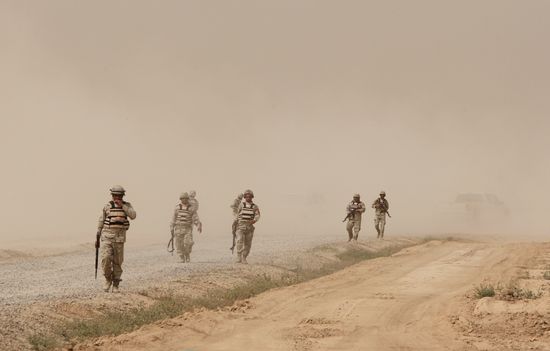
(Photo: Iraqi soldiers walk during the start of the Lion's Leap Operation, a joint US-Iraqi service exercise to demonstrate the Iraqi Security Forces' ability to provide for the security of the Iraqi people and maintain stability throughout the region on April 18, 2011, in Basmaya base, south of Baghdad. The operation which will continue on for the next ten days in different regions of Iraq will consist of Iraqi troops on the ground and US F-16 fighter planes in the air. By Ahmad Al-Rubaye/AFP/Getty Images.)

The Signal From The S&P

It seems clear enough to me: you cannot wait till after 2012. Credit markets are fine, until they aren't. We are skating on ice as the weather slowly warms. By their nature, cracks emerge suddenly and unexpectedly. Ezra:

The upside of the S&P’s move, of course, is that it makes an eventual downgrade less likely. The more external pressure Washington has to act, and the more it fears the consequences of inaction, the more likely it is to actually do something. This “negative outlook” is the sort of thing that builds pressure. Same for PIMCO’s decision to flee the market for Treasurys. As the market sends more and more of these warning shots, it becomes likelier and likelier that Washington will actually act. S&P is an observer here, but it’s also a player, and everyone knows it.

Look At Me When I’m Talking To You

I've gotten progressively ruder with my friends, who, even when just hanging out in the evening, keep their iPhones and Blackberrys in their hands. David Carr memorably described the phenomenon at the South By Southwest Interactive conference:

Once the badge-decorated horde spilled into the halls or went to the hundreds of parties that mark the ritual, almost everyone walked or talked with one eye, or both, on a little screen. We were adjacent but essentially alone, texting and talking our way through what should have been a great chance to engage flesh-and-blood human beings. The wait in line for panels, badges or food became one more chance to check in digitally instead of an opportunity to meet someone you didn’t know.

I understand the desire to check your email, stocks, Facebook wall, OKCupid or Grindr message in those moments when you simply have to walk or sit on a train or scarf some lunchtime Chipotle. But when you are actually among people you know, the act of glancing down at your mobile device is simply bad manners. It states absolutely that your current interaction is not as important or as interesting as any number of online connections. It's rude. And it misses the point.

The point is that these devices can enhance your social life, not replace it. And yet they seem like cuckoos in our social nest. I know I'm not one to talk. I communicate directly with probably ten times the number of people online that I do by face or physical presence. (Summers in Provincetown change that ratio dramatically, thank God.) But I try not to do both at once.

Is that so hard? Are you that addicted?

The Case For Cluster Bombs

Qaddafi's forces are now using these diffuse weapons in civilian areas. They often don't explode on impact and therefore pose a danger to the surrounding public for years after firing. Nonetheless, Andrew Exum has a qualified defense of them:

I understand why the United States is not a signatory to the Convention on Cluster Munitions — just as I understand why the United States is not a signatory to the Ottawa Treaty on land mines. … [C]luster munitions have their uses in combat. In defensive, conventional warfare — such as the kind of warfare the United States and its Korean allies prepare for daily on the Korean Peninsula — cluster munitions and land mines would be terribly useful. I certainly would not want to take either weapon system off the table for commanders there. (Plus, cluster munitions are getting smarter.)