Between Ryan and Obama

I see Krugman is all moist-for-Obama again, with a little illicit dig at Brooks:

The president, we were told, was being too partisan; he needs to treat his opponents with respect; he should have lunch with them, and work out a consensus.

He senses a "progressive" majority for higher taxes on the rich, maybe a VAT, cuts in defense, and an end to tax deductions in order to save Medicare and Medicaid from the chopping block – and wants Obama to wait to campaign on them in 2012. The worry about that is precisely that it would mean few fundamental changes to the entitlements that remain on a trajectory to make any viable, solvent government close to impossible.

On the other hand, is the GOP really asking 90 year-olds to pick and choose between various private insurance policies, none of which, if the subsidies keep slowly growing less than the price of healthcare, will come close to providing their needs?

Is it really so tough to come up with the obvious compromise:

end all tax deductions (including the cirporate and middle class ones, but excluding charity), let the Bush tax cuts expire in their entirety (including those earning under $250,000), cut defense, raise the retirement age (with exceptions for manual labor), intensify and speed up the cost-control experiments in the ACA, and offer the elderly a Ryan style cut off – but more generously subsidized than he currently intends – and taking place in five years' time so we do not let the boomers off scott-free? (In my dreams, I'd add a gas tax. But that's far too win-win a proposal to get through the American political system.)

I've been mulling these choices over. I'm uncomfortable with either the full Ryan or the full Krugman. Which means, I think, my main problem with Krugman is that it fails to act now. And my main issue with the GOP is that it fails in any serious way to raise revenues.

Optimum Distraction?

Conor Friedersdorf does his best work at coffee shops:

Put in a silent room before a blank page, it's almost impossible to write. Neither is it be ideal to work near a television set that keeps drawing one's attention or a room where a child keeps interrupting. In a coffeehouse, its rare for someone to intrude on the space of a patron with an open laptop and a look of concentration. Still, there is just enough conversation and foot traffic in the background that you're forced to semi-consciously tune it out.

I feel exactly the same way. The Dish often comes together in a Starbucks, where the bustle of caffeination helps take the edge off silence. Silence requires distraction, via Angry Birds or (my personal tic) playing around with Google Maps. Not-quite-silence stills these stirrings.

Ghettoized Christianity

In reviewing Soul Surfer, Andrew O'Hehir argues that Christian movies aren't getting any better:

At the risk of offending many people in many different directions, Christian cinema reminds me of gay cinema. If, that is, gay cinema were permanently stuck in 1986, with a self-ghettoizing mandate to present positive role models for youth and tell an anodyne but uplifting story that sends a message of hope.

The Writing On The Walls

Jonah Lehrer explains why your surroundings matter. From a 2009 study that tested cognitive tasks in red and blue rooms:

When people took tests in the red condition – they were surrounded by walls the color of a stop sign – they were much better at skills that required accuracy and attention to detail, such as catching spelling mistakes or keeping random numbers in short-term memory.  According to the scientists, this is because people automatically associate red with danger, which makes them more alert and aware.

The color blue, however, carried a completely different set of psychological benefits.

While people in the blue group performed worse on short-term memory tasks, they did far better on those requiring some imagination, such as coming up with creative uses for a brick or designing a children’s toy out of simple geometric shapes.  In fact, subjects in the blue condition generated twice as many “creative outputs” as subjects in the red condition. That’s right: the color of a wall doubled our imaginative power.

The Economics Of H2O

5528593758_cc05248691_b

Charles Fishman explains why “free” is the wrong price for water:

[R]esources that are free are wasted; there’s no incentive to learn to use them smartly; there’s no money to maintain and modernize the existing water system; there’s no incentive to reach back and protect the source of something that’s free. If it’s free, the message is that it’s unlimited.

In the U.S., we spend $21 billion a year on bottled water. We spend $29 billion maintaining our entire water system: the pipes, treatment plants, and pumps. We spend almost as much on crushable plastic bottles as we do on our most fundamental infrastructure system.

(Photo by Flickr user John K)

Why The Innocent Confess

In studying 250 cases of the wrongly convicted, Brandon Garrett explains why we should sometimes be wary of detailed confessions:

Of those 40 exonerees who confessed, for instance, 14 were mentally disabled or borderline mentally disabled, and three more (at least) were mentally ill. Thirteen of the 40 were juveniles. All but four were interrogated for more than three hours at a sitting. Seven described their involvement in the crime as coming to them in a "dream" or "vision." Seven were told they had failed polygraph tests. Like [Frank] Sterling, all of them waived their Miranda rights. Despite all these hints that their confessions were lengthy and coercive, and despite the fact that they were mostly vulnerable individuals, none had any luck challenging their confessions before trial. The confessions were thought to be such powerful evidence of guilt that eight were convicted despite DNA tests at trial that in fact excluded them as the culprit.

The Recovery Rides Coach, Ctd

Screen shot 2011-04-18 at 3.03.58 AM

A few readers nicely complement Reihan's conclusion on Fung Wah's influence on the marketplace. One writes:

I just wanted to put some of the complaints about the Chinatown buses in perspective.

While Fung Wah's safety record really does cry out for better regulation, the rest of the complaints about curbside service can easily be outmatched by Greyhound's pitiful service. The last time I rode Greyhound, it first took me forever to find the gate in the unmarked labyrinth of the Port Authority, and once there I found they'd oversold my bus by a long shot. About 30 of us had to wait two hours in the station, because apparently one bus was caught in traffic (an hour late) and the driver of another just hadn't come in that day (I guess that's a privilege Greyhound's drivers' unions have earned them) . The day only got worse after I was on the bus when the replacement driver started to get lost, and angrily shouted at people offering directions. She also shouted at me and threatened to kick me off the bus when I called my out-of-town guest and explained (in hushed tones) why I would be three hours late to our rendezvous. That day was the most frustrating, humiliating, enraging experience I've ever had traveling (which is saying a lot).

In Chinatown, by contrast, if you miss one bus there are two competitors fighting for your business down the block, leaving five minutes later, and another arriving from that same operator in 15 minutes anyway. My fellow passengers on Chinatown buses have been no more or less weird or numerous than on Greyhound, but honestly I'd be happy to carry some lady AND her chicken crate on my lap if I could have avoided my nightmare day on Greyhound.

As for the people complaining about the curb space they block: are you kidding? Intercity bus transit is the most space and fuel-efficient use of the roads possible! A bus with 60 passengers needs as much space as maybe three or four cars while parked, and maybe 1.5 while going highway speeds. If they're parking illegally, I'm sure they are ticketed just like anyone else, and I'm sure they set aside cash to pay the fines. That driver complaining about the bus blocking a lane ought to be thanking those people for not clogging the road with another 60 private space-hogs like his own car.

The bottom line is that Greyhound is a bloated, lazy, bureaucratic fat cat only now being whipped into shape by some much-deserved, if imperfect, competition.

Another writes:

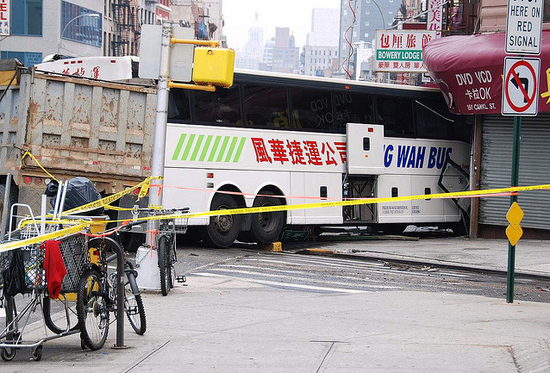
The horror stories you've heard are no exaggeration. Imagine my surprise the first time I rode Fung Wah when we arrived in NYC to find the bus ahead of us rammed halfway into a jewelry store. I wish I still had the camera phone picture to prove it. So yes, Fung Wah & Co. do illustrate some dangers of unregulated free market capitalism, i.e. cutting corners on consumer safety.

However, they do illustrate at least one benefit of the free market. Their ridiculously low prices forced Greyhound, who was incredibly overpriced for the same routes, to be more competitive. After they had no luck with litigation against the Chinatown buses, Greyhound opened up BoltBus, a bus service with much better quality standards and comparable prices to Chinatown, with free wifi to boot. I've been on BoltBus and it's great.

So while the Chinatown standard itself isn't exactly a shining beacon of the wonders of capitalism, there is no denying the indirect positive impact that those buses had on the marketplace.

Another:

The complaints that you've been posting about the Fung Wah bus service are worthy of a spot on www.whitewhine.com.  What did these people expect from a dirt-cheap service?

(Photo of the aforementioned Fung Wah crash by Flickr user Filippo Diotalevi. Details, including one fatality, here.)

Real World Skills

Scott Adams contemplates something he's labeled the Education Complexity Shift:

Today, life is more complicated than school. That means the best way to expand a student's mind is by teaching more about the practical complexities of the real world and less about, for example, the history of Europe, or trigonometry.  I'll pause here to acknowledge that both history and trigonometry are useful for students who plan to become historians or rocket scientists. For the other 99.9% of the world, little from those classes will be retained. The only benefit from much of what is taught in school is generic training of the mind, and for that we now have a better and more complicated option: the real world.

Giving All, Ctd

Loveyou

A reader writes:

My mother gave me The Giving Tree during my sophomore year of college. I knew and loved the book but was slightly embarrassed to receive it from her at age 20. I rarely called home at that time. I even stayed with my girlfriend's family when she and I returned home for the holidays. My father had left when I was four. When Mom remarried she quickly became a diplomat in a makeshift family. She graduated college with a 4.0 GPA when I was a teen, but never missed a basketball game, band concert or school play. Only now – eight years later and still a zombie on the phone – do I realize the significance of her buying me The Giving Tree. You've put a lump in my throat.

Another writes:

I am a businessman, the father of a 13-, 11- and 9-year-old, and I cannot read The Giving Tree without choking up.  I think there are several reasons:

The child’s dreams end in disappointment, and he becomes a lonely, failed old man.  I think it’s a rare person who doesn’t see a little of himself there.  I also fear for my children, so fresh and young, with everything in front of them.  I would do anything to protect them from ending up like this child.

The tree loves the child unconditionally, sacrifices everything for him and always sees him as the child he was.  This is awe-inspiring.  I’m not religious, but if I believed God loved me, this is how I would imagine it.  I believe the man knows he doesn’t deserve it, which makes it even sadder.

In the end, the message to me is that our time is brief, much of what we do isn’t very meaningful, and we fall short and disappoint ourselves, but that we can still be graced by an overwhelming love that we haven’t earned.  This gets me every time.

(Photo: Graffiti spotted in Brooklyn)

Deafness As An Ethnicity

Margot Sanger-Katz speaks to Harlan Lane, psychology professor and one of the authors of People of the Eye: Deaf Ethnicity and Ancestry:

Deaf people marry deaf more than any other minority. I think that’s very significant. It just shows you how inept the concept of disability is for these people, because people who are blind as a rule do not want to marry other blind people. People in wheelchairs do not seek other people in wheelchairs. I mean, there may be individuals who do, but as a cultural norm, it tells you that something is up here. And what’s up is the value placed on being deaf.