What The Internet Makes Possible

Jamie Holmes reviews Duncan Watts' Everything Is Obvious:

Watts is at his best when exploring the Internet as a tool of sociology. Previously, it has been nearly impossible to study things like how people influence each other, because it’s extraordinarily difficult to track such interactions using randomized trial experiments. For the first time, the Internet now allows us to do exactly that, fairly cheaply and at massive scale. Watts hopes, in what in many ways should have been the true thesis of the book, that “by rendering the unmeasurable measurable, the technological revolution in mobile, Web, and Internet communications has the potential to revolutionize our understanding of ourselves and how we interact.”

The Kids These Days, Ctd

Mat Morgan from The American Red Cross e-mails a response to this Dish reader:

Our recent survey includes surprising results on how youth understand the rules of war, and we are grateful for the high interest and debate these results have spurred about the importance of these rules and values. We would like to emphasize the American Red Cross position on these findings and also clarify survey methodology. Many media outlets and blogs have provided their opinion on the meaning of the results. However, as characterized in our press release, our take-away is a simple one:

1) Only 1 in 5 American youth understand these rules, which are extremely relevant to current events.

2) Many don’t even know that they exist. By contrast, 4 in 5 youth – the vast majority – would like schools to teach students about International Humanitarian Law before they can vote or enlist in the military.

3) Youth can learn about the dilemmas in war through exposure to the free, nonpartisan Exploring Humanitarian Law (EHL) curriculum. This high school curriculum is used in all 50 states, but to reach more schools, we ask for help in promoting this curriculum to local teachers.

In response to discussion about our methodology, the survey was conducted and reviewed thoroughly by ORC International. It is important to point out that the statistical difference between 51% of adults who believe that torture is sometimes or always acceptable and 59% for youth is significant at the .01 level, based on a z-test of differences of proportion. This is only one statistic from the survey, and we encourage discussion and analysis of the full survey results.

Face Of The Day

112214463

Ben Quilty's Archibald Prize winning portrait of Margaret Olley is seen at the winners announcement for the Archibald, Wynne and Sulman Prizes at the Art Gallery Of NSW on April 15, 2011 in Sydney, Australia. This year saw 798 entries for the Archibald, 810 for the Wynne and 633 for the Sulman Prize, with 41 finalists making the shortlist for this year's Archibald Prize. By Brendon Thorne/Getty Images.

LGBusTed

A reader writes:

You wrote: "Every now and again, you see how acceptable cruelty and approved stigma is uniquely reserved for LGBT children." Ahem. Need I remind you, you once derided "LGBT" as a "Croatian-sounding acronym" and said:

Many professional 'LGBT' activists are so marinated in far-left ideology they do not even see this. That's why I don't use the term LGBT. It's crude and dumb and as ideologically loaded as the previous attempts by the left to coopt language, like 'queer.'

And just last October you allowed your readers riff at length on the "BLT community." An explanation of your change of heart on the term "LGBT," or else acknowledgment of a slip-up, would seem to be needed now.

Yes, I relented, even though I hate the term. I relented because the question at hand could actually mean the kid is gay, bi, lesbian or transgendered. And LGBT is a shorthand for that in a blog-post. On many political questions, however, this conflation is simply p.c. On marriage, for example, there is only discrimination if you marry someone of the same gender. Some bi and transgender people happily marry the opposite gender and are not ipso facto excluded the way gays are.

The Recovery Rides Coach, Ctd

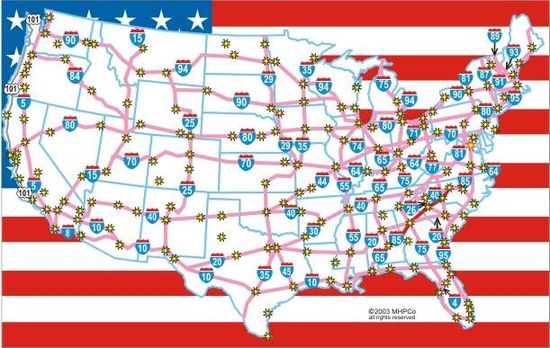
USA_Interstate-85

Several Dish readers felt that Reihan Salam's article on the Fung Wah bus company glossed over the company's spotted safety record. Reihan responds:

[M]y point was that while Fung Wah was an innovator in this space, it has been followed by better-capitalized corporates that, as it happens, have a much stronger safety record. This is an important thing to remember about about competition: a mom-and-pop can have a great idea, but this great idea will soon imitated by others who will do their best to out-execute the first movers.

Touché. Another common criticism from readers:

It's not "either entrepreneurs start stuff and help the economy" or "government invests" – it's both. Fung Wah is a great story, but they didn't exactly rebuild the highways they're driving on. 

Another:

As a resident of an East Coast city, I applaud the success of Fung Wah and the business model of cheap city-to-city bus travel. Fung Wah, along with companies like Megabus, MVP and BoltBus, have made DC-BOS travel extraordinarily affordable and heavily patronized.

But, come on, is Reihan really knocking public infrastructure investment in rail? Would Fung Wah have been able to achieve this level of success without President Eisenhower's championing of the National Interstate and Defense Highways Act of 1956 and the trillions we have invested in upgrading and maintaining the system in the decades since?

I am often skeptical of public investment on bells and whistles, but it seems that an investment in our passenger rail system to make it capable of handling more traffic and moving people faster – much like adding lanes to an interstate highway – would lead to more patronage, more revenues for the carrier, and, eventually, a success story along the lines of Fung Wah.

And to ignore how much we've put into our highways versus what we've spent on rail is disingenuous. Government investment of tax dollars in infrastructure is precisely the type of investment the only actor who has the power of eminent domain should be making.

Another:

While Amtrak and the airlines do receive direct subsidies, the discount bus companies wouldn't be able to operate without significant government spending either. Fuel taxes only pay for a part of the costs of the roads that the buses use – the amount is debatable but it's under 50%.

Furthermore, buses are some of the most damaging vehicles to the roads, and since the maintenance costs of roads are in proportion to the damage, buses do more of the wear and tear than they pay for. Engineering tests conducted by  the American Association of State Highway and Transportation Officials (AASHTO) in the 1950s established that damage to road surfaces scales as the *fourth* power of vehicle axle weight, and a 44,000-pound bus easily does 15,000 times as much damage to the road as even a large car. Buses pay more than cars in registration fees, but not 15,000 times as much.

Finally, the Chinatown buses got their start – and some still operate this way – by loading and unloading curbside in Chinatown neighborhoods. This worked well when the buses were relatively unknown, but if scaled to the passenger volume of, say, Amtrak, it would involve substantial use of valuable city curbside space without paying for it, space that could also be used for parking or travel lanes or loading zones, and so forth.

Who Would Insure Seniors Anyway?

It's a good question about Paul Ryan's Medicare plan, isn't it? Without a mandate, as in the ACA, the insurance companies have no requirement to bring the sickest and most expensive customers into their insurance pools – and no incentive. In fact, the experience of Medicare Advantage would seem to prove that this is a non-starter.

The more generous system brought insurance companies back to the table, but ended up spending 14% more per patient than regular Medicare in the process. "In theory the idea of a more competitive market would have a lot to recommend it," MIT economist Jonathan Gruber told TPM, "But in fact it just simply hasn't worked. We have the example, we've lived it, it's Medicare Advantage, and it hasn't worked"

Yglesias piles on. Even Ed Morrissey sees the long term problem:

[A] $15,000 voucher in 2014 that sufficiently subsidizes an insurance plan may fall woefully short in 2020 when the costs become more apparent.  Better insurance also runs the risk of overuse that will drive up provider costs as well, just as it does now in the non-senior health-care sector.

The best system overall for the US is one that gets third party payers out of the way of pricing signals, but on senior care, that’s almost certainly a political impossibility.  Ryan’s plan works best to get cost control in the government portion of health-care financing as a transition from single payer, but it may not be a viable long-term solution, either.

Rick Santorum Meets Langston Hughes, Ctd

As a reader suggests, "Let America Be America Again" is a somewhat better campaign slogan for Santorum than, say, "Google Me." Another prods me to re-read the whole poem by the homosexual Negro poet. Yes, it's quite something. And not quite what Santorum usually represents:

O, let America be America again–
The land that never has been yet–
And yet must be–
the land where every man is free.

What If The Standard Operating Procedure Sucks? Ctd

A reader writes:

I'm the father of a 7-year-old boy and a 4-year-old girl.  I've watched that video a couple times.  I don't have a strong stance on the TSA controversy.  I pretty much agree that it's all theater and probably doesn't really make us safer. But as a father watching that video I have to wonder: am I the only parent that thinks this is a whole lot of something about nothing?  

The woman seems to be doing her job professionally.  She doesn't in any way touch the girl inappropriately.  And the story of how the girl was in tears following the pat down seems bogus to me.  If she was in tears, it was because the parents were overreacting and made the situation worse than it was.  A child that age would have no idea that she was "violated" in some way from what I saw in the video.  

Does she feel violated after seeing a doctor?  A doctor may have more education than a TSA agent.  But a doctor touches children in much more intimate and potentially violating ways.  A person puts on a white coat and hangs a degree on their wall and most people are fine having their naked bodies touched and fingers inserted into any body cavity.  We are OK with this because we know it may save our lives or at least help us get over some malady.  Certainly the privacy of a doctor's office makes the situation somewhat different.  But my guess is the child would be even more traumatized, or at least the parents would be, if they rushed her off to a small room and did the pat-down in private.  

The pat-downs may indeed be theater.  But the parents posting this on YouTube and going on all the morning talk shows is theater too.

Why Does Trig Matter?

Jonathan Bernstein is exhausted by the story:

I've said this before: imagine the worst rumor you've heard about this story is true. Now, honestly: does that really change your view of Sarah Palin's worthiness to serve in high office? Does it change your view of how seriously we should take her policy pronouncements?

To whom is Jonathan speaking? For most educated non-wing-nuts, at this point, this is indeed merely a matter of house-keeping – especially if she doesn't run for president. But for her base, this kind of deception, if true, would be pretty damning, perhaps the only thing that could shatter the cult. And for the media, it is a fascinating moment of collective restraint. Why is this – like no other – question out of bounds for resolution? And why is that the media's fault, rather than Palin's?