Qaddafi Must Go, Somehow

GT_MISURATA_04152011

Cameron, Sarko, and Obama collectively authored an op-ed on Libya that asserts "Qaddafi must go and go for good." Greg Scoblete makes the obvious rejoinder:

Nowhere in the article, however, do they explain how they intend to bring about his downfall. The leaders state that unseating Gaddafi was not the point of the mission, but then declare that the NATO mission will not end unless and until Gaddafi steps aside. So it's only natural for people to point out that there is a rather glaring mismatch between means and ends here. Why harp on the fact that the goal is Gaddafi's departure if you're not going to take the necessary steps to hasten him to the door?

Or even taking the humanitarian intervention at face value, how does an air-campaign prevent the use of clusterbombs in urban areas? Or GRAD rockets?

The toll of the GRAD rocket strikes also framed the ways in which civilians in this war are forced into vulnerability. Misurata has few open markets, almost no electricity and limited supplies of food. To eat, many residents must stand in bread lines.

One of the rockets that landed in Qasr Ahmed exploded beside one of those lines, killing several people waiting for food. “I jumped onto the ground when the explosions started,” said Ali Hmouda, 36, an employee of the port. “My friend did not. His head came off.”

This is not to say that NATO or the US should adopt a mission of regime change. Just that the not-intervention in a not-war could go on for quite some time.

(Photo: Libyan men make the V-sign for victory as they stand on the deck of a libyan ship arriving from Misrata to the port of Benghazi on April 9, 2011.  By Mahmud Hams/AFP/Getty Images.)
Education For Its Own Sake

Freddie DeBoer rejects these types of calculations:

To see an education, college or otherwise, as merely a way to increase the amount of money you make is a terrible corruption and fundamentally unsustainable. Education was never intended that way, and it cannot succeed on those grounds.

If learning is not for its own sake, it isn't liberal learning. It's a utilitarian calculus for material self-advancement. The important things are not worth knowing because they are useful. They are worth knowing because they are true.

Mental Health Break

A close friend of the band writes:

Not many fans of MGMT know this, but their song "Kids" is in fact loosely based on The Giving Tree.

Money quote:

Control yourself.
Take only what you need from it.
A family of trees wantin',
To be haunted. 

The story behind the unofficial music video, which became a YouTube mega-hit, is here. (The official music video, seen here, is an anti-MHB.)

Down With The Queen!

Johann Hari is suffering through the run-up to the royal wedding:

We live with a weird cognitive dissonance in Britain. We are always saying we should be a meritocracy, but we shriek in horror at the idea that we should pick our head of state on the basis of merit. Earlier this month, David Cameron in an interview lamented that too many people in Britain get ahead simply because of who their parents are, and said it was a scandal. A few minutes later, without missing a beat, he praised the monarchy as the best of Britain. Nobody laughed. 

I confess that this queen is not so into that Queen. But the incoherence of the monarchy is perhaps one reason it endures. It just is. And to have a family represent a nation is a brilliant formula, and avoids the Brits getting the knickers on a twist over, say, flags. Johnnie Freedland explores the whole dichotomy in a lovely essay in the current NYRB. This gets to the nub of the obsession, some kind of fusion of patriotism, celebrity and tradition:

For many, the royals remain the ultimate soap opera, a family saga that, like the best of the genre, seems to have gone on forever. Ian Jack recently recalled in the Guardian the conversation he and his wife had on returning from seeing The King’s Speech:

“So how many brothers did George VI actually have?”

“Well, there’s Edward the Abdicator and there’s the other one mentioned in the film—John, the one we never used to hear about, who had epilepsy and died young. And then there’s a couple of dukes, Kent, the one who died in the air crash, and the other one—Norfolk?”

“You mean Gloucester,” my wife said, and so I did. Norfolk is the Catholic duke who lives in Arundel; he has nothing to do with it. “But George VI had a sister, too. A total of five brothers and a sister is what I remember.”

“Princess Marina?”

“No, I think Marina married Kent.” She looked towards the ceiling like a spiritualist. “I’m getting the name the Hon Angus Ogilvy here. Whoever he was or is, he’s mixed up in this somewhere.”

Its like Trivial Pursuit for an entire country. And we just cannot rid ourselves of it.

We Lost The Drug War

Wire creator David Simon asks politicians to admit the obvious:

You talk honestly with some of the veteran and smarter detectives in Baltimore, the guys who have given their career to the drug war, including, for example, Ed Burns, who was a drug warrior for twenty years, and they’ll tell you, this war’s lost. This is all over but the shouting and the tragedy and the waste. And yet there isn’t a political leader with the stomach to really assess it for what it is.

On this, and on so much else. Humankind cannot bear very much reality.

(Hat tip: Damon Root)

Deep Thought Of The Day

Bears

A reader writes:

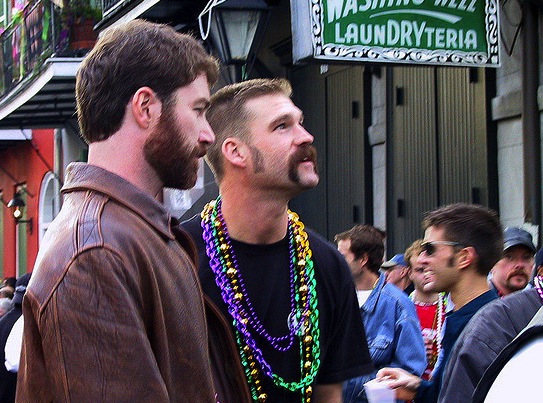
Your most recent gratuitous beard shout-out (while discussing the still-potent myths of the Civil War) has finally prompted me to ask you something I've wondered about for a while now: 

Should bears' fascination for beards be considered the counterpart of straight guys' fascination with breasts?

In some respects, yes. Beards are a somewhat crude and physical marker for maleness. They are literally testosterone-driven. To sexually fixate on maleness qua maleness is a little like fixating on femaleness qua femaleness. And the most visible sign of that is boobage. Which goes to show, I think, that gay men and straight men have one thing very much in common: we're shallower than we want to admit.

(Mardi Gras photo by Frank Carroll.)

Ayn Rand vs Jesus Christ

It's not an easy co-existence, Mr Gingrich. Some contrasts:

“Run for your life from any man who tells you that money is evil. That sentence is the leper's bell of an approaching looter.”

“For the love of money is a root of all kinds of evil, and in their eagerness to be rich some have wandered away from the faith,” – I Timothy 6:10.

Or this:

“It is one’s own personal selfish happiness that one seeks, earns, and derives from love.” 

“This is my commandment, that you love one another as I have loved you. No one has greater love than this, to lay down one’s life for one’s friends.”

Or this:

“I swear, by my life and my love of it, that I will never live for the sake of another man, nor ask another man to live for mine.” 

“Those who love their life lose it, and those who hate their life in this world will keep it for eternal life.”

It is possible to read the Gospels as entirely a personal and not political message, and certainly not view Christianity as a short route to socialism. But it is impossible even in one's personal life to be a Christian and to be a Randian. The whole point of the Gospels is that Rand's value system leads to profound misery and spiritual loss. And the whole point of Rand is that Nietzsche was onto something.

The Usual Degree Of Fiscal Bullshit

Howard Gleckman does the math on Obama's deficit proposal and comes up short:

In a funny way, Obama and Ryan are in the same boat. They have staked out largely ideological positions while leaving the hot-button details for another time. As a result, neither plan holds up very well when you look too closely. If their tactics lead to an eventual deal, these gaps will be long-forgotten. If not, both initiatives will end up on the growing scrap pile of fiscal plans that never did quite add up.

And the key reason they don't is that it's impossible to raise the revenue he wants solely by ending the Bush tax cuts on those earning over $250,000. The fact that the middle classes will have to pay more in taxes and get less in benefits if we are to escape the debt trap is the truth the president is still trying to fudge.

The National Debt Is Paid In Full

Jackson

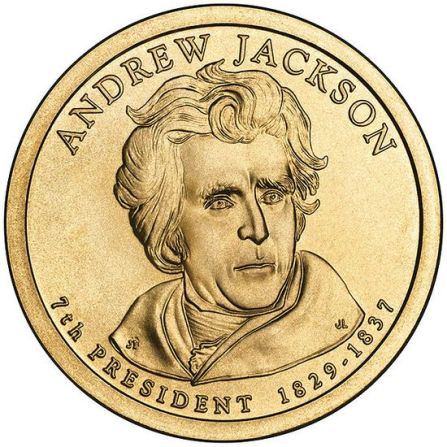
… in 1835. Robert Smith has the story of how it happened at the behest of Andrew Jackson, and why the good times lasted only one year and were followed by "the longest depression in American history." Matt Yglesias uses the story to make the case for debt:

Having a decent pool of creditworthy sovereign debt outstanding greases the wheels of private sector commerce in helpful ways and also gives people a useful low-risk savings vehicle. That’s not to say that a giant debt load is unproblematic or that it’s healthy to have a huge share of GDP going to interest payments. But there’s nothing wrong, as such, with a country having debt any more than it’s a moral failing for a business to avail itself of a line of credit.   

Let's just concede that right now, America has a lot more on its plate than access to a line of credit.

(Image of a $1 coin via Wikimedia Commons).