The Kids These Days, Ctd

A reader builds on these dissents:

I can barely contain my discontent with the Red Cross study you featured. I am teaching a statistics class this semester and I was in the middle of prepping my lecture on sampling when I took a break and saw the post. I have to say the study will be a perfect example for my class on how NOT to sample or interpret survey results.

So, the actual Red Cross post on the study starts by chastising the "youth" of our country for having such wrong, no-good, immoral preferences when it comes to torture and that they do not know what the Geneva Convention is. It moves on to mock them because they have the audacity to believe people should be educated before they can vote and proceeds to lecture us, and the youth, on the importance of the Geneva Convention. It ends with some psycho-blabber on why youth these days are so messed up. Of course, it's because they were exposed to horrible, terrible things, which makes them hold horrible, terrible beliefs about the morality of torture and such. 

Yes, it takes a long time to get to the point, because it takes the "study" a long time to tell me what kind of "youth" we are talking about. It's 12- to 17 year olds! Yes, we are made to read through all that moralizing and finger wagging, add some Dr. Phill theorizing, to finally learn that the sample is composed of 12- to 17 year olds, it is half of the sample size of the adults surveyed and, as a result, has a wider margin of error (+/- 4.4 as opposed to +/- 3.1). I don't need to be a statistician to know that  you cannot compare the two samples that straightforwardly!

In fact, as I will explain to the "youth" in my research methods class tomorrow, they would have to at least account for the different sample sizes in their interpretation, if not do the correct and decent thing and conduct some significance testing – like simple z-score, which my students have learned all about yesterday and will calculate tomorrow in class. My guess is that if you actually take the time to analyze the results properly, the difference between the responses of the two groups will come out as barely statistically significant.

I mean, just eye-ball it! If you take 4.4 percent out of the "youth" answers in favor of torture, you pretty much get very close to the response rate of the adults. If you keep playing around with the margin of error like that, you will notice that more often than not the confidence interval between the two results overlap. That tells you that more often then not, the results cannot be distinguished from one another. Which is actually pretty darn surprising, given what I will say below. 

Aside from the boring statistical stuff above (which my students will get tomorrow anyway), how wise is it to draw such harsh conclusions based on answers given by 12- to 17 year olds on such an abstract topic? Really, what do you expect to get? If you expect to get some meaningful, fully formed, stable statement of preference, you have obviously managed to avoid meeting "youth" in your adult life and/or stay away from serious research on child development. Has anyone taken the time to notice how odd it is that the "No opinion/Dk" category is selected by only 1% of 12- to 17 year olds in the sample? These "youth" do what all youth do when confronted by a grown-up and asked about some "important" grown-up issue: they give you a gut instinct answer. Maybe it's the answer they think you want to hear; maybe it's the answer they think is most popular; maybe it's the answer that will make them look tough; or maybe they just don't want to look stupid in front of a grown-up with a clip board. Hence the 1% of "youth" who courageously admit they don't know, don't care, or otherwise have better things to do. 

Don't get me wrong; the same problems outlined above are common among adult respondents as well. Which only proves my point: if we expect (and we do!) that adults, when confronted with questions on issues they know little about, will make stuff up (literally) or just give you the answer they think you expect or makes them look good, then how likely is it that 12 to 17 -year olds will exhibit more of that behavior? When you deal with "youth" who are just that young, you should be overly careful not to oversimplify and overstate your results. The study asks teenagers a bunch of complicated questions about scary things (like terrorists and wars) and then mocks the youth when they don't give a rational, correct answer.

I am not saying that the "youth" is stupid. I am saying that basic brain development studies (the kind adults would be expected to know if they theorize about youth) tell you that the frontal cortex – the one responsible for calculating risks and self-control – is not fully developed until the age of 25, which is why "youth" do not get to drive (and if they do, they pay higher insurance rates, or their parents do), don't vote, and some are not even left home alone yet. Knee-jerk solutions like torture to get to the truth would sound like a good idea EVEN IF the "youth" knew about the Geneva Convention or read studies showing torture doesn't work; they are just young and restless. The irony is that a large portion of adult respondents (presumably with a fully functional frontal cortex) do the same thing, while having very high expectations of today's "youth."

In my opinion, what this study does is entrapment – loosely defined, aside from methodological malpraxis. The condescending tone and painting a whole generation with a broad acusatory brush just adds insult to injury. 
How Big Were The Cuts?

Ezra Klein polices the debate:

[T]he real number of cuts isn’t $38.5 billion. It’s probably closer to $20-$25 billion. That’s not nothing. But it’s also not $38.5 billion, and Republicans are a) figuring that out and b) unhappy about it. In the end, the CR will probably pass because a lot of Democrats are going to vote for it, but as Republicans come to realize they got a rawer deal than they were initially told, I imagine there’s going to be a fair amount of anger at John Boehner, and a lot more resistance to cutting a bipartisan deal on the debt ceiling.

On A Gender Bender

Gender-bender

The culture war pileup over a J.Crew ad in which a designer paints her son's toenails pink could use a strong dose of history. Jeanne Maglaty explains how baby colors evolved in America. From a Ladies’ Home Journal article in June 1918:

The generally accepted rule is pink for the boys, and blue for the girls. The reason is that pink, being a more decided and stronger color, is more suitable for the boy, while blue, which is more delicate and dainty, is prettier for the girl.

My mum recounts how she learned of my gender. The midwife – me and my two siblings were all delivered at home in the same bed – uttered the words: "Well, he doesn't have blue booties on, but he's definitely a boy!" Not to brag or anything.

The fooferaw about painting an infant boy's toe-nails neon pink struck me as the usual panic about any sort of childhood influence that might somehow lead your son or daughter to be gay. I'm not sure there's much to be done about this, but I was struck by this comment:

J.Crew, a popular preppy woman's clothing brand and favorite affordable line of first lady Michelle Obama, is targeting a new demographic – mothers of gender-confused young boys. At least, that's the impression given by a new marketing piece that features blatant propaganda celebrating transgendered children.

Well, what would be the right approach to transgendered children? Shaming and stigmatizing them?

Just think of the parallels. The paragraph above accepts, as one must, the reality of children with gender confusion or transgendered identity. We know this is real, and sometimes goes nowhere, sometimes leads to kids being gay, and sometimes means a child is indeed transgendered. The child is obviously not making some kind of choice, just expressing his or her nature. So think of a paragraph dealing with another simple reality for some babies and children: Down Syndrome. And let's imagine that a rather brave and admirable clothes catalogue featured a child with Down Syndrome in their ads.

Does anyone believe that anyone would bemoan this fact as being "blatant propaganda celebrating children with Down Syndrome"? Every now and again, you see how acceptable cruelty and approved stigma is uniquely reserved for LGBT children. Yes, children. Often in the name of Christianity!

As Woody Allen memorably noted, "If Jesus came back and saw what was being done in his name, he'd never stop throwing up."

(Photo: Baby boy in a dress, wearing a bullet around his neck, by Flickr user clotho98)

Giving All

A reader writes:

At this stage of my life – 55 years old – I have come to see that the "giving tree" is me. My husband, an extremely high functioning paraplegic – an "uber-gimp" – suffered a massive stroke in October 2009. He is now a severely brain damaged paraplegic.  And now, for 1.5 years, I have been his caregiver.

I give of myself so much that I have lost my own life.

I work full-time (as you can see from my email address, I am a Federal employee working for the U.S. Navy). And yet, my REAL full time job is that of my husband's caregiver. I don't live MY life; I live HIS. His care comes before mine, always. Dressing him, changing him (he is bowel incontinent), ensuring his meals are given, ensuring his "helper" arrives on time and cares for him properly. Not an hour goes by while at work (like now), that I do not call either him or his "helper" to ensure everything is running smoothly. I have no annual leave accumulated, as I use it up for HIS needs, never my own. Even my sick leave is used on my husband's needs, leaving zero in case I should get ill.

Give, give, give. My "leaves" are almost gone from my branches, and even some of my "branches" are beginning to be snapped off and given to my husband's needs. And because I receive nothing in return – no expressions of love from him, no affection, little or no conversation from him on how my day went or how I am doing – I will soon be a stump without anyone to sit on it. Just a lonely dry stump.

The point of The Giving Tree is most often seen from the receiver's end. But the fact is, we caregivers never fail to see that WE are the "giving trees" – complete with the extreme loneliness of knowing that our "friends" and extended "family" have also abandoned us, so that more "leaves" fall off from the sheer loneliness of it all.

This isn't something I talk about often; it seems so weak to do so. And it is what I vowed to do in our Catholic Nuptial Mass, after all – to care for him "in sickness and in health." But seeing the topic of that painful book has come up on your blog – which I read, and enjoy, daily – I thought I'd mention it.

Another writes:

I may be the Tree in Shel Silverstein's book. I am not sure yet. 

Eight months ago my three-year old daughter got a diagnosis of being on the autism spectrum.  We started the process of getting her evaluated when a pediatrician friend pulled me aside and told me that the ability to read on a 3rd birthday might be a bad thing.  When we began researching autism we realized that our child had sensory issues and language processing problems despite her ability to read and being very verbal. We have over 30 books on autism in our house and Ms. Gilman's book will soon be joining it.  The last eight months have been a clusterfuck of doctors, educational evaluations, psychologists, occupational therapists and language specialists, much of it not covered by our insurance.  

My child's therapy over the next few years will eat into and possibly destroy our savings. It may last a few years or it may last her lifetime.  We have no way of knowing.   Vacations we had planned will be put off indefinitely due to lack of funds or the destination would not work for a child with sensory issues.  It may effect my abilility to retire when I want. 

Despite her challenges,  my child is very smart and I hope she will do well in school, go to college and become an independant person with relationships and can contribute to society.  In the back of my mind, I am starting to put a contingency plan in place in case she can never live an independant life.  

Your commenters who view the relationship between parent and child as abusive may be missing the point.  The child in the story never demands anything of the tree.   The child has a challenge and the tree sees a way to help and does.   The tree makes all the choices and is truly happy when it helps the child reach his potential and live a happy life.  For the tree, a child with no chance at happiness may be an unthinkable alternative, worse than ending up as a stump. 

Not all parents are required to give up everything.  I really hope my wife and I will be required to give up everything either, but if I have to sell my house, never see Europe, and work until I die to give my child a genuine chance to reach her full potential, I will do it without blinking and without any bitter feelings toward my child. If she gets that chance it will be worth it.  I couldn't even imagine feeling any other way.   

Being Honest With Your Doctor, Ctd

A reader writes:

I was diagnosed with HIV ten years ago. I had rarely, up to that point, ever had a need to step foot in a doctor's office; I was almost never sick. Now that I had to go in every three months for blood work, I got to know my HIV doctor very well. Being a big mouth, I had no qualms in answering any questions he had. As part of one of my early visits, he went down a list of questions related to my lifestyle (eating habits, exercise, smoking, etc). When he asked me "Do you smoke?", I said "not cigarettes". He followed up with "Do you smoke tobacco of any kind?" I said, "No, I only smoke weed, and have done so since I was 18 and I'm not quitting." (I was 34 at the time.) His reply? "That's fine, as long as you don't smoke tobacco … that's a no-no when you're Poz." 

In subsequent visits over the years, we've developed a very open rapport. I've told him how weed has helped me deal with some of the side effects of the HIV meds I took. One of the drugs I took (Sustiva) was affecting my sleep. I don't get crazy dreams or anything, but it definitely caused me to wake up constantly during the night. I would get maybe 4-5 hours sleep each night. The insomnia was killing me. The one thing I knew that worked against it was smoking weed before bedtime – boom, I'd get 7-8 sleep. It's been this way since I was in college (long before I was Poz). It sure beats taking prescription sleep aids every night. 

My doctor has found this interesting and has never asked me to stop smoking weed.

Stalemate Watch

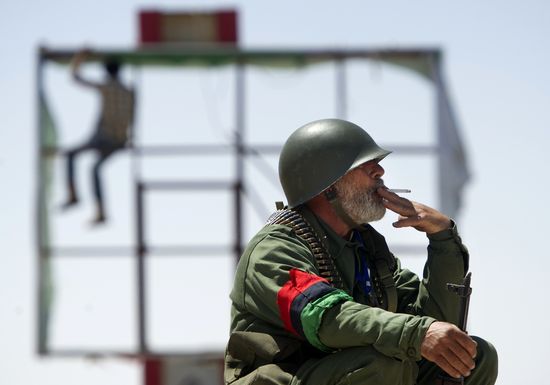
GT-LIBYA-REBEL-SMOKING-041411

Al Jazeera reports:

NATO has promised "all necessary resources" to Libya's opposition in its campaign to topple Muammar Gaddafi but the military alliance struggled to agree on whether that included arming rebel fighters.

The pledge, made by Anders Fogh Rasmussen, NATO's secretary general, came during a two-day meeting in Berlin marked by disputes over how to resolve the Libyan conflict and the extent of the alliance's support for the rebels. … [D]ivisions evident since a March 29 conference on Libya in London, were still manifest at a meeting in Doha on Wednesday of the contact group on Libya, which includes Western and Arab states, the United Nations, the North Atlantic Treaty Organisation and the Arab League.

Wow. You could never have predicted that, could you? Meanwhile, a somewhat familiar prediction:

Rebels have warned of an impending "massacre" by troops loyal to Muammar Gaddafi if NATO does not intensify its attacks on government forces in and around Misurata, which has been besieged for weeks. Libyan government forces launched a heavy attack against the coastal city on Thursday, with dozens of Grad rockets, killing at least 23 people, a rebel spokesman said. Misurata, Libya's third-biggest city, is the only major rebel stronghold in the west of the country.

(Photo: A Libyan rebel fighter smokes a cigarette while guarding a staging area outside Ajdabiya on April 14, 2011. NATO allies sought to show a united front in the Libya campaign, insisting they all wanted to see the back of Moamer Kadhafi even as they remained divided over dropping more bombs. By Odd Andersen/AFP/Getty Images)

How Serious Was Obama’s Deficit Plan?

Keith Hennessey was unimpressed:

OMB says the President’s February budget reduces the 2021 deficit to 3.1% of GDP. CBO said the same policies would result in a 4.9% deficit in that year. That’s a big gap, and the same will likely be true here. CBO is likely to say that the President’s specific policies don’t come close to hitting his stated deficit targets.

Hennessey says it "appears that the President’s trigger would exempt more than 90% of government spending from the automatic across-the-board cut."  Will Wilkinson is equally harsh:

[T]he president's approach to the budget is guided by two substantive principles. First, the rich ought to pay more. Second, altering the structure of Social Security and Medicare is absolutely out of bounds—even though marginal tweaks to the big entitlements simply won't suffice to make them sustainable. Sacrifice for the few; consoling untruths for the many. In the end, Obama's fiscal rescue plan isn't really serious.

Well, given our options, shouldn't the rich pay more? How else do we credibly get to balance? And "altering the structure" of Medicare and Medicaid means abolishing them in their current form, right? On this, though, it seems to me the critique from the right is correct: we are talking about major rationing in Obama's plan; in Ryan's, we're talking about cutting seniors off long before their full medical needs are met. I'm not sure which option will provoke the most resistance and therefore eventual repeal. I suspect, given what we have been used to for fifty years, Ryan's.

“I’ll Give Him That. It’s Odd.”

Slate deigns to cover the question of Trig Palin's provenance and the literally incredible claims by Sarah Palin about her pregnancy. But it avoids the obvious question: is it legit, given the ample use of Trig by Palin as a political prop and campaign mascot, to ask her for simple proof, like medical records, as the editor of the ADN did, and as I asked from the get-go?

It's funny to see journalists speculate – and Larimore's Occam's Razor conclusion is one of the likeliest scenarios to be true – but never actually commit journalism by asking for easily accessible documentation by the public figure. I tried directly asking the McCain campaign and was slapped down by the Washington Post. Maybe we're getting enough critical mass of new interest to have Palin be asked by a news organization other than the ADN for proof.

“A Power-Mad Egomaniac” Ctd

Tumblr_lep89tPFJR1qatu3jo1_500

A reader writes:

I lost my 89-year-old grandmother today, so I've been feeling a little down and destabilized and in need of a good chuckle. That picture of The Donald gave it to me. Thanks, Dish reader – what a hoot!

Another:

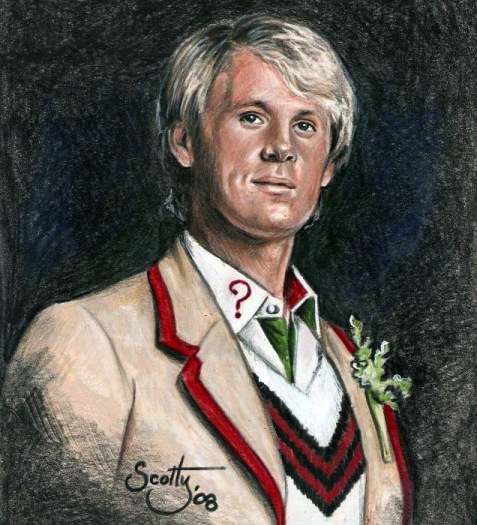
Your reader wrote, "Thought you'd get a kick out of seeing how [Trump] sees himself." Apparently as the fifth incarnation of Doctor Who, Peter Davison.

Above. Compare and contrast.