“Wimpy And Gullible”

Those are Henry Blodgett's words for the MSM's refusal even to ask serious questions about the strange – and, frankly, incredible – stories Sarah Palin has told about her fifth pregnancy. He's right. There was a strange collective decision not to know – and to stigmatize those who simply wanted to get the question resolved. And we still don't know. Now that Palin herself has joined the Birther nonsense, would it be too much to ask for former half-term governor Palin to provide some medical records – as she promised? Money quote:

Given the amount of publicity (and support) presidential candidate Donald Trump has gotten in recent weeks by picking up the Obama-wasn't-born-here mantra, the silence on this other question is indeed startling. The evidence Scharlott's cites about about Palin's possible hoax is by no means conclusive, but it certainly raises as many questions as the logic about Obama's birthplace.

In light of Scharlott's evidence that Palin staged a hoax, as well as the ongoing absence of any proof that Palin is actually Trig's mother, one wonders if the media will now, finally, seek to determine the truth–especially because Palin is considered a candidate for president.

But there really is no comparison. We have gotten all the data one can want out of the Obama administration on his birth certificate. He has delivered it. Palin has delivered nothing … but a fantastical, un-fact-checked manuscript, bald-faced lies, and a campaign of media intimidation. Which worked.

Cooking As A Lifestyle

Megan McArdle theorizes that "we’re spending so much on our kitchens precisely because we’re using them less":

When women left the kitchen, they began earning their own money—and the spending authority that comes with it. Since 1990, while the inflation-adjusted income of traditional single-earner couples has barely risen, the income of dual-earner couples has risen 16 percent. [Jack Schwefel, the CEO of Sur La Table,] says, “The core of my business is that 40- or 50-something woman who has more time than she did 10 years ago and is rediscovering kitchens.”

In other words, cooking is increasingly a leisure activity, especially at the high end of the market.

But it has utterly passed me by. As the years go by, few things bore me more than foodie-ism. I don't begrudge those who are obsessed. I can certainly appreciate good, healthy food. It's just way down on my list of goods – barely above clothes and shoes.

The Future Of Books

James Warner imagines it. What 2080 will hold:

For the benefit of those people at future-of-publishing panels—there's always one, for some reason—who insist it's really not about the text but the smell of the book, books will by this time be available exclusively as lines of fragrances. Subsequently, humans will modify themselves into a species with a powerful olfactory sense, able to read underwater by decoding strings of pheronomes.

(Hat tip: MR)

The Recovery Rides Coach

1367999219_571ab134d4_z
Reihan praises cheap bus travel as "the grubby, messy, inspiring story of capitalism in a nutshell." He focuses on the $25 buses from NYC to Boston started by a company called Fung Wah:

In the space of a decade, ethnic entrepreneurs had carved out a profitable new niche, and then deep-pocketed corporate types came in and perfected the model. … What is even more impressive is that these nimble bus companies are starting to pose some competition to heavily subsidized Amtrak and the airlines, thanks to the combination of ultra-cheap fares, low-cost creature comforts and decent customer service.

… If you listen to President Obama, you’d get the distinct impression that it is the government that is going to get the American economy moving again, by making huge public investments in projects like the Tampa-to-Orlando train and other marvels of the modern age. In truth, it is nameless entrepreneurs like the Chinatown founders of Fung Wah who will get us where we need to go. The most important thing government can do is to live within its means.

(Photo by Flickr user Christopher W. Moriarty)

$100,000 To Drop Out

Sarah Lacy profiles Peter Thiel, paypal co-founder and venture capitalist. Thiel is on a mission to pay smart kids to drop out of school and start a company. His reasoning:

If Harvard were really the best education, if it makes that much of a difference, why not franchise it so more people can attend? Why not create 100 Harvard affiliates? […] It’s something about the scarcity and the status. In education your value depends on other people failing. Whenever Darwinism is invoked it’s usually a justification for doing something mean. It’s a way to ignore that people are falling through the cracks, because you pretend that if they could just go to Harvard, they’d be fine. Maybe that’s not true.

Reihan's interest is piqued:

Soaring education spending is as striking as soaring health spending, yet it has only recently started attracting the same critical scrutiny. Alternative credentialing systems, improved funding formulas, and tighter limits on education spending are all part of the solution. But the deeper change will be cultural. 

North Korea’s Cut Phone Line

Adam Rawnsley reports that North Korea's official cell phone network is now estimated to have 450,000 users. But the network "doesn’t let North Koreans dial outside the country or access the internet":

[U]nlicensed mobile phones have allowed families in the North to clandestinely connect with foreign intelligence services in South Korea and the United States and spread news through the rumor mill. It’s not without risk, as Illegal phone use can carry stiff punishments, including death.

Dining With Autocrats

GT_

Dani Rodrik defends it:

[W]hat about a country like Ethiopia? I have had intensive economic-policy discussions with Prime Minister Meles Zenawi in Addis Ababa. I must confess to having enjoyed these talks more than most meetings I have in Washington, DC and other democratic capitals. I have no illusions about Meles’ commitment to democracy – or lack thereof. But I also believe that he is trying to develop his economy, and I offer policy advice because I believe it may benefit ordinary Ethiopians.

The conundrum that advisers to authoritarian regimes face is akin to a long-standing problem in moral philosophy known as the dilemma of “dirty hands.” A terrorist is holding several people hostage, and he asks you to deliver water and food to them. You may choose the moral high ground and say, “I will never deal with a terrorist.” But you will have passed up an opportunity to assist the hostages.

Reihan further complicates the issue.

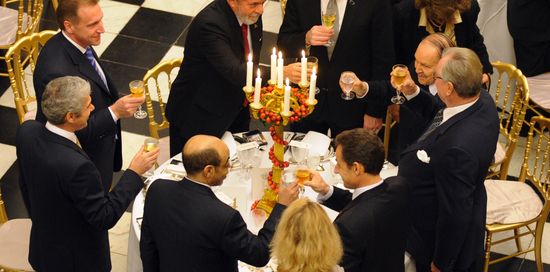
(Photo: France's President Nicolas Sarkozy (bottomR), Ethiopia's Prime Minister Meles Zenawi (bottom L), Algerian President Abdelaziz Bouteflika (2ndR), Sweden's Prime Minister Fredrik Reinfeldt (C right), Portugal's Prime Minister Jose Socrates (bottomL), Brazilian President Luiz Inacio Lula da Silva (top 2ndL) share a toast before the dinner at the royal palace in Copenhagen on December 17, 2009 on the sidelines of COP15 UN Climate Change Conference. By Eric Feferberg/AFP/Getty Images)

Tax Brackets 101, Ctd

A reader writes:

Your reader's chart may lead others to think that the highest earners (in terms of adjusted gross income) will pay an effective tax rate in the upper 20% to low 30%. In fact, the top 400 taxpayers, with the highest adjusted gross income, paid an effective tax rate of 17% in 2008; the top 1% of all taxpayers paid an effective tax rate of 23% in 2008 (IRS figures from Bloomberg's Businessweek April 11-17, 2011 edition, page 45).

Another writes:

There were several arguments in that post that need addressing:

Argument 1) Bill Gates only pays payroll tax on up to $106,800 of salary

Payroll taxes fund social security. The formula that pays out social security benefits is loosely tied to the income you earned while working, but with a cap. Earning more than $106k a year won't entitle you to any more in social security benefits, so one should not be taxed on income in excess of that. The system as a whole is progressive, too, so Bill Gates is paying more in to the system than he takes out.

Argument 2) Dividends and capital gains are income that is only taxed at 15%

Dividends are paid by corporations who are already subject to 35% federal tax rates on the income they earn. So while Bill Gates personally may pay 15% on the cash Microsoft pays him as dividends, Microsoft has already paid 35% of federal income tax on its earnings in that year, whether or not it chooses to pay the dividend. And that dividend the company pays out is not deductible against its tax bill.

Similarly, a capital gain arises when you sell an asset for more than you paid for it. That asset is income producing or expected to be income producing in the future … and so is expected to have a tax liability on the income it earns. If Microsoft was subject to a lower corporate tax, its expected earnings would be higher and Gates could sell his shares at a higher price. So taxes do bite into the value of the shares Gates sold, beyond the simple 15% he pays himself.

Argument 3) High income people can claim so many deductions they avoid most taxes

Three words: Alternative minimum tax. There's a limit on how much you can lower your effective tax rate through deductions such as taxes paid and charitable contributions.

For a resident of New York City making $250k a year, the effective tax rate (federal, state, local, social security, medicare) is close to 40%. That's a sizeable chunk.

The Daily Wrap

Today on the Dish, we previewed Obama's speech, Andrew live-blogged it, and we gathered the web's full reax here. Andrew sized up the Do-Nothing Plan and read in between the lines on Obama's, Ezra Klein wanted to hold future Congresses to any budget plans, and Jonathan Chait wanted Obama to wait. Andrew eyed Ryan's healthcare plan next to Obama's, Paul Ryan's voting record was a pretty glaring fault in his deficit stance, and Allahpundit wasn't sure what Boehner was thinking. Trump undid his own image, a reader called Ann Coulter on her birther whitewashing, Massie spotted another weakness in the Romney attack ads, and we parsed Romneycare's effect on his image. Mark Seddon lauded the UN's intervention in the Ivory Coast crisis, Qaddafi had a thing for hot nurses, and America still hadn't healed its 9-11 trauma.

Andrew remembered Sidney Harman, and readers continued to psychoanalyze The Giving Tree. We oogled other nation's dress codes, Mike Ervin relished his adult sippy cup, and Vanity Fair continued to drool over the Kennedys. Indoor-grown pot hurts the environment, snacks influence how judges rule, and Tina Fey trumped Palin's pregnancy. Bryan Caplan promoted Serenity Parenting, and readers shared hyperlexia stories, stories of parenting or not, connected Ayn Rand to video games, and high-fived their pro-pot doctors.

Creepy ad watch here, time suck of the day here, quotes for the day here and here, map of the day here, VFYW here, MHB here, and FOTD here.

–Z.P.

Map Of The Day

Map

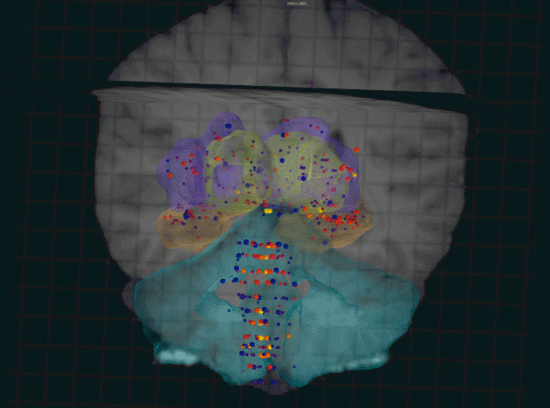
The Allen Institute for Brain Science has just completed its map of the human brain. Jonah Lehrer wrote about the project a couple years back: 

[W]hile conventional brain maps describe distinct anatomical areas, like the frontal lobes and the hippocampus—many of which were first outlined in the 19th century—the Allen Brain Atlas seeks to describe the cortex at the level of specific genes and individual neurons. Slices of tissue containing billions of brain cells will be analyzed to see which snippets of DNA are turned on in each cell.

Lehrer interviews Allan Jones, CEO of the Allen Institute:

I think the first fields of study to see high yield from the Allen Human Brain Atlas will be drug discovery and human genetics.  Drug discovery because researchers will now have a way to filter promising candidates and better understand the activity of existing compounds as they are able to match up expression of the drug target with the areas of the brain in which it is turned on.  Human genetics because it adds additional information (where is the gene turned on?) to the ever-growing gene lists that are coming out of larger population studies, which is an essential step toward understanding the role these genes play in the biology of the disease.

(Image: a 3-D snapshot of all the locations where Prozac alters gene expression in the brain. Researchers can click on each dot and see which genes are expressed in those specific areas, in addition to the underlying biochemistry.)