Married Without Children, Ctd

Many more readers are sounding off.  One writes:

I was content to leave this topic alone, but with the email from your reader who exhorts the joys of being The Fun Aunt, along with your comments on the matter, have spurred me to wander into the fray. I wonder if the childless out there know that we, the parents of your beloved nieces and nephews, sometimes feel a sense of loss when you decide not to have any children.

My husband and I are the oldest of all our siblings, and have recently found out that we are never going to have the chance to be Aunt and Uncle. I was surprised to find myself shedding tears when I heard the news. I had looked forward to being an aunt for the same reasons you and some of your readers have suggested: to spoil our nieces and nephews a little, teach them things, take them places their parents might not have. Parents don't always have the luxury of doing these things – or, if so, they're drowned out in the day to day thankless and routine parts of parenting.

While I would never say that anyone should have kids to give me something in my life, and think that the "to have or not to have" question remains deeply personal, I wanted to let you know that some of us parents aren't jealous that you have freedom, or a better job, or a better sex life … we're just a little sad for what we see as a missed opportunity.

Another writes:

The notion that the childless by choice tend to be introverts and "planners" hits home with me. I have encountered many, many strange and irritating reactions to the decision of my wife and me not to have children. But none is more insulting – or frankly, common – than the insinuation that we haven't thought it through.

"Who will care for you when you are older?" "Aren't you afraid of being old and alone?" To which the only honest answers are, respectively, "I don't know," and "who isn't?" regardless of whether one has children or not. No one knows whether the baby you have now will be able (or willing) to be your caretaker 30 or 40 years hence. Moreover, this seems a particularly selfish reason to bring a child into the world.

Another:

I have a problem with idea that married couples who choose not to have children are the only kind of people who "think before they act." This is a little arrogant and condescending. I am a new father of a one-month-old daughter. Did I weigh heavily the responsibilities of being a parent, and the freedoms of not being a parent? Of course. Did I consider the economic and social impact my decision to have a child would have on me and my family. Of course I did.

By all means people should be free to be married and not have children. But to classify those people as individuals who think more deeply than those who decide to have children or as having a special ability to avoid being "led into a conventional life" (whatever that means) is bullshit. We all can think deeply. And we can all feel a reward and enjoyment in our lives based on the decisions we make. I thought long and hard with my wife about having a child. My life is so different and much more rich because I am now a father. It was the best deep thought I've had.

Another:

You said, "But I got to leave and merely enjoy this kid after a few hours, not stay and take care of him, or to endure a week of his sickness, or a minute of his nightly cries."

Ah, but you see, that's one of the things that makes having children so great: there is nothing I've ever experienced in my life quite like the feeling when I lay in bed with one of my boys when they've got a spiking fever. I know there isn't anyone else in the world (besides my wife) that they'd rather be with at that moment. The fact that I can be that for them is just a thrilling feeling.

I tell people all the time that I love my wife in ways that are deep and profound, but the love I have for my children is just on a whole other level. And I didn't know until I had them.

One more:

I am 34 and single and will likely never have children of my own. In the last ten years, however, I have fostered a little boy who is now 15 and an integral part of my life; I worked full-time at a homeless shelter with the children who lived there; I led a church youth group; and I have been able to open my door to several teenage mothers, be it for a weekend or for a month, to teach them how to parent their newborns.

I figured out a while ago that I could either be absorbed in two or three children of my own, or I could be the adult who stands in the gap for a larger number of inadequately parented children, being the adult they need to demonstrate love, discipline and loyalty. I have chosen the latter and never regretted it.
Growing Up Objectivist, Ctd

A reader writes:

I've never read Ayn Rand.  My experience with the writer extends to a particular video game franchise, BioShock.  (If Roger Ebert continues to insist that video games should not be considered as art, I'll point him to this one.) BioShock is set in an underwater city called Rapture, designed and built by one Andrew Ryan.  You first meet this Captain Of Industry on a journey downward to the city, where a projector plays a recorded message laying out Ryan's philosophy:

I am Andrew Ryan and I am here to ask you a question:  Is a man not entitled to the sweat of his brow?  No, says the man in Washington; it belongs to the poor.  No, says the man in the Vatican; it belongs to God.  No, says the man in Moscow; it belongs to everyone.  I rejected those answers. Instead, I chose something different. I chose the impossible. I chose… Rapture.  A city where the artist would not fear the censor.  Where the scientist would not be bound by petty morality.  Where the great would not be constrained by the small.  And with the sweat of your brow, Rapture can become your city as well.

Sound familiar? 

Andrew Ryan's name is obviously based off Ayn Rand.  I doubt many of your readers will play the game, so I feel safe revealing spoilers. 

Ryan's philosophy ultimately creates a caste system between the extremely wealthy (backed by Ryan) and an underprivileged class (manipulated by a former mobster named Frank Fontaine).  Here's where science fiction enters in: a new genetic technology based on stem cells is discovered, allowing users to enhance themselves with superhuman abilities.  Fontaine discovered the tech and used it, along with a smuggling operation, to become immensely powerful and try to overthrow Ryan.  Ryan, in response, becomes increasingly paranoid to maintain control and starts a genetic arms race.  The end result is war.  Rapture as a city no longer exists by the time the player arrives.  It's a wreck, ruined by a civil war between two factions who still fight it out, one controlled by Ryan, another controlled by Fontaine. 

One would think a man intelligent enough to somehow plan, construct, and populate and underwater city would have the foresight to see Fontaine coming.  And Ryan did see what Fontaine was doing.  However he refused to do anything about it, adhering to his ideology of market forces, free will, and capitalism above all, so long as his own position at the top of the pyramid was never seriously challenged. 

The point of the whole story is Objectivism run amok.  Ryan's disdain for "the losers" and his selfishness, hoarding his wealth and building more, more, more for himself, creates the very conditions which lead to his downfall.  

I guess the thing that strikes me most about this ideology is that I was raised to think a culture is best judged by how it treats its poorest and weakest.  Objectivism as a philosophy seems to discard these people as useless bugs – less than human.  And it forgets that at some point in life, everyone needs a helping hand.

Adam Serwer blogged about BioShock a while back. First, the Ebert bait:

I'm not a fan of shooters, because I'm just generally not very good at them. Most of them are built for a multiplayer experience, and I tired of getting my butt kicked by my prepubescent cousins and better coordinated friends shortly after Halo came out. But the first Bioshock game was something different–it was a shooter, but with the thematic complexity and consistency approaching that of literature. It's not that BioShock tries to be a movie or a book–it's that it utilizes the limitations of the video game form as plot devices the same way a poet wields rhyme and meter in a sonnet.

The heart of his long and engrossing post:

Sophia Lamb works as a replacement antagonist in [Bioshock 2], but her fall from doting mother to radical collectivist is less interesting than Ryan's because her particular brand of evil is so recognizable. The collectivist cult of personality Lamb creates in the aftermath of Rapture's destruction is so clearly inspired by real-life monsters responsible for the death of millions (i.e. Stalin, Mao) that there's little payoff. It's not hard to imagine how Lamb's dream got twisted. 

Ryan's fall is more interesting because we've never actually seen a society completely based on extreme libertarian ideals, so the reimagined sci-fi "Galt's Gulch" is fascinating. BioShock imagines a kind of society that hasn't had a real world proxy, and that's what makes it so engrossing. 

The most potent details in BioShock 2 are still the ones that explore the death of Ryan's dream–or more accurately, the way Ryan destroyed his own dream. The absence of a welfare state prepares the people of Rapture to accept his nemesis Frank Fontaine's charity, Fontaine's alias Atlas' underclass revolution, and Lamb's collectivist "rebirth." We hear about the bank runs, and the descents into religious bigotry. And in the final level of the game, we are presented with the ultimate perversion of Ryan's ideal of "freedom:" the deep sea gulag Persephone, where Ryan spirited away ideological dissidents who dared to challenge him. The wretches are then forced to be guinea pigs for Ryan Industries' grotesque genetic modification experiments. Ryan founded Rapture because he believed government was an impediment to freedom–but the absence of a competent government that can intervene on the side of the downtrodden proves just as fatal to society. 

E.D. Kain engaged Serwer on Serwer's review of Bioshock 3, which focuses on American exceptionalism:

As Serwer notes, “Having gone from Rand to Marx, it sounds like the third BioShock might have a sprinkling of Niebuhr.” Naturally, few of BioShock’s fans will be familiar with Reinhold Niebuhr or his critique of American exceptionalism but that’s neither here nor there; it’s the ideas that count, not how we come by them.

The Ryan-Obama Difference

Obama's plan, says Ezra, includes both the cost controls in the ACA and this:

He then proposes to shave a further half-percentage point off the [healthcare system's] growth rate by introducing value-based insurance — where we pay more for treatments that are proven to work than for treatments that are not proven to work — into Medicare and giving generic drugs quicker entry into the marketplace. These programs have worked at smaller scales and in more limited pilots. We don’t know if they’ll work across the entire Medicare system, but we have reason to think they will.

He then focuses on the fail-safe trigger if the costs don't come down. It's a trigger that Ryan doesn't have.

To my mind, the core difference is that Ryan shifts Medicare from the feds to seniors and Medicaid from the feds to the states. It's hard to see how this won't simply mean many more people going without access to any healthcare at all – especially since Ryan proposes to abolish the ACA as well. But it certainly insulates the federal government from going broke. Obama, meanwhile, offers nothing so drastic. And his speech today was really a defense of the status quo with much more top-down rationing, tax hikes for the wealthy and pressure on the drug companies.

So you have a radical end of health insurance as we know it; or a drift toward patching the existing framework as best we can – and a fail-safe trigger for more taxes and spending cuts if none of it works.

Politically methinks: meep, meep. Whether fiscally, it works is another matter entirely. But that, I guess, is what the trigger is for.

The Small Print

Andrew Sprung analyzes the 3:1 spending cut vs tax hike that Obama has outlined (pretty much the ratio of the British Tories). There's more there than may meet the eye:

Just to clarify, the White House fact sheet explicitly counts interest savings in the 3:1 ratio. But counting reduced "tax expenditures" as spending cuts — that really tips the ratio, and it's brilliant politics as well as a perfectly fair use of the English language.  It's brilliant because a) conservatives occasionally have flirted with the same concept — Coburn, in a recent tussle with Grover Norquist, struggled to effectively define ending the ethanol tax credit as a spending cut — and b) protesting that cutting a tax break is not a "spending cut" should tie the GOP in knots, since creating new tax breaks has been a preferred mode of social spending for two decades.

Even Krugman is happy. Because the Obama plan includes much greater power for top-down rationing dictated by "people who actually know about health care and health costs". Gulp. But he has a point here:

And when people start screaming about death panels again, remember: you can always buy whatever health care you want; the question is what taxpayers should pay for. And compare this with a voucher system, in which you have insurance company executives, rather than health-care professionals, deciding which care won’t be paid for.

My italics. The British version of this is what's called "top-up" plans in the National Heath Service. If you want more than the NHS will deliver, you have an option to pay more. And if that works in a truly socialized system, it will surely work here.

The Nurse’s Tale

Oksana Balinskaya describes life in a dictator's palace:

Gaddafi chose to hire only attractive Ukrainian women, most probably for our looks. He just liked to be surrounded by beautiful things and people. He had first picked me from a line of candidates after shaking my hand and looking me in the eye. Later I learned he made all his decisions about people at the first handshake. He is a great psychologist.

Have More Children?

Bryan Caplan says "the most prominent conclusion of twin research is that practically everything—health, intelligence, happiness, success, personality, values, interests—is partly genetic." He uses that research to argue that parents should have more children and spend less time on each of them:

I call it “Serenity Parenting”: Parents need the serenity to accept the things they cannot change, the courage to change the things they can, and (thank you twin research) the wisdom to know the difference.  Focus on enjoying your journey with your child, instead of trying to control his destination. Accept that your child’s future depends mostly on him, not your sacrifices. Realize that the point of discipline is to make your kid treat the people around him decently—not to mold him into a better adult.

Will Wilkinson masterfully deconstructs the heart of Caplan's argument.

The Birther Whitewash

A reader writes:

I don't know if this is exactly a dissent, but yesterday's Yglesias award to Ann Coulter for being a voice of reason? Bullshit. There's nothing brave going on here. This is the beginning of the whitewashing of the establishment right's culpability in the spreading of birtherism.  

Ann said, "Every responsible conservative organization to look at it has shot it down, which is why you normally hear it being talked about exclusively on the liberal stations." Really? Then Hannity says, "One of the main people demanding it (Obama's birth certificate) be released is Chris Mathews." Really??!   Coulter goes on to say, "You haven't heard it (birther conspiracies) on Fox News…" REALLY!??!

They're blaming Hillary Clinton, the liberal media and the Obama administration for the spreading of this crap. Not Rush Limbaugh. Not Glenn Beck. Not Fox News. Not themselves. And I'm afraid this is only the beginning.

The Kids These Days, Ctd

The American Red Cross reported yesterday that America's youth are overwhelmingly pro-torture. Adam Serwer reacts:

I think Americans are still in the midst of a kind of national post-traumatic stress disorder over the 9/11 attacks, and we really still have yet to come to our senses. Why would young people be any different? Growing up in a world where one of the two major political parties has all but embraced torture as policy must make torture seem, well, normal. Treating it like a crime might have changed that, but no one in the U.S. government has any intention of doing so. 

A reader is on the same page:

As a "kid" myself (well, college student), another factor to be considered is that for many of us 9/11 happened at a critical time during our childhood. Since middle school we have been bombarded with warnings that we are always at threat and it only is through extraordinary measures we can stay safe. This however comes from more than just the political parties. It comes from the media, parents, and experiences we faced. For most of us we cannot remember a time that terrorism was not seen (realistically or not) as a menace waiting to strike at our moment of weakness.

Obama’s Moment Of Fiscal Truth Reax

AP_OBAMA_BUDGET_SPEECH_110413

Ezra Klein:

My initial impression is that this looks a lot like the Simpson-Bowles report, but in a good way. It doesn’t go quite as far on defense cuts, but it also doesn’t implement a cap on tax or spending. It goes a lot further than Ryan’s budget does in terms of actually figuring out ways to save money rather than just using caps to shift costs onto states/beneficiaries.

Greg Ip:

In truth, Mr Obama’s speech today was less a blueprint of how to save America from fiscal ruin than a means to establish a stronger negotiating position. Until last week, Simpson-Bowles had represented the centre of the fiscal debate; it was the basis for the Gang of Six’s deliberations. Mr Ryan’s plan threatened to move the centre of debate significantly to the right. By staking out ground to the left of Simpson-Bowles, Mr Obama may succeed in moving the debate back to the centre.

Paul Krugman:

I could live with this as an end result. If this becomes the left pole, and the center is halfway between this and Ryan, then no — better to pursue the zero option of just doing nothing and letting the Bush tax cuts as a whole expire.

Clive Crook:

His rebuttal of the Ryan plan was all very well–I agree it's no good–but the administration still lacks a rival plan. That, surely, is what this speech had to provide, or at least point to, if it was going to be worth giving in the first place. His criticisms of Ryan and the Republicans need no restating. And did the country need another defense of public investment in clean energy and the American social contract? It wanted to be told how fiscal policy is going to be mended: if not by the Ryan plan, with its many grave defects, then how?

Ed Morrissey:

Not only did Obama fail to resurrect his own deficit commission’s plan, he offered nothing specific in response to the specifics Paul Ryan and the GOP have already laid on the table.  It’s almost impossible to present a substantive criticism of the proposal because it contains nothing substantive, an impression that more and more people have of this White House.

Jonathan Cohn:

The new health care reforms sound very good upon initial inspection–and, particularly when added to cost controls already in the Affordable Care Act, this is far more serious than what Paul Ryan and the Republicans have in mind. And if Obama is more serious about controlling health care costs, then he's more serious about reducing deficits overall.

Kate Pickert:

Obama left other deficit reduction ideas on the table. He does not support raising the Medicare retirement age to 67, as Ryan suggests. A senior administration official was also careful to point out that capping or eliminating the tax exclusion for job-sponsored health benefits has not been proposed. (This was a major proposal in Simpson-Bowles and one that health care economists say should be seriously considered if the long-term health spending crisis is to be addressed.) Simpson-Bowles also recommended increasing cost-sharing for Medicare beneficiaries; Obama said nothing about this.

Michael Tanner:

Essentially, the president declared that he still wants to raise taxes, that he is opposed to any substantive changes to entitlements — oh, and he wants to raise taxes. He did suggest that if somehow he hasn’t been able to cut spending by 2014 (anyone taking bets?), he would appoint a commission to recommend spending cuts and (surprise) tax increases. A commission: Now there’s an original idea.

David Frum:

That speech was not so especially eloquent. It was, however, very effective. It frames the debate in a way that is maximally useful for Democrats. This framing was made possible by the efforts of Republicans themselves, blinded by their own hopes, misdirected by their own messaging.

Jonathan Chait:

The Republican approach has been to embrace such radical proposals that they pull the terms of the debate rightward, making the unthinkable thinkable. The weakness of this approach is that it forces the party to adopt wildly unpopular positions. And not just wildly unpopular because they're "bold." Wildly unpopular because, as Obama explained, they benefit the rich and powerful and victimize the powerless, and they violate Americans' basic sense of civic obligation. They only way to force Republicans to abandon their maximalism is to force them to pay a price for their extremism. Today's speech may or may not result in a budget deal–I still prefer for Obama to wait until the Bush tax cuts expire–but it was an important step in that direction.

Adam Serwer:

[T]here was a lot of liberals to love in this speech. Don't think this will shift public opinion substantially — remember the bully pulpit fallacy — but it sends a clear signal to Democrats who have spent the last couple of days wondering whether they were supposed to run around defending everything in Simpson-Bowles now that the battle lines have been drawn. 

James Pethokoukis:

 [I]f Obama had actually offered a multi-decade blueprint, like Ryan did, he would have had to concede that there’s no way he can pay for all his spending over the long term without Washington raisingtaxes on the middle-class and probably instituting a value-added tax. (On that count, one nonpartisan budget expert told me, the Obama plan is “ridiculous.”)

Kevin Drum:

Question: is Obama laying down a marker in hopes of getting a bill that extends only the middle-class [Bush tax] cuts? Or is he laying down a marker knowing that Republicans will refuse to budge and therefore the entire Bush tax cut package will expire?

Yuval Levin:

I fully expected the Democrats to respond to the Ryan budget by simple undiluted demagoguery—that is, with the “Paul Ryan’s America” part of this speech alone. And some Democrats in Congress have certainly done that, with all the usual preposterous dishonesty of the Democrats’ Mediscare playbook. But this speech did not limit itself to that. Its demagoguery was diluted some. It accepted Paul Ryan’s definition of the fiscal problem, and it accepted more or less his broad outline of what a solution would look like in fiscal terms—in terms of deficit and debt reduction. And so it defined the debate going forward as a debate about how best to achieve the Republicans’ fiscal goals.

William Galston:

[T]he president has decided to come off the sidelines and participate actively in the debate. He called for negotiations involving both parties and both houses of Congress as well as the White House to begin in early May. This discussion will be neither short nor easy. While it must reach some concrete agreements prior to a vote to raise the debt ceiling (a linkage the president seems to have accepted), many important issues are bound to be left unresolved by the president’s target date of late June. This momentous fiscal debate will probably dominate the 112th Congress and shape the 2012 presidential contest as well.

PM Carpenter:

Right or wrong, "The People" whom the left extol as the virtuous voice of democratic government voted, in part, for deficit reduction — now. In my view, and obviously that of the president, now is the wrong time. But elections do have consequences. Cutting some spending — now — is one of them. Hence Obama is only accepting the people's wishes, as well as juggling the resulting and rather brutal reality of Capitol Hill.

Digby:

[T]his was a good first speech of the 2012 re-election campaign. I have no doubt that it will reassure most of the Democratic base and appeal to the independents who are very skeptical of the Tea Party Republicans.

Live-blog of the speech here.

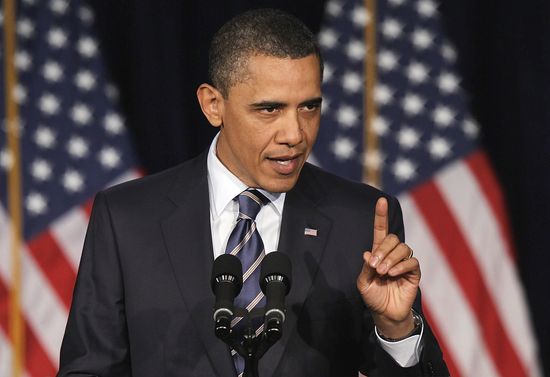
(Photo: President Barack Obama outlines his fiscal policy during an address at George Washington University in Washington, Wednesday, April 13, 2011.  By Charles Dharapak/AP.)