The Anti-Romney Campaign

Alex Massie spots another weakness:

No matter how much private wealth can impress some voters it's also easy to see how you can write an attack ad pointing out that Romney became a vastly wealthy man by purchasing ailing companies, firing half the workforce and stripping any assets that could be used to turn a profit.

This isn't entirely fair. Some of those companies might have failed anyway and others were doubtless saved by private equity. If that meant a smaller workforce so other jobs could be saved and the business resurrected then so be it. A price worth paying and so on but a tougher thing to sell during an election campaign.

Being Honest With Your Doctor, Ctd

A reader writes:

I was recently diagnosed with a brain tumor. Turns out it is highly treatable, but it did affect me profoundly in many ways. During a recent visit with my doctor, he asked if I was using any illegal drugs, including pot. I told him (much to my surprise): "Yes, I have been smoking a lot of pot lately". His response: "How is that working for you?" "Just fine, but the munchies are getting the better of me." He said, "Well, that is just about the only negative side-effect for use at home."

I wanted to give this 70+ year-old doctor a hug and a high-five! He demolished my preconceived notions about what the older generations think about pot, and what some doctors think about it as well.

“A Power-Mad Egomaniac” Ctd

Portrait

A reader writes:

Many years ago, I attended a social event at Donald Trump's Mad King Ludwig digs, Mar-A-Lago in Palm Beach. (Trump rents it out to anyone with enough cash.) Donald wasn't there (I think this was during the Ivana divorce, so he was a bit distracted). But he was there in … oils. Right off the main bar, there's a huge portrait of Trump. 

Thought you'd get a kick out of seeing how he sees himself.  I swear I am not making this up.

Update: The photo was in fact taken by Joan Gage.

Grand Bargain, 2013?

Jonathan Chait wants Obama to wait to cut the deficit:

Democrats will obtain massively greater leverage after 2012. As I've argued, if Obama refuses to accept another extension of the Bush tax cuts on income over $250,000, then Republicans will kill the entire Bush tax cuts for him. That would change the entire course of the budget debate. Restoring Clinton-era revenue levels won't be a huge concession wrested from Republicans at the cost of horrible social policy, it will be a fait accompli. If Obama wants to make another deficit deal after that, maybe reforming the tax code in the process, he can knock himself out. And making a deal coming off a win is likely to find the GOP is a more chastened — or, at least, less insanely triumphal — mood.

It seems to me that Obama just told us that he could not wait to propose a serious plan. The debt-ceiling is a powerful mind-concentrator, and in the battle over that, the last thing the president needed was to give his opponents a credible charge that he is fiscally more reckless than they.

The Best Children’s Books, Ctd

Shit-my-kid-ruined

A reader writes:

The readers who see the boy in The Giving Tree as a selfish little brat are exactly right, but that is the entire point of the book. It holds the mirror up to each little boy and girl who reads it. 

I remember reading the book as a young boy and being just crushed with the realization that the tree was my parents and that I was the boy.  Now that I’m a dad, I think I was right on. One of the searing truths of life is that we take so much more from parents than we give and, what’s more, we don’t realize how much our parents are giving.  

When we become adults we begin to realize that many people in our lives view us as a means to an end, as a useful object.  But not our parents – they continue to see us as an end in ourselves and continue to offer whatever they can.  We continue to use our parents for support without fully reciprocating their love and support. I see The Giving Tree as an extraordinarily beautiful book because it doesn’t hold back from sharing that very painful truth about the world with children.

Another writes:

The Giving Tree is clearly a parable about parenthood, i.e true love. The irony of your readers telling their child to never to be a "tree" is that parents are "trees" themselves. Good parents love their children so deeply they willingly sacrifice to make them happy.

Another:

This entry from "Better Book Titles" is what I always think about whenever The Giving Tree comes up.

(Photo from the tumblr, Shit My Kids Ruined)

Anything Congress Can Do, It Can Undo

Ezra Klein emphasizes an obvious fact: a deficit deal isn't worth anything "if it’s not honored by future Congresses":

[T]he question can’t just be whether we can make hard decisions this year and write a big bill that allows us to pat ourselves on the back and say we solved the deficit problem. The question has to be what processes and policies are we putting into place that make it easier for future Congresses to stick to the fiscally responsible laws we put on the books. In the end, real deficit reduction is a decades-long commitment, not a vote and a press conference.

Sure, but an epic attempt to solve the problem now, if endorsed by the political middle, will have long-term ramifications. And the sooner we start, the less crushing will the debt eventually be.

Live-Blogging Obama’s Moment Of Fiscal Truth

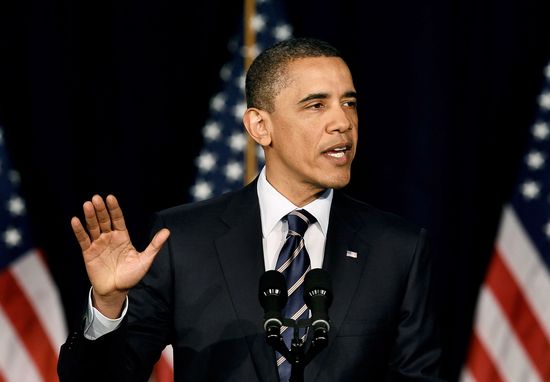
GT_OBAMA_04132011

2.40 pm. I'm not sure how major an impact this midday speech will have – simply because it will be highly limited in its audience. But it was classic Obama – a center left approach to a center-right conviction: that the debt is unsustainable; that we all have to make sacrifices; that defense-cutting, reducing the cost of healthcare; and tax reform are integral to this possibility.

And it looks as if he will indeed use the debt ceiling moment to push some version of this through. I didn't get the sense from this speech that he was only planning to do this in his second term. And surely, after the cold shock of the Ryan plan, his less draconian vision for the vulnerable will be popular in the middle. The least persuasive part of the GOP proposal is its refusal to ask anything from the top one percent in this crisis. Obama saw this, and went for it.

2.38 pm. Now the classic Obama move: not red or blue but both; not Republican or Democrat but patriotism. And the three Rs: "Rebuilding, refurbishing, reforming."

2.35 pm. He's invoking Reagan and Tip O'Neill – and Gingrich and Clinton! A nice formulation: a "balanced approach" to debt reduction. And this will drive Krugman up the wall: an assertion that the GOP leadership wants to do the right thing. Then a deadline of resolving this by June – before the final deadline for national default.

2.33 pm. Then the classic pivot against the left. "Doing nothing" is not an option. Calls out progressives for not seeking to prove that government can get leaner and more effective in delivering liberal goals.

2.32 pm. "I do not need another tax cut." And then the real dinger: he claims most of the well-off would welcome paying a little more to save the country from fiscal ruin.

2.26 pm. Tax reform is, in his view, a major potential revenue raiser. It's a stronger position than the GOP's, which seems more like anti-tax theology than debt-cutting pragmatism.

2.24 pm. This speech is getting more defiantly liberal as it goes along. He uses the v-word ("vouchers") to describe what the GOP wants to do to Medicare. Putting "seniors at the mercy of insurance companies" is a politically potent piece of fear-mongering.

2.20 pm. He'll use Medicare's power, he says, to bring down drug prices (and, of course, make the development of new drugs even riskier than it is).

2.18 pm. "We wil do what we need to do to win the future." He starts with last week's cuts in discretionary spending. Then he goes right away to cutting defense. These rhetorical priorities must be encouraging his base. More encouraging: a thoroughgoing review of America's global commitments. Do we really need tens of thousands of troops in Germany?

2.17 pm. Are you for children with Down Syndrome … or tax cuts for the increasingly wealthy? Then he describes himself as one of the rich, and compares his new tax break with 33 seniors having to find $6,000 each to fund their healthcare. Then a hard-hitting claim that the Ryan plan isn't "serious or courageous."

All of this is casting the GOP plan as pessimistic about America's future. A deft blending of Reagan's rhetoric with Clinton's policies.

2.16 pm. A nice jujitsu on the Republicans' alleged pessimism about what America can do to compete with emerging economic powers, like China and Brazil.

2.14 pm. He describes the Ryan plan as something Ryan deserves credit for introducing. Then he goes for the jugular, presenting himself as a defender of traditional American values.

2.13 pm. He's now listing things that most Independents like about government spending – and implying that this is where the GOP wants to cut the most.

2.10 pm. He really is speaking as a bipartisan president, not as a Democratic party leader. This is a speech to the center: "No one believes they should be paying higher taxes."

2.05 pm. The statistic of a trillion dollar annual interest payment does bring the crisis home, doesn't it?

2 pm. Back to the bipartisan 1990s!

1.55 pm. He's going strong on the Bush tax cuts. But surely the Clinton surplus was distorted by the tech bubble.

1.49 pm. He's way late.

(Photo: Mark Wilson/Getty.)

Counting Triumphs, Ctd

A reader writes:

My mother, born in 1934, was, I suspect, hyperlexic. But she made her own life on her own terms, and was for the most part happy. She died last year at age 75. My sister (a clinical social worker) and I had, as adults, always felt our mother was on the autism spectrum, but as we came to learn about Asperger's, her behaviors didn't quite fit (no monomania, for example). I am reasonably sure that, in actuality, she suffered from hyperlexia, although "suffer" isn't the right word. "Experienced" might be better.

She taught herself to read, fluently and at a high-school level, before she was two years old. That I know of, she had no friends in childhood. Her brothers — my uncles — were outgoing and popular. My mother was solitary, because she wasn't able to engage other children. When my grandmother would arrange for potential playmates to visit, my mother would lead the visiting child proudly to her bookcase, offer the visitor a book, and sit down with one to read herself. I don't know about her speech in early childhood, but her activities certainly suggest hyperlexic tendencies. If she had ever once seen a word, she could spell it perfectly from memory forever. She wasn't permitted to participate in spelling bees in school, because it would be "unfair" to the other children. All her life, she enjoyed tapping out letters and words with her toes, silently, inside her shoes, so no one would notice. She enjoyed long words which fit in numerically with her toes (which she tapped in groups.)

My grandmother laid out her clothes and dressed her each morning until she left home for college. She entered Bryn Mawr at age 16, graduated summa cum laude in Ancient Greek, won a Fulbright to study in Athens and was admitted to Yale's PhD program in Classics. She suffered a nervous breakdown in her first semester of graduate school, left, and did not return. She told me once that studying Greek in college appealed to her because of her great facility with translation, but that when the time came to write an original paper in graduate school, she panicked, knowing she could not do it.

My grandmother found her work at a publishing house, editing a dictionary (Funk & Wagnall's.) She liked the work, lived at home, took the bus to work and back, and gave my grandfather her wages for safekeeping. She had almost no outside life. For recreation, as always, she read. By this time, though, she did have a few friends from college. Her social abilities had slowly expanded over the course of adolescence. One of her friends introduced her to another Classics scholar (my father.) At her death, they had been happily married for two weeks short of 50 years.

Her personality was utterly frank and blunt, very shy, practical-minded, and kind, though she always had great trouble seeing things from other people's point of view, understanding jokes, or detecting any conversational subtlety. She was awkward in social situations, and desperately avoided parties, etc. She preferred reading to any other activity. She read all the time — ALL the time — and could finish a book each day. Her favorites were dense works of historical scholarship.

"Ask Mommy about Merovingian dowry customs," was typical of how we teased her. Because if you asked, she would tell you and tell you, until you said, "Enough!" She could borrow all the books she wanted from Brown University's library, where, as a cataloguer, she had the pick of their new acquisitions, and, in the fields that interested her, read them all: 20 or 30 books each month. We carted them back and forth to the library in canvas tote bags.

She didn't care much for fiction, enjoyed Agatha Christie for the plots. Her work as a cataloguer drew on her reading comprehension of English, French, German, Italian, Spanish, Portugese, Latin, and Greek (the modern languages mostly self-taught just by reading), and her dense knowledge of the intricate minutiae of European and U.S. history. Cataloguing is not well paid, nor highly respected within the academy, but it was work she enjoyed very much and excelled at.

Naturally, being her child was not a "normal" childhood. But she was an attentive, caring mother. My sister and I had to make our own ways, socially, but in other respects were well-equipped and emotionally secure. In the 1940s, my grandmother had brought my mother, then about age ten, to be examined by a psychiatrist at Columbia University. He foretold a very unhappy, isolated life, given her evident extreme intelligence — based on reading tests — and social deficits, especially since she was female; I have seen his written report. Luckily, he turned out to be wrong.