Prince William’s Uniform

A subtle tribute to the forces in Afghanistan. The Royal Family's engagement with military service at all levels is something Americans don't always appreciate. It's the highest test of patriotism – and perhaps because of their privilege, each generation serves.

And, yes, I find this a little more interesting than the dress, lovely though it is.

Face Of The Day

GT_ROYALWEDDING-GIRL-FACE_110429

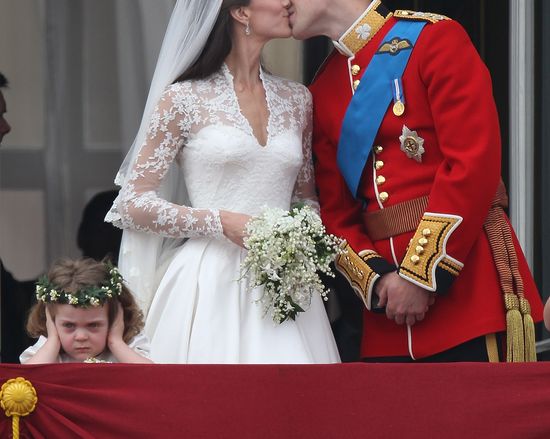
Prince William, Duke of Cambridge and Catherine, Duchess of Cambridge, kiss as Bridesmaid Grace Van Cutsem (L) looks at the crowd from the balcony at Buckingham Palace on April 29, 2011 in London, England. The marriage of the second in line to the British throne was led by the Archbishop of Canterbury and was attended by 1900 guests, including foreign Royal family members and heads of state. Thousands of well-wishers from around the world have also flocked to London to witness the spectacle and pageantry of the Royal Wedding. By Peter Macdiarmid/Getty Images.

Quote For The Day

“I find the idea of expansionary fiscal contraction in the context of the world in which we now live to be every bit as oxymoronic as it sounds … [I]f Britain enjoys a boom over the next two years … I would be required … to be quite contrite about the seriousness of the misjudgments that I am making. You can make a judgment – those of you who know me – how big a risk I would take of putting myself in a position of great contrition. You might therefore conclude that I am fairly confident this experiment is not going to work out well,” – Larry Summers.

The Cost Of Quality

Hatchet

Robin Hanson thinks deeply about it:

It seems to me that what people usually mean by a product’s “quality” is the overall value someone might gain from it, ignoring its price. Sometimes people talk about a product’s “value”, or it being a good “deal,” referring to its over all value including its price. And sometimes people will talk about quality given certain constraints. For example, folks might talk about a “great one bedroom apartment” suggesting that two bedroom place might be better, but that such comparisons are set aside for now. But the most common way to evaluate products is to just talk about value ignoring price. Yet why ignore price?

(Photo by Flickr user kafka4prez from the photo pool Fake Products: Mutant Knock-offs)

Raising Taxes, Uncreatively

Howard Gleckman admits the progressive budget, discussed by the Dish here,  is "worthy of some praise." But Gleckman highlights numerous flaws and feels the plan's "greatest sin is that it lacks imagination":

The problem with these very high tax rates [in the progressive budget], of course, is that the wealthy will find ways to avoid them. Some may incorporate and take advantage of those much lower corporate rates. Rich individuals will shelter or defer income, or find ways to move it (or themselves) offshore.  Corporations will surely decamp for tax havens.

I was disappointed that, beyond the 28 percent cap on deductions, the plan failed to tackle the $1 trillion in tax preferences that litter the revenue code. You’d think that liberals desperately seeking revenue might find ways to, for instance, make the mortgage interest deduction more progressive by turning it into a credit. But instead they seem happy to try to enhance tax fairness by merely raising rates on the rich—by a lot.

The Market For Funny Videos

Brian Raftery reports that, despite having "long ago disappeared from pop-culture radar," America's Funniest Home Videos (AFV) still "averages more than 7 million viewers a week." How?

There are now simply more videos to choose from. After a few low years when submissions dropped to a trickle, these days the show is steadily getting about 2,000 clips a week. And in addition to direct submissions, producers also occasionally comb the web for breaking hits. The challenge, of course, is that by the time a great clip gets spotted by AFV, it may be too well-known. To deal with this, the producers have come up with their own YouTube barometer: If a video is starting to gain traction but has yet to hit 50,000 views, AFV will ask the uploader to take it off the web (or at least set it to private) and submit it to the show. Once it breaks the 50,000-view mark, however, Di Bona has little use for it.

The Weakness Of A Strong Hand

Graeme Robertson outlines truths about dictatorships. Among them:

[S]uggesting that dictators can force better policies upon their people assumes that a dictator is likely to know what those better policies are. The idea that there are technocratic solutions to most economic, social, and environmental problems might be comforting, but it is usually wrong. Such questions rarely have purely technical, apolitical answers — and only in a democracy can they be aired and answered in a way that, if not entirely fair, is at least broadly acceptable.

Why Hasn’t The Pill Evolved? Ctd

Pills_Flickr_RachelC

A reader writes:

I have a theory for why the pill hasn't evolved, for why birth control isn't getting better: Manipulating human biology actually isn't a very easy to do without side effects. Especially when it involves the manipulation of hormones. I bet Barry Bonds would have liked to hit 73 home runs in a season with regularly-sized testicles. I bet Uncle Al wishes his cholesterol pill was better, too: why can't he eat his bacon and his hamburgers with diminished risk of heart disease AND without nauseau and diarrhea?

I'm sure this sort of opinion will provoke much ire from people my age who have grown up under the assumption that risk-free sex is par for the course. But when you realize that even condoms fail 3% of the time and go into this with a modicum of respect for the biological complexities of the human body, I kinda find it hard to sympathize with Ms. Friedman.

A better pill would be a goldmine for pharmaceutical companies. If there is one to be had, it will be created. Just don't hold your breath.

(Photo of an "exhibit demonstrating the 45k pills that a woman may take in her life." By Flickr user RachelC.)

A Non-Tragedy

Ta-Nehisi does a cost-benefit analysis and doesn't find the Civil War tragic at all:

Six hundred thousand people died in the Civil War, a shocking figure which doesn't really capture the toll that this sort of violence took on the country at large. And yet when I think about the Civil War I don't feel sad at all. To be honest, I feel positively fucking giddy. … The Civil War is our revolution. It ended slavery, and birthed both modern America, and modern black America. 

That can never be tragic to me.

In later posts, TNC clarifies his position and responds to J.L. Wall's complementary argument.