The Single Most Damning Thing About Ryan

I remain of the view that he deserves credit for being the first American with real political accountability to tell the truth about the depth of our fiscal predicament. But one has to contrast his current anti-spending stance with the record:

Every policy change of the last decade that increased the deficit—the Bush tax cuts, the Medicare prescription-drug benefit, the wars in Afghanistan and Iraq—Ryan voted for.

How exactly does a Randian vote for Medicare-D – a fiscally open-ended entitlement, combining the fastest growing demographic with a product with one of the fastest growing pice-tags?

The Best Children’s Books, Ctd

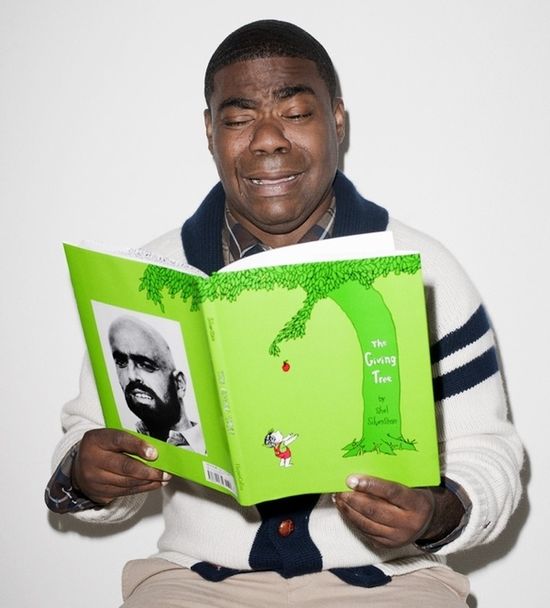
Tracy-morgan-reading-the-giving-tree-22773-1279720209-1

A reader writes:

I'm surprised by the reactions of some of your readers to The Giving Tree, one of my favorite books. Reactions like "the book presents [the tree giving until it has nothing left] as a good thing" and telling children "don't ever grow up to be that tree" seem to miss the point of the book – wildly.

I won't claim to know what Mr. Silverstein's intentions were, but art is in what viewers and readers see, not what the artist intended – and it boggles my mind that any readers have reactions like the ones you posted. The message of the book is clearly, "Don't ever grow up to be like that boy" – and it screams it pretty loudly! 

Every scene reiterates that the boy does not give the tree what it needs and asks (climb on me, play with me), takes only what he wants, and makes it plain he hurts what he supposedly loves. I almost can't see how it could be any clearer a statement against unbridled selfishness! I mean the book is simply heartbreaking, because the boy is so damn cruel.  How can this be missed?  I proudly read the book to my daughter and trust she understands the anti-selfishness message well.

To me, it's as if someone cautioned against reading Little Red Riding Hood to their children and pointed out their need to say, "Don't ever be like that wolf!"

Another writes:

Of course it's a depressing book. The problem isn't Silverstein, the problem is all the hippies (like me) who thought it was so sweet 30 years ago. It's not sweet – it's as horrible as the real world. He just uses the cute cartoon/children's book format to present a horrible reality. 

So welcome to the world, kiddies. And when you grow up, try not to turn out like that little shit.

(Photo via Matt Stopera)

Sidney Harman, RIP

Newsweek’s Executive Chairman passed away last night. The family’s statement is here. Jonathan Alter remembers Sidney:

I was intrigued by Sidney’s ideas and, like so many who encountered him, soon enough impressed at his charm and astonishing vigor. He strode quickly into a room, tanned and fit, offered a firm mogul handshake like a man decades younger. With a near-photographic memory, he dazzled dinner parties and meetings of editors by reciting long passages from Shakespeare, Tennyson and long-forgotten essayists, all of which had some genuine wisdom to impart. He saved Newsweek, hired Tina Brown as editor and told me just last week that the magazine was on track to break even. When he died April 12 after a brief battle with leukemia, it came as a shock. He was 92 and expected to live past 100. We all believed him.

I met him recently for the first time. He regaled me with World War II stories – as freshly minted as if they had just happened. We were scheduled for a half-hour and I didn’t leave for nearly two. I have never met a 92 year-old who acted like 32. And this you can surely say of him: he was alive when he died.

Outflanking The GOP

Matt Miller is dead-on. Obama should contrast the Ryan plan with his own, more fiscally conservative agenda. The key is to advertize the bottom line of the Ryan plan, which only brings us into balance by 2030, because of the need to avoid any new taxes, and sustain the fiscally ruinous federal revenues under George W. Bush. Why not get there sooner? Money quote:

What Obama should say is that America can't afford to wait a generation, as Republicans want to do, to balance the budget.  He should mock that Republican goal as preposterous and reckless, and say it exposes the party's supposed fiscal conservativism as a fraud.  Obama should say, so long as unemployment comes down to more normal levels, we should get to balance by 2018, and if the Republicans weren't so busy defending the Bush tax cuts, we could absolutely do this.  And he can sketch the outlines of a plan with a balanced blend of spending cuts and tax increases that would be enacted now, but which would click in only once unemployment is under 7 or 6 percent.

I'm not sure that last criterion is workable, especially since employment is a lagging indicator of growth. But the general idea is a great one, and Bowles-Simpson the obvious starting point. Simply making tax reform revenue-positive is a relatively painless way to raise taxes. A gas tax to pay for the two wars would also make sense (although, alas, it's a political non-starter).

Accounting For The Flood

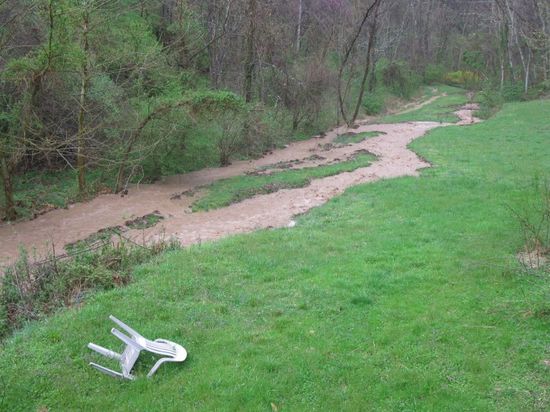
Flood1

Aaron Bady recounts the yearly spring floods in his Appalachian hometown:

Flooding has been getting worse and worse in the last decade or so, and as more and more of the dense network of Southern Appalachia’s creeks and streams — that once absorbed excess rainflow — have been transformed into post- mountaintop removal hellscapes, people whose campaign coffers aren’t filled with coal and industry donations have started to question whether there’s a relationship between increasingly regular and destructive flooding and the kind of environmental devastation necessitated by [mountaintop removal] mining.

Attack Ad Of The Day, Ctd

Peter Suderman suspects that attacks like this will backfire on "those who continue to be genuinely happy with the precedent set by the Massachusetts health care overhaul":

[T]he more that liberals celebrate RomneyCare, the less appealing he becomes to the conservative base that dominates Republican primaries. Sure, Romney isn’t going to come out swinging in favor of ObamaCare, but so long as he doesn’t disavow the Massachusetts plan completely—which doesn’t seem likely—he’s going to be a lot more amenable to mandate-driven state reforms. And in general, he’s a lot closer to liberals on health care policy than any other potential GOP candidate.

Counting Triumphs, Ctd

A reader writes:

The Dish has been an important part of my life for a long time now, but I've never been so personally touched by it than when I read the post on Ms. Gilman's piece about her struggles with her son's hyperlexia. Ever since my brother was diagnosed with hyperlexia almost a year ago (he's going to be five years old in May), dealing with his condition has been a crushingly lonely experience.

Since hyperlexia was classified comparatively recently (1967, according to the Wikipedia article), there is very little literature online, there are very few specialists, there are very few case studies, and, worst of all, there is very little awareness.

There is a lot of emotional support out there for most families with special-needs children – be it Down Syndrome or Asperger's – but when it comes to hyperlexia, almost no one has heard of it. Many, including myself, assume at first that it must be the opposite of dyslexia, which sounds like it must be a good thing! My brother is hyperlexic! But once I learned that hyperlexia is actually a form of autism, and that my brother would never lead a normal life, and that all of my hopes and dreams for him would never come to be, and that he would never be able to have the kind of childhood that I had, and that he would always have difficulty making friends and relating to his peers, I felt a kind of pain I didn't even realize I was capable of experiencing. I cried. I broke things. I questioned my faith. My anger and my grief at the unfairness of it all was unbearable.

Why couldn't I be the autistic son and he be the Ivy League-educated son? I have done plenty in my life to the deserve the loneliness, the frustration, and the isolation that my little brother has been condemned with, whereas he hasn't done anything to deserve that.

Like Ms. Gilman, I came to view every aspect of his personality as nothing more than a symptom. No words can really describe the kind of anguish I felt when I learned that what I once viewed as endearing are really just manifestations of his disorder: his perfect recitations of entire episodes of Thomas the Tank Engine, his use of dialogues from Thomas to express himself (like screaming "I'm over-heated!" during a tantrum), his instant mastery of the Ipad (he knows how to use it better than I do), his memorization of roads and routes (he knows his way around town better than my sister, who'll be driving next year), his precocious reading ability (there are few words he is incapable of reading or spelling), and his obsession with numbers (he can count to 100 – forwards and backwards – in three different languages).

But again, the most painful part about this was the fact that I had so few people to turn to; I had to deal with the pain on my own. For a while, my parents even forbade me from telling others about his condition, lest he be stigmatized as the autistic kid (not realizing that this only further alienated people, who simply could not sympathize with or understand his bizarre manner of speaking and behaving). That's why it seemed almost like divine providence when I came across a post about something so relevant to my own life on THE DISH! It truly felt like a beacon of light had shown through in a cavern of darkness. Ms. Gilman's article was so touching because it mirrored by exact experience. And most important of all, by relating how she coped with her son's problems – by resetting her expectations – I too have been given some hope.
“A Power-Mad Egomaniac”

Trump_Book

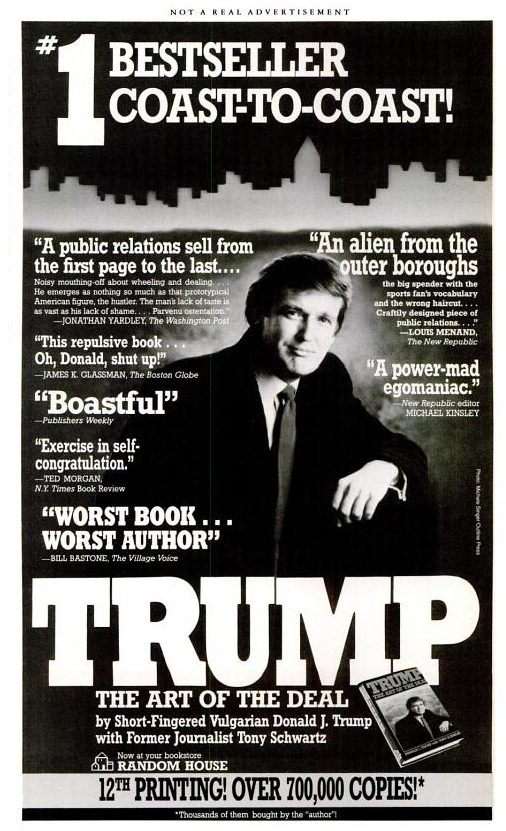
Alex Pareene fears that The Donald is serious:

Trump is giving every journalist in the country the opportunity to delve into his past financial troubles, his old political donations, his marriages, his horrid books, his failed business ventures, his defaulted loans — everything that the viewers of "Celebrity Apprentice" and the purchasers of Trump-branded crap don't quite remember through the mists of time. This is Trump undoing the years of public image rehabilitation that allowed him to host a show — on network TV, in prime time … He's politicizing his straight-talking billionaire persona, and soon only Free Republic commenters will have him.

(Photo: Fake Spy Magazine ad via Nick Baumann)

Before The Adult Sippy Cup

Mike Ervin, aka Smart Ass Cripple, remembers "the day when you couldn’t find a sippy cup that wasn’t embarrassing":

Sippy cups have always been a great piece of cheap assistive technology for cripples. If you want to drink a rum and coke, for instance, it’s good to drink it out of a sippy cup, especially if you’re the kind of cripple that’s prone to spilling, like a quadriplegic with no grip or a spastic. You get the most out of your rum and coke if you drink it out of the sippy cup because it practically takes an earthquake to spill it.

But way back when, the sippy cup manufacturers thought their product was only for children so no matter how hard a grown-up cripple tried, you couldn’t find a sippy cup without Winnie the Fucking Pooh or My Little Goddam Pony on it. So in those dark days, if you wanted to fully enjoy a rum and coke, you had to risk ridicule.