Trump’s Transformation

Andy Kroll reports on The Donald's growing extremism and his flip-flop on gay rights. DiA notes his flip on abortion. And Frum finds a silver lining to Trump's birtherism:

It used to be that the person offering the Obama-is-African-not-American message to the Republican primary electorate was a former speaker of the House, a fellow at the American Enterprise Institute, and a Fox News contributor: in other words, an eminent and respectable personage. Now Trump has stolen the Gingrich spotlight, knocked Gingrich out of the top 3. With the result that the bearer of the Obama-not-American message is a clownish TV personality in an absurd hairdo. That’s progress. Birtherism is being quarantined within the GOP. Better if it were repudiated and extinguished, but although this week was positive, it was not miraculous.

Weigel dutifully rebuts Trump's latest factual inaccuracies.

A Presidential Figure

Jonathan Chait says "electoral politics is a highly superficial field" and rules out GOP hopefuls like Mitch Daniels, in part, because, well, he's really short. Andrew Gelman fires back:

It really irritates me when pundits trivialize politics and insult the voters. I’m sure Chait means well and, yes, I know that most voters don’t know anything about the federal budget, probably half of them can’t find Miami on a map, etc. But there’s no evidence that people vote based on candidates’ looks. Certainly not in presidential elections where the stakes are high and their party identification is clear.

If you want to rail at the mistakes voters make and the problems with our political system . . . fine, go for it! There’s a lot to complain about. But please don’t slam the voters for something they don’t do.

I'm with Jon on this. Our votes are not entirely rational and politics, especially the presidential variety, is not totally meritocratic. And that doesn't mean the system isn't valid. It just means we are human beings. Chait defends himself:

[Gelman] concedes that [Haley] Barbour could be hurt "on ideology." But is Barbour more conservative substantively than most of his opponents? Not at all. Barbour is right in the Republican mainstream. His weakness is precisely the non-ideological aspects of his political persona. And then Gelman begins by saying such factors "wouldn't make much of a difference," but winds up noting offhand that we could be talking about a percentage point or two. That's a lot! Parties and candidates will kill themselves to move the needle a percentage point or two in a presidential race. And again, the fundamentals determine the bigger picture, but within that big picture political tactics and candidate quality still matters around the margins.

Three Months Later

Peter J. Boyer checks in on Gabby Giffords:

Giffords still doesn't know everything. She doesn't know that among the dead were a 9-year-old girl, her beloved young staffer, Gabe Zimmerman, and her friend, federal Judge John Roll. "When she starts asking for more details, we're going to tell her," Kelly says. "But she hasn't asked that specific question yet."

And, despite the chatter, Giffords hasn't been mulling a Senate run:

“We haven’t discussed any Senate race with her,” [Giffords's husband Mark Kelly] says. “And I have no plans to do that for some time. She’s focused on her recovery.”

Home And Dry

Trees

There are days in your life you always remember, days when some great burden is lifted or some grave news changes everything.

This is one of those days.

I remember the moment when I found out I had somehow gotten into Oxford University. My family had never had anyone go to college before, and the day the letter came, I felt my whole world move into a different orbit. I remember my first day in America, and the sense of something truly new and liberating in my 21 years of life. I remember my first kiss with a man, when the world that had previously been black and white suddenly burst into color. I remember the day when I found out I was HIV-positive, and the sky and my heart broke in two. I remember the day one of my dearest friends died in his mother's arms of the same disease. I remember the moment I first saw my first nephew, and simultaneously wondered if I would ever live to see him go to high school. I remember the day I got married, a strange, wonderful, totally integrating moment in my public and private life.

In my in-tray today was a simple email from my immigration lawyer with the content line saying simply "Congrats." I am still a little numb, reeling, unable to really think much, rapidly dialing my family and friends, listening to my husband open the letter over the phone and reading the words "Welcome to the United States." The "green card" was approved.

It has been a journey of 18 years – the promise of a new life and a new start for a jejune, precocious kid from England somehow always coming with an asterisk, the shame of my illness conflated with this crushing fear that I still did not belong and would probably never belong to the country I had fallen in love with.

Nothing scared me as much; nothing was able to get into my heart and soul with this level of anxiety and fear. Not HIV. This was deeper than HIV. It was a threat to the home from where I could fight the HIV.

Nothing in my future could confidently be planned; everything was a gamble that one day,  I could actually, simply, finally be secure in my own home with my own husband in a life that would have been so hard to rebuild from scratch somewhere else. That fear hanging over my head never left me from June 23 1993 to a few hours ago.

How do I explain it? So few understood, and so much had to be kept confidential. How do you express living a life rendered so provisional to friends or strangers who see you as totally secure and have no way to analogize the otherness that followed me around? How do you live somewhere for a majority of your existence and still not know if you could remain for another year, another month, as each visa was sent for adjudication and each trip abroad became full of foreboding. And as the time went by, as the stakes grew, as I put down deeper and deeper roots of work, of friends and of family, the fear actually intensified. How much more traumatic would the uprooting be, when I had reached so deep into the ground?

And then it lifts. And I do not know right now what to do or say. Except to express my love and gratitude for my family and friends and husband who lived through this with me; and to those who helped lift the HIV ban; and to my lawyer who was simply magnificent; and to those who did what they could – and they know who they are – to keep this show on the road.

But I do know this. America remains the great dream, the great promise. For all its dysfunction, it remains an ideal, a place where the restlessness of the human mind and soul comes to rest in a place it constantly reinvents and forever re-imagines. I know this in my bones, perhaps more than many who take this amazing mess of a country for granted. But for the first time in my life, I do not feel somewhere in my psyche that I am displaced, unwelcome, an impostor.

I have indefinite leave to remain.

Tax Brackets 101, Ctd

2010FedTaxRates_2

A reader writes:

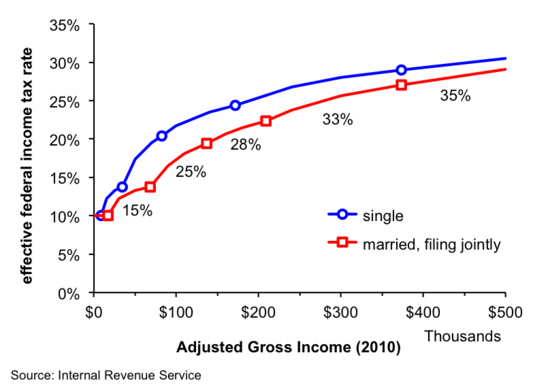
I made this graph to illustrate what happens to your effective federal income tax rates as your AGI increases. (I included several extra data points for the curve, but only showed the bracket points as marked data points.) I think people are thinking about effective tax rate when they're trying to understand marginal tax rates. This graph shows that effective tax rates increase relatively smoothly as you go up the income ladder. You don't see punctuated changes at the bracket points.

The implication is that it doesn't make much sense to significantly modify your income-earning behavior in order to stay within a tax bracket. The more you earn the higher the tax rate, true, but this increase is relatively monotonic by design.

Another writes:

Everything your reader writes about tax rates is correct, but he’s leaving two major pieces of the picture. For example, “Bill Gates pays the same taxes on the first $10K that he makes as does the Safeway clerk on the first $10K that she makes.” That’s theoretically true, but the practical truth is very different, due to the effect of deductions and the taxation of capital gains and dividends, and the effect of payroll taxes.

So let’s focus on Bill Gates.

Back when he was CEO, his salary and bonus for was just under a million dollars a year. However, he also owns 580 million shares of Microsoft. Microsoft pays an annual dividend of 64 cents a share, so he has about $370 million a year in dividend income. In the past year he has sold about 80 million of his shares, at the current price that would mean a hair over $2 billion in capital gains.  In the US, capital gains are taxed at a maximum tax rate of 15%. Dividends are taxed at the same rate.

So let’s look at Gates’ income summary (in millions):
Income taxed as income:                                             1
Income taxed at a maximum rate of 15%:             2,371

Well at least he’s paying at a higher rate on that $1 million right? Probably not. While I’m not privy to his 1040, almost certainly he has deductions that completely cancel it out. His primary residence is reportedly valued at over $50 million. There’s a good chance that just the property taxes on that eliminate any income tax liability. If they don’t, surely he can spend $2 billion in a way to generate a million of deductions.

Finally, your reader overlooked a tax that is important to low-income earners – payroll tax. Payroll tax is 7.65% of income. The hypothetical $10,000 earner doesn’t pay just $1,082 in income tax, but also $765 in payroll tax.  That’s a big bite. Now, the Bill Gateses of the world do have to pay payroll tax, and it's on every dollar of income, so there are no deductions – but it’s capped at $106,800 of income, or $8,170.  That’s the most Bill Gates would pay on his $2 billion-plus income.

The hypothetical worker with $10,000 in income pays $1,847 in total federal tax, or 18.47%.  It’s inconceivable that Bill Gates pays a rate over 15% and it’s likely substantially less.

Another:

Your reader leaves out a really important point (as I'm sure he/she knows, but didn't want to confuse folks).  The reader writes: "An individual's marginal income tax bracket depends upon his or her income and tax-filing classification."

Not true.  It should be edited to say "depends upon his or her TAXABLE income."  For instance, I dug out my two most recent tax returns. I'm married, 2 kids, have a mortgage, but make no special effort to avoid taxes at all.

2008 Income: $90K, Taxable Income: $56K, Tax: $5K Total tax rate is <6%
2009 Income: $114K, Taxable Income: $81K, Tax: $12K Total tax rate is 10%
In 2010 I will take the tax-loss from the business I started in 2009 and probably pay almost no tax at all.

Not even counted in the income above is money I made from investments in a SEP-IRA (which will be taxable income when I withdraw it) and ROTH-IRAs (which will never count as income).  So if you look at nominal income and the tax brackets you would think I pay 25% when in fact I pay about 4%-8%.  That's a big difference.

Of course there is also property tax, state and local tax, sales tax.  But taken all together and given all the services and opportunity I receive  from living in the USA,  I'm seriously under taxed.  If letting my effective federal tax rate rise from 4%-8% to 15% would help balance the budget, I'm all for it.

Our complicated tax system seems designed to make taxes seem high, while actually being very low.

Why Would Fox Dump Glenn Beck?

Rick Hertzberg's guess:

With Beck and his chalkboards … there’s an ever-present danger of distraction or worse. It would be an inconvenience if, every couple of weeks, the G.O.P. candidate and his or her surrogates had to choose between agreeing with (or just temporizing over) some exotic new Beck conspiracy theory or disavowing it, thereby alienating Beck and his army of head-nodders.

The Shutdown That Wasn’t: Reax

AP_SHUTDOWN_PROTEST_CROP_110408

Dave Weigel:

Let’s go back to the raw politics. Can we say that Republicans got the better of the no-shutdown deal? Yes, because if there had been a shutdown, Republicans would have been blamed for it. The record was all cued up. Democrats spent months predicting that Boehner would have trouble controlling his new Tea Party members. They spent this week saying he had to put the Tea Party “horse back in the barn,” as Dick Durbin said. Well, there’s a deal – the implication is that he put the horse back in the barn. If the Republicans would have been blamed for a shutdown, it follows that they get credit for a shutdown being avoided.

Nate Silver:

[T]he notion that Democrats were going to get a radically better deal, with Republicans having such a large and conservative majority in the House, is probably unrealistic. It’s also conceivable that they would have gotten a worse one — say $45 or $50 billion in cuts — had Mr. Boehner made a bolder offer initially.

Jonathan Chait:

I’m not sure I can think of an example of a party that leverage[d] control of one House of Congress into significant policy movement in its direction on a high profile issue. When Democrats took control of the Senate in 2001, there was the sense that they could limit the ambition of President Bush’s domestic agenda, but nobody considered the possibility that they could force Bush to move policy in their direction as a condition for keeping the government open. Even when the Democrats won both Houses of Congress in 2006, they used their leverage merely to veto additional policy changes in Bush’s direction, not to adopt their own policy goals opposed by Bush.

Ezra Klein:

[W]hy were Reid and Obama so eager to celebrate Boehner’s compromise with his conservative members? The Democrats believe it’s good to look like a winner, even if you’ve lost. But they’re sacrificing more than they let on. By celebrating spending cuts, they’ve opened the door to further austerity measures at a moment when the recovery remains fragile. Claiming political victory now opens the door to further policy defeats later.

Andrew Stiles:

 Republicans should feel plenty confident heading into the upcoming debates over the debt ceiling and the 2012 budget, Paul Ryan’s daring proposal to cut the deficit by $6 trillion. This deal, thanks to Boehner’s robust leadership, was a good start — much less for the size of the spending cuts it yielded than for the political dynamic it revealed. They will need all the political capitol they can muster going forward, because it’s only the beginning.

David Frum:

The debate dramatizes how completely budget policy has displaced economic policy in Washington debate. Tonight’s action may help stabilize federal finances. But even economists who support spending cuts will acknowledge that the immediate effect of cuts is to subtract demand from the economy. A strongly growing economy can sustain and benefit from this demand-subtraction. The US economy in 2011 is not a strongly growing economy. Yet how much time has the new Congress spent debating ideas to accelerate growth?

Ryan Avent:

Everyone involved should be embarrassed. But few journalists seem to think that this absurd sequence of events will in anyway reduce the likelihood of an even greater mess down the road when it comes time to raise the federal debt ceiling. The case for raising the debt ceiling is incredibly strong. … And yet, the government will likely be pushed to the edge of crisis. These fights are risky and counterproductive. Sadly, I suspect that the reaction of most of the Washington press corps will be to—once again—get so caught up in the tick-tock of the dramatic showdown that they'll neglect to point out just how magnificently the elected leadership in Washington is failing its citizenry.

Kevin Drum:

I suspect Obama really is a long-term deficit hawk and figures that the current budget battle, though not really of his choosing, can be turned to his advantage. He's agreed to cuts but also shown that he'll fight against crazy cuts, and he thinks that will help him take the high ground when he unveils his own long-term deficit program on Wednesday. This isn't how the events of the past week look to us liberals, of course, but I'll bet it's approximately what they look like to independents. And as we've all learned over the past couple of years, Obama doesn't really care much about how liberals view events.

Peter Beinart:

 It is more than a little depressing that Boehner—who embodies the regressive, lobbyist-driven politics that Obama was supposed to banish—is now Obama’s political wingman. But that’s what has become of the Obama revolution. Not long ago, this was an era of liberal dreams. Now liberals must content themselves, once again, with reelecting a Democratic president, even as his interests and theirs continue to diverge.

Ross Douthat:

[T]here’s a case to be made that Reid and Obama would have been better off taking a much harder line, and then just sitting back and chuckling as the Tea Party caucus pushed an unwilling Boehner off the plank. So why didn’t they? Well, maybe they put country before party, and calculated that shutting down the government over what amounts to a fraction of a fraction of a vast federal budget would be horribly irresponsible, even if it made liberals happy and redounded to the Democratic Party’s short-term benefit. If so, good for them.

Josh Marshall:

The costs in terms of over-zealous cutting are small — very small — in comparison to the vast decisions to be made next. For that reason, I'm not convinced yet that this was quite the defeat for the president that a lot of people are claiming. It all depends what comes next. 

(Photo: U.S. diplomats and federal workers take part in a rally against the prospect of a government shutdown, Friday, April 8, 2011, in Washington. The rally was organized by the American Foreign Service Association (AFSA). By Jacquelyn Martin/AP)

Correction Of The Day

A reader writes:

First of all, this isn't a chart of Planned Parenthood "spending," as you say. If you read the source pdf  (which you guys even linked to!) you'll see that the chart is based on number of services provided, not their cost. Also, the Ezra Klein post you linked to, while technically accurate, badly obscures the important numbers. 

Planned Parenthood obviously doesn't do very many abortions compared to the number of condoms they hand out, but they still do about 330,000 abortions a year. That's a lot. How much? Compare that number to CDC data and you'll see that Planned Parenthood performs about a third of all known abortions in the United States. So, yes, they're a big abortion provider. 

I support abortion rights and think Planned Parenthood's a great organization. But I can't abide sloppy reporting or deceptive messaging, and you guys fell victim to both.