The Best Children’s Books

Chaplain Mike's favorite is Shel Silverstein's The Giving Tree. He uses the book to explain the concept of grace:

I had a “giving tree” when I was a young boy. It was not an apple tree, as in Silverstein’s book, but a weeping willow. She was the perfect climbing tree in which to go high, high, chasing my dreams. She had the wonderful vine-like branches on which to swing like Tarzan. When those branches fell, they became swords and whips and weapons with which to fight the forces of evil like Robin Hood. The shade of that tree filled our backyard with a serene place of rest on hot summer days. Where the trunk split into multiple parts, it formed a small platform just the right size where a boy could lie and think and imagine the wide world beyond.

Even as a grown man with children and grandchildren of my own, I think of that tree. I long to see her again, to climb and swing and feel her embrace. And when I read this book to my little ones, I rejoice to know that there is One who gives and gives and gives, who for some mysterious reason has bound up his own happiness with ours.

And that is grace.

Tech Transcendentalism

2886355241_ba5306cabe_b

Robert M. Geraci sees an uptick in those who believe in the Singularity, or "the moment when robots become transcendently intelligent and we, as a consequence, upload our minds into machines":

What we see is the emergence of a genuine religious tradition. Is it new? Not exactly: faith in technology to produce transcendent human conditions is centuries old. But this manifestation, whether it be under the label of transhumanism, Singularitarianism, or (as I’ve called it) Apocalyptic AI, has a cultural cachet that goes far and allows it to separate itself from other religious visions.

(Photo by Flickr user Don Solo)

The Paradox Of Genius

In a beautifully crafted essay, Maria Bustillos combs through David Foster Wallace's dog-eared and highlighted books:

One surprise was the number of popular self-help books in the collection, and the care and attention with which he read and reread them. I mean stuff of the best-sellingest, Oprah-level cheesiness and la-la reputation was to be found in Wallace's library. Along with all the Wittgenstein, Husserl and Borges, he read John Bradshaw, Willard Beecher, Neil Fiore, Andrew Weil, M. Scott Peck and Alice Miller. Carefully. …

To sum up: all his life Wallace was praised and admired for being exceptional, but in order to accept treatment he had to first accept and then embrace the idea that he was a regular person who could be helped by "ordinary" means. Then he went to rehab and learned a ton of valuable things from "ordinary" people whom he would never have imagined would be in a position to teach him anything. Furthermore, these people obviously had inner lives and problems and ideas that were every bit as complex and vital as those of the most "sophisticated" and "exceptional."

Quote For The Day

"We know our world by learning about difference. What is the word we often use? Tolerance. Is that a positive notion? Not really. 'For the time being, I will tolerate you?' I'm against that concept. It means difference is a threat. Difference is a blessing and you don't tolerate a blessing. You embrace it," – Mohammad Mahallati, presidential scholar in Islamic studies at Oberlin College.

Is Philosophy A Luxury?

Professor Todd Edwin Jones defends his department in the face of budget cuts that would eliminate it:

Philosophers look at what can and can’t be inferred from prior claims. They examine what makes analogies strong or weak, the conditions under which we should and shouldn’t defer to experts, and what kinds of things (e.g., inflammatory rhetoric, wishful thinking, inadequate sample size) lead us to reason poorly. This is not to say that doctors, district attorneys, or drain manufactures cannot make decent assessments without ever taking a philosophy class. It’s also possible for someone to diagnose a case of measles without having gone to medical school. The point is that people will tend to do better if, as part of their education, they’ve studied some philosophy.

A Poem For Sunday

Lambros8-400x600

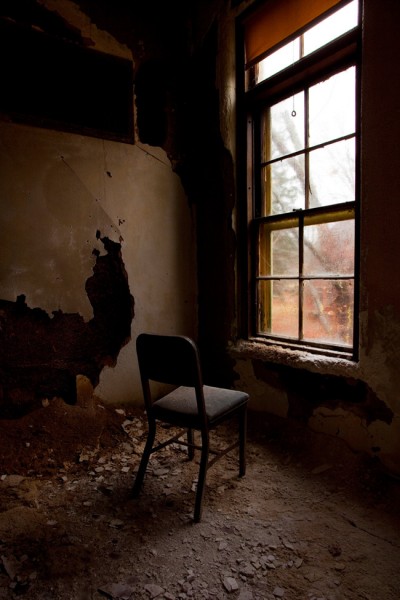
"Things Shouldn't Be So Hard" by Kay Ryan:

A life should leave
deep tracks:
ruts where she
went out and back
to get the mail
or move the hose
around the yard;
where she used to
stand before the sink,
a worn out place;
beneath her hand,
the china knobs
rubbed down to
white pastilles;
the switch she
used to feel for
in the dark
almost erased.
Her things should
keep her marks.

You can read the full poem here.

(Photo of Norwich State Hospital by Matt Lambros)

“Cancer Is Not The Concluding Sentence”

D. G. Myers contemplates life in the shadow of death:

As an organism, I react to cancer in ways that I am unable to control. As a person, though, I respond to it—and not to an organic process, but to a human drama. My response is entirely within my control. I can elect self-pity or a universe without pity or take an altogether different stance. The right question, then, is How am I going to respond?

Dying Authentically

Molly Tennyson recalls an especially moving tale about a dying man from her time as a hospice nurse:

Even though death happens to everyone, when it strikes, people are shocked stupid. They will repeat anything they've heard before and anything they've seen in movies; a strange vacuum forms in the wake of terminal illness that renders words inadequate. So grieving people often lean on stock answers for support. In turn, I try to speak authentically and honestly because these types of words are a little sturdier.

There is nothing about getting older that prepares you for dying. The process of dying, though similar for everyone, always feels so uniquely individual that the fact that the world continues to turn and Big Macs continue to be sold and there is a line at the DMV all feels like a great betrayal. But the world doesn't stop for death, even when it's our turn.

The Living Texts

Mark Vernon draws a lesson about the Bible from Plato's Symposium:

There is no one reading of the Symposium that's definitive. Love, like life, is both of us Plato-raphael and beyond us. And this is why the Symposium is a living text, and worthy of comparison with the real Good Book. Ultimately, it's not rational or even ethical, is not a distillation of wisdom or a consolatory read. Rather, it's a living text – and hence, like the Bible, has inspired art and further literature, architecture and generations of human beings. It forces us to read between its lines to glimpse something of the mystery of life, and thereby to want to make something of this most tremendous energy in life.

Or, of course, to draw back and flee in the opposite direction.

(Image: Plato by Raffaello Sanzio)