Yglesias Award Nominee

"The one thing I’ve learned in my years here is there’s one reason to talk about something, if you want to talk about it, to create a political climate. There’s another, the common sense way is what can I really get done? What’s the realities of the situation? And my recommendation to my friends in the House is, you know, it’s highly unlikely that many riders are going to get passed with a Democrat president and a Democrat Senate, so why don’t you take the spending and let’s get on to the budget," – Tom Coburn.

By the way, remember all those who told us the Tea Party was just concerned about the debt and were downplaying Christianism? I think we know better now. To shut the government down because Planned Parenthood offers some abortion services that are strictly segregated from federal funding is about as wacked as it gets.

Global Warming Gets Dialed To 11.1

W11temps

Brad Johnson explains:

This winter saw large regions of Canada and Greenland about 10°C (about 15-20°F) above the historical average. Temperatures in eastern Canada in the dead of winter were a staggering 21°C (37.8°F) above average. The extreme Arctic warming is wreaking havoc with the polar ecosystems and is linked to the catastrophic snowstorms that pummeled the United States. In a summary of how global climate change is becoming observable to people in their daily lives, NASA scientist James Hansen was forced to redraw his global map with hot pink.

Boehner’s Move

TPM reports:

Senate Majority Leader Harry Reid (D-NV) has laid a final offer at Republicans' feet, and it will require them to drop their insistence on defunding Planned Parenthood, and accepting what Reid insists is an agreed upon level of spending cuts. If Republicans don't take it, and if Reid's not bluffing, the government will shutdown.

TPM also interviewed a Tea Party freshman about why he's unwilling to compromise on this issue:

[Rep. Blake Farenthold (R-TX)] said the riders are important to voters back home. And if House Speaker John Boehner agrees to a deal which doesn't included the abortion rider, he could have a tough time convincing his members to go along with it. "I've gotta go back home, look people in the eye and say, look, I told you $100 billion, but I went for less, and I've got to have a because," Farenthold said. "Because I don't want to be perceived as a liar back home."

A Regular View From Your Airplane Window?

Rangiroa, French Polynesia

Rangiroa, French Polynesia, 12 pm.

A reader writes:

I don’t understand why you are getting rid of views from airplane windows. The daily VFYWs are such a treat each day, reminding us that the people who read and write on your blog are people attached to a place. In this, they represent the private, partial, and subjective aspect of political discourse.

But the airplane views are also emblematic of something that this blog seeks (in my opinion) to attain: a more universal point of view.

OK, so we may not all think such a thing is possible, but the airplane views remind us that we should aim our discourse at something that goes beyond our own individual viewpoints and takes a broader perspective. We see ourselves in those photos not exactly from a “God’s eye view,” but nevertheless from something approximating it. This is good, and healthy, and reminds us that we are part of something larger than ourselves.

Several readers have expressed similar sentiments. Another:

I thoroughly enjoy the VFYW series, but only when it has something to offer.  Yesterday’s Valley Forge shot does nothing for me.  It’s trees.  Could be Kansas City for all I know (or care).  It’s trees.

The aerials, though, I really enjoy.  The Provo, Utah shot I can relate too (my wife’s family lives there).  We’ve flown to Salt Lake many times, and this shot is from the air traffic approach pattern for SLC. This view is in fact incredible, as are many of the other aerials you’ve featured.  But even if I haven’t flown over something, I think the shots are great (and informative).

Perhaps a weekly feature?

John Cole’s Debt Solution, Ctd

A reader writes:

I know John Cole is being harsh, but come on.  If you read the very next sentence of his post (beyond the end of your quote), you see that he isn't suggesting that ending the Bush tax cuts will solve the fiscal crisis.  He merely says that we will be better off – with that simple step – than under Ryan's plan.  Yet you intentionally misrepresent his point as saying "he seems to believe this will actually end our looming fiscal crisis."  I don't read your blog to see unfairness responded to with misrepresentation.  Do you disagree with his point?

When we have the kind of fiscal meltdown in the future that we face, offering nothing but an end to the Bush tax cuts for the wealthy is not serious. And Cole offers nothing else but bile, ad hominems and class hatred. Another writes:

Distributionally, the Ryan plan is a monstrosity. The rich would receive huge tax cuts while the social safety net would be shredded to pay for them. Even as an opening bid to begin budget negotiations with the Democrats, the Ryan plan cannot be taken seriously.

Bolding mine. That's not John Cole or "The Hard Left." That's Bruce Bartlett. Andrew, you blog in real-time and you let us see your reaction to events more or less the same time you do. That's why I've been visiting the Dish for so long. But, is it possible that maybe you just saw that Ryan was willing to target entitlement spending and that was enough for you to call his proposal "courageous" and "serious"?  You didn't really take time to study it in depth or reflect on it?

I was 17 in 1984, so I missed Reagan. Since then, my presidential voting record has been Bush, Bush, Clinton, Bush, Kerry, Obama. I only regret one of those votes – you can probably guess which one. I'm not "Hard Left." I'm not angry at Paul Ryan for his proposal – today's GOP will be today's GOP. There was a time, in my view, when the GOP was the party of realism and pragmatism, but that time is long gone. Clinton and the New Democrats co-opted that ground and the GOP has been moving further and further to the right ever since. So no surprise there – a dog's gonna bark. What is outrageous, not just to liberals, but to moderates like me, is that pundits like you swallow this stuff every single time they serve it up.
 
You keep insisting that tax increases won't do the trick, that Medicare is simply unaffordable, that the math simply doesn't work. But, Andrew, you never actually do the math and show it to us! The fact is, you can pretty much eliminate deficits in the 10-year budget window (Ryan's plan actually increases them) simply by allowing income, investment, and estate taxes to revert to Clinton levels. You can completely eliminate them if you also withdraw from Iraq and Afghanistan and scale back defense spending to pre-Bush levels, and cut the projected 2030 deficit in HALF.
 
That's your "budget crisis" in a nutshell. Now, long-term, we have a health care cost crisis. That crisis exists whether we try to pay for it with public or private dollars. Privatizing Medicare takes the costs we don't like off the Federal budget, but it doesn't mean those costs go away – it's just that private individuals have to pay those costs out of pocket. The well-off will be able to, and the poorest and sickest will not. Whether we ultimately decide to pay for it out of pocket or with tax dollars, we have to restrain health care costs: we need to get healthier, and we need to be more efficient in delivering health care. Full stop.
 
That's the serious discussion we need to have. Paul Ryan's budget proposal doesn't advance it. The Affordable Care Act did; today's GOP screamed "DEATH PANELS!" and Paul Ryan decried the Medicare cuts in the plan – cuts his bold, courageous, serious budget proposal quietly retains while repealing its revenue increases and cost controls. And again, that's fine. That's Paul Ryan and the GOP. But it's pretty freaking hard to take when Andrew Sullivan cheers this fraud and simulataneously attacks the president for being "unserious."

If you seriously believe that the cost-control plans in the ACA will solve the mounting fiscal crisis, then I think you're dreaming. There's no guarantee any of them would make a real systemic difference – although I heartily support them. Even your ideal solution sustains huge deficits and no balanced budget, let alone a surplus, in 2030. And giving elderly consumers some level of choice in their healthcare is precisely the kind of mechanism that could control costs. Individuals cannot borrow in the same way governments can. And so patients will try and get the best for their assigned money, and healthcare providers will have to compete for it. We've seen how good government is at restraining costs. I suspect consumers will be better. Which is, of course, the logic of the ACA. If you support ACA, why oppose giving seniors the same options from similar health insurance exchanges.

More importantly, I cannot see, given the extraordinary advances in medical science, healthcare and pharmaceuticals, how it is a reasonable answer to say: "we need to get healthier, and we need to be more efficient in delivering health care." No shit. But the cost of healthcare is a moving target which if left to government control will drag us all into collective bankruptcy. So, yes, at some point, we are going to have to admit that we simply cannot provide the best medicine for all because it will bankrupt us in ways that will also primarily hurt the poot. Rather than government picking who wins and who loses, I favor the market picking. That means, I know, that above a minimal threshhold, the rich will tend to be healthier than the poor. As long as we provide a safety net, I can live with that. I can certainly live with it better than some government board making decisions about how gets what and when.

And yes, I am largely glad that the Ryan plan, for all its blindspots, is on the table. Because, as my reader points out, it does actually tackle entitlements. That alone elevates it above the usual political fray. So far, Obama has proposed nothing adequate to grapple with entitlements' metastasizing costs in an era of technological miracles and a fast-aging society. The same can be said of the Tea Party. I've acknowledged and aired many valid criticisms of Ryan's proposal. But my core point is: we cannot say the same about the president's or the Democrats' plan to solve the problem. Because they have none.

Gas Tax And The Working Poor

111840345

A reader writes:

I want to tease out some deeper thinking around your support for a hefty increase in the gas tax.  Yes, we have to kick our habit.  Yes, a gas tax can be part of that process.  But I need to hear some consideration of the impact that would have on the lower classes in America. It may be different on the East Coast, but I live in the San Francisco Bay Area and the poor and working classes are being pushed farther and farther from cities where their jobs are often located.  Also, many working-class jobs require trucks to haul tools and supplies – maintenance, gardeners, handymen, etc.  Even when mass transit reaches their homes, which it often doesn't, the prices there are on the rise.  Bridge tolls are being raised year after year to reduce car usage. 

What are we to do?   

Logan Penza, a fiscal conservative, recently came around to the idea of a gas tax and considered its impact on the poor:

A gas tax increase doesn’t kidney punch consumers as much as in previous years.  When gas was $1.75 a gallon, a gas tax increase looked pretty nasty, as it would proportionally add a great deal to the cost of transportation.  But now that fuel-efficient cars are far more common and gas prices are already higher, even a large increase in the gas tax would not proportionally raise transportation costs all that much.  To the degree that expensive cars are less fuel efficient, the burden would fall on those who are both choosing to accept that burden and largely more able to pay it.

And to the extent that it might impact the working poor who must rely on older and less fuel efficient cars to get to work (especially given the continuing lack of reliable and safe public transport in many cities), the effect could be mitigated by a needs-based voucher system entitling them to discounts and operated through the food stamps program.

Another idea aired on the Dish is to use the revenue from a gas tax to lower payroll taxes for the working poor. I'd favor that – but would make the trade-off slightly revenue-positive as a whole.

(Photo: Gas prices of more than $4.00 a gallon are displayed at a gas station on April 7, 2011 in Los Angeles, California. National gas prices jumped by 10 cents over a week. The average price of a gallon of self-serve regular gasoline in Los Angeles increased 2 cents to $4.124, rising for the 16th consecutive day. By Kevork Djansezian/Getty Images)

Life Beyond Cougarville

Jesse Bering explores the little known world of gerontophilia, or a young person's erotic fixation with the elderly. Though there's no link between violence and gerontophilia, Bering contemplates the fuzzy ethical considerations of those who prey on the elderly:

Elder sexual abuse is reprehensible, of course; but from a bloodless moral philosophical perspective, it does raise intriguing questions about issues related to consent, trauma, and the impact of sex crimes on victims with different psychological and physical stakes. Is the rape of a 98-year-old Alzheimer's patient—who, whether we like it or not, has only a limited awareness of what is happening, just as the perpetrator says—comparable to, say, the rape of a lucid, vulnerable child who would have to deal with the emotional scars of such sexual violence for the rest of his or her long life, or a teenager who might be impregnated? …

Alas, from the perspective of psychiatry, gerontophilia is the youngest of all the paraphilias, and remains a great enigma.

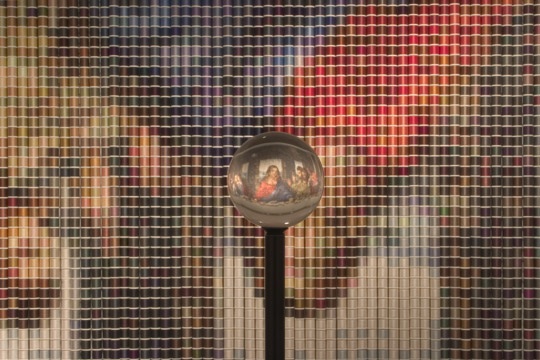
The Bible As In-Joke

Devorahsperber7

Alan Jacobs makes the connection by reading Tim Larsen’s A People of One Book: the Bible and the Victorians:

Tim’s thesis is that in major and often unexpected ways, Victorian culture is built around knowledge of and regular reading of the Bible — and this is true across the theological and atheological spectrum. … Today, it seems to me, there is no such truly common cultural currency. Instead, there is currency shared among small groups of initiates into certain mysteries, often meant to exclude others as much as to include the like-minded. This is what song lyrics and South Park quotes are for, after all.

(Photo: After The Last Supper by Devorah Sperber, made from 20,736 spools of thread.)

A “Fairy Tale” Budget

Bruce Bartlett slams Paul Ryan's budget:

It is less of a wish list than a fairy tale utterly disconnected from the real world, backed up by make-believe numbers and unreasonable assumptions. Ryan’s plan isn’t even an act of courage; it’s just pandering to the Tea Party. A real act of courage would have been for him to admit, as all serious budget analysts know, that revenues will have to rise well above 19 percent of GDP to stabilize the debt. 

Meanwhile, David Frum, who blasted Ryan's plan on Wednesday, lists those parts of the plan he likes. Money quote:

1) The Ryan plan accepts that tax cuts must be “paid for” with offsets elsewhere in the budget. That’s a welcome departure from the tax cut + borrow approach of the past.

2) The Ryan plan redirects Republicans away from the illusion that budgets can be balanced with cuts to NPR, foreign aid, etc. The money is in healthcare – and Ryan has started an important Republican discussion about healthcare.

In other words, it's a start.

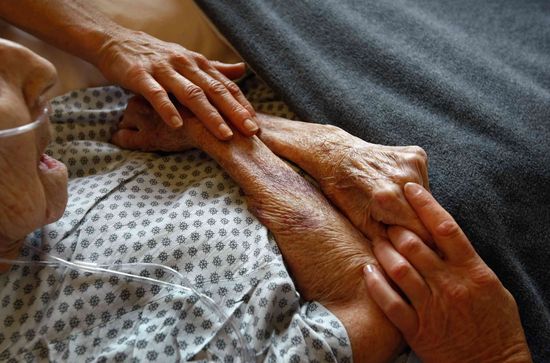
Rationing One Way Or Another

GT_DYING_04082011

Here’s one way of looking at the crisis in Medicare and, indeed, private health insurance. The diagnostic advances, pharmaceutical innovations, and bio-technology now available for doctors have transformed the very meaning of what constitutes health. Instead of being a limited number of options for a limited number of diseases, the sky is now the limit. This, of course, is a wonderful thing (without it, I would be dead by now) but it also means higher costs as health shifts from rescuing people from a few diseases to offering people any number of treatments to prevent illness, extend life and promote health. I can’t see any way around this cost. If we want to reduce this giant suck from the rest of the working economy, there are two options: have a government body decide which treatments can be afforded and which cannot; or have patients ration themselves by price. That is one core difference between the Democratic approach and the Republican one. CATO’s Michael Tanner puts it simply enough: “Rationing is going to go on within the Medicare system. It’s a fact of life” given financial constraints, he said. “The question’s going to be, is that decision going to be made by government and imposed top down under the current system? Ryan wants to shift that responsibility to individuals and from the bottom up.” Case in point: The Medicare subsidies proposed by Ryan would barely meet elementary health needs of seniors, and they would have to supplement them with their own savings if they wanted better care. The alternative would be not unlike what happens in Britain, where rationing occurs by waiting lists. My own view is that central government diktat on these things is more likely to provoke anger and even more heated debates and paralysis than now.

Every politician seeking to rein in costs will be called a callous accessory to murder (just take some time to see how the British parliament spends hours debating abstruse medical procedures and expenditures best left to doctors and patients). It will make “death panels” and “death traps” key parts of the political discourse.

But it also seems to me that empowering patients to choose from a variety of health plans should also include empowering them to make end-of-life decisions ahead of time. So much healthcare expenditure occurs by keeping people alive for a few more final days in an ICU. If only a fraction of Medicare recipients were asked – just asked – to consider a living will, and made one, we could move those huge and, in some cases, needless expenditures toward preventive care or better options for all seniors. But Paul Ryan will have none of that. And by abolishing Obamacare, he would also kill off several important cost-control pilot schemes. There’s a lot of good in his proposal, but also a lot of partisan posturing and bullshit math.

(Photo: Hospice volunteers caress the hands of terminally ill patient Annabelle Martin, 92, as her health quickly declined at the Hospice of Saint John on September 1, 2009 in Lakewood, Colorado. The non-profit hospice, which serves on average 200 people at a time, is the second oldest hospice in the United States. The hospice accepts patients regardless of their ability to pay, although most are covered by Medicare or Medicaid. End of life care has become a contentious issue in the current national debate on health care reform. By John Moore/Getty Images.)