Dissents Of The Day

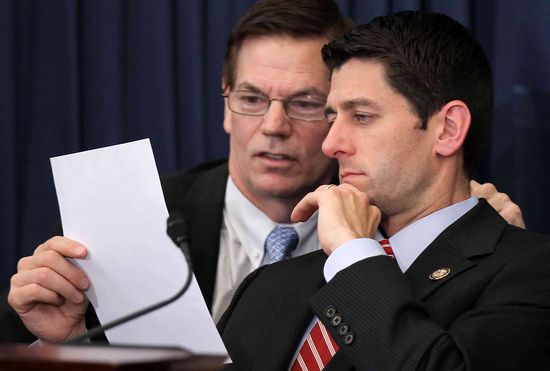
GT_PAULRYAN_04072011

The in-tray is still bulging with fury over Paul Ryan. I find the arguments bracing – and in themselves evidence that Ryan's proposal has already helped move the debate to more earnest grounds. A reader writes:

One can understand Ryan's appeal in light of the failure of almost every other Republican to even look like he's putting in the work. But to call it courageous is simply wrong and, as others have pointed out, elevates Ryan to a status he doesn't deserve. Since when does it take political balls to place the burden for reducing the deficit on a constituency – the poor, the old – with relatively little power to exact retribution? It hardly seems worth the effort to point out that suggesting we raise taxes would be the truly courageous act – there'd actually be something at stake. But Ryan can't even bring himself to suggest we repeal some or all of the Bush tax cuts – cuts that were sold as temporary to begin with.

Anything that even hints at sacrifices from the elderly – increasingly a bulwark of Republican support – has a long history of being political death. That's why I think courage is not a misplaced term here. Another writes:

Count me as a long-time reader who isn't angry at you over your support of the Ryan plan, but simply perplexed. 

Quite frankly, I don't know why you insist on calling this a "serious" proposal.  If the Democrats had proposed a plan that was based on cooked-up numbers and ridiculous assumptions from a liberal thinktank, that catered to Democrat interests while attacking Republican sacred cows, and that increased the deficit over the next 10 years while pushing the highly-theoretical deficit reduction out past the 10-year horizon, I think you'd call such a proposal exactly what it would be – fundamentally unserious.  Yet this is exactly what Ryan's plan does. 

You keep bringing up the British experience as a comparison for Ryan's plan, but nothing could be further from the truth.  The British are making their cuts TODAY.  Call their plan what you want, but it's serious and it's immediate.  Ryan's plan is just more of the sadly too-prevelant modern American way (one which both the Republicans and the Democrats buy into) – feast now, pay later.  I believe that deficit reduction will appear under Ryan's plan about as much as I believe that Shake Weights are all that's holding me back from a rock-hard physique.

Another:

You claim the plan is “serious” except for the “refusal to add new taxation to the proposal.” The thing is, given Ryan’s ideology, taxation is the only available test of his seriousness, and he fails it spectacularly! 

Let’s put it this way: let’s say the Obama administration had proposed a plan that repealed the Bush tax cuts, created a million-dollar tax bracket at 50%, cut military spending, instituted cap-and-trade, created a universal single-payer healthcare system, and provided massive funding for public schools in low-income areas.  Let’s say that the plan claimed as much deficit reduction as Ryan’s plan does.  Would you praise that plan as evidence that “we finally have a political party being honest about what it takes to avoid falling off a fiscal cliff?”  I don’t think even I would say that, and that’s a plan I would like a lot.

Any truly serious Republican budget would have included tax increases, or at least revenue-positive reforms to the tax system.  But the Ryan Plan is essentially a Grover Norquist wet dream, masquerading as fiscal responsibility.

Another:

By now you will of course have hundreds of e-mails on this subject.  Still, I can't avoid weighing in: You've been had.  You're very wrong that the Ryan budget "honestly reveals" anything.  For its sheer dishonesty, it's breathtaking.

1.  It raises the deficit right away, and for the next ten years (even given its dubious assumptions), by reducing taxes on the top 10% and especially top 1% of the income distribution.  (And it does this while raising taxes on almost everyone else.)  All the savings it posits depend on sharp benefit cutbacks to take place well in the future – cutbacks that some future Congress would likely reverse.   That mix hardly seems likely to reassure our creditors.

2.  The proposal's deficit and debt projections depends on economic assumptions that are fantastical.  The reductions in the top marginal tax rates are supposed to unleash an economic boom with no historical precedent.  (You're no doubt aware of the long-term unemployment rate projection of 2.8% imbedded in the original Heritage Foundation "study" underlying the proposal, since scrubbed from its website.)  Given more realistic assumptions, and the mix of tax and spending changes in the plan increases the deficit and debt beyond the current policy baseline.  This is pure snake oil.

3.  The proposal assumes that Federal spending outside of Social Security and healthcare can be squeezed from 12% to 3 1/2% of GDP (and that including defense!),  That's ultra pure snake oil.

4.  The cost of the new tax cuts for the rich are very nearly the same size as the projected savings from reduced Medicare and Medicaid spending.  All its "savings" come from fantastical economic assumptions (see 2) and even more fantastical assumptions about other Federal spending (see 3).

5.  The proposal reverses all the cost containment measures in the Affordable Care Act, and increases costs by moving people from efficient and relatively low cost Medicare to a dysfunctional and higher cost private insurance system.

6.  The proposal is politically cowardly.  The benefits of the largely white elderly and near elderly will be entirely protected.  That's the Republican base.  The benefits of the poorest and most vulnerable will be cut.  Meanwhile, most of the younger generation will pay higher taxes to support benefits for the elderly and near elderly far more generous than they will ever see.

7.  The proposal is fiscally reckless.  What happens after we explode the deficit via tax cuts for the rich over the next decade, and then today's  45 and 50 year olds demand benefits akin to what those slightly older have been getting?

The medical care and budget choices we face are fairly simple.  We can do a mix of three things.  1)  Implement the cost containment measures contemplated in the Affordable Care Act, and follow those up with much, much more.  2)  Put hard caps on public support for medical care spending.  3)  Raise taxes.  Reversing 2) and going backwards on 3) hardly counts as a serious proposal.

Ryan's plan is a three card monty trick for cutting taxes for the rich.  That's all it is.

Some responses. 1. The Bowles-Simpson type tax reform in Ryan's budget really does boost revenue, largely fom the rich who benefit disproportionately from the byzantine tax code. 2. Agreed. 3. Agreed. 4. As I understand it the lower tax rates for the successul are paid for by eliminating tax expenditures that largely benefit the wealthy. 5. I don't agree with repeal of Obamacare for precisely these reasons. 6. No possible reform of Medicare is going to dramatically alter benefits for those now receiving them. Suddenly yanking seniors into a different system than they bargained for would make any reform impossible. 7. My generation will have to suck it up. That's the price to be paid by both Democrats and Republicans failing to tackle this issue seriously in the past decade. and to my reader's final point: it amounts to crippling tax increases, crude government rationing and cost-control pilot schemes being expanded pronto. Another:

You seem to be giving the Ryan budget a lot of credit, not really for its substance, but because you think it opens a space for dialogue. But didn't the President's budget commission do this first? Yes, he ultimately walked away from it, but he ordered it, and he must have known what it would find. He is smarter than me, and I knew what it would find.

So, yes, the Democrats need to counter with a meaningful plan of their own, one that is much better than Ryan's. Hopefully, his regressive plan will be seen for what it is, and will be unconscionable to the American public. Give Ryan credit for furthering the conversation if you want, but give Obama credit for starting it.

But Obama started it and then walked briskly away. Another:

You make a fair point in wanting to see the next Democratic alternative proposal, but I would hope they at least get a few days’ grace period to put something together before you write off their criticism as “merely throw[ing] brickbats.”  Van Hollen has promised a proposal next week, so let’s see what they bring to the table.

Indeed. I have lots of issues with Ryan's plan, but it's the first time a Republican has publicly stood up and said Medicare as it now is is unaffordable and Americans are going to have to get used to a less generous program if we have any hope of living within our means. That's more serious than the Democrats' simple denial of the problem and silence on how to address it.

(Photo: Alex Wong/Getty.)
Polygamy In The Muslim World

Maggie Koerth-Baker describes two interpretations of how Sharia Law applies to multiple marriages. First up, the view of Pakistani geopolitics researcher Azmat Hassan:

Sharia Law says a Muslim man can have four wives, but it comes with conditions. You can have four wives IF you love, care for, and treat them all equally. Up to, and including, having houses for each of them. The Koran is trying to make a point here, [Azmat] Hassan says, and it's not that having four wives is awesome. Instead, you're to understand that it's impossible to be that fair to multiple spouses at once, and thus, understand why you should only have one. This interpretation is common, he says. In fact, he claims it's a big part of why polygamy isn't particularly popular in Pakistan.

Islamic studies professor Mohammad Mahallati's interpretation:

When the Koran gives thumbs up to polygamy, he says, it's in the context of talking about how the community should care for widows and orphans. In a world where it was difficult for a woman to provide for herself—and where there were no formal social programs to fall back on—encouraging financially stable men to protect widows and orphans through marriage made sense.

The Rapes Few Talk About

Jesse Ellison confronts male-on-male rape in the armed forces: 

What’s clear is that the Pentagon has only just begun to figure out how to treat men who have been sexually traumatized. Until 2006, sexual assault was classified as a women’s health issue, and even today, Pentagon awareness campaigns target women almost exclusively. Kathleen Chard, the Cincinnati VA psychologist who runs PTSD programs, says that more than 11 percent of the men she works with eventually admit that they were sexually victimized. Nationwide, there are just six programs like hers, and there is a single VA facility, in Bay Pines, Fla., that specifically treats male survivors of sexual trauma. When Matthews finally sought treatment for the PTSD caused by his rape, he says he had to wait six months for a space to open up. “I went to the group and there’s all these guys from the Korean War through Desert Storm,” he recalls. “And you say, ‘Oh, my God.’ ”

Suicide On Screen

A reader writes:

I would have to respectfully disagree with your reader who categorized the attempted suicide scene in The Royal Tenenbaums as "romanticizing and glamorizing" the act. As a person who has survived an unsuccessful suicide attempt, and someone who has also lost a loved one to the act, I've always found that scene to be profoundly sobering and unflinchingly honest. Stylized, yes, much like everything else Wes Anderson's done; however, it perfectly captures that woozy, almost dream-like state I recall myself being in before I tried to take my life.

I have a hard time watching it because of this, and depictions of suicide generally aren't emotional triggers for me, despite my past experiences. It's the obvious emotional nadir of the film, and nothing in the scene is sensationalistic or played for anything else than genuine pathos. Suicide doesn't seem like something painless or glorified in it, but rather searingly ugly and violent. It feels like a fever dream, or a particularly lucid nightmare. No other depiction of suicide in art strikes so close to home for me, save for Leonard Cohen's "Dress Rehearsal Rag" and pretty much Joy Division's entire oeuvre (Closer in particular).

Another also disagrees:

As someone who has suffered from terrible and regularly suicidal depression for his entire adult life, that scene in The Royal Tenenbaums seems like an anti-suicide plea to me. Not to mention doesn't it seem that …

It's not private because it can't be contained. It's not the end of suffering; it's the proliferation of suffering. It's not solemn, because most, if not all of the time, it's a mad scramble.

… is EXACTLY how the movie plays out the suicide attempt?  Yeah, things end up happier because he fails, but the implicit crushing of everyone close to him should it have succeeded is very obviously there to me.

Another:

Should we shy away from depicting anything that carries the kind of weight that suicide does in the real world? What about depicting murder, rape, war, bigotry? All these things, including suicide, have a long history of being represented, yes, as "art," but also as comedy, propaganda, satire, and pure entertainment. I think it would truly be a shame if our culture avoided engaging with the horrible and tragic aspects of humanity, even if those products do not do justice to the harsh reality. The fact is, the scene from The Royal Tenenbaums makes perfect sense in the context of THAT movie and THAT character, and should not be seen as a surrogate for any real-world circumstance.

Agricultural Terrorism

Alex Tabarrok claims that it would be "easy to do billions of dollars worth of damage to crops and animals with little risk of being caught":

Single bottles of wine from La Romanée-Conti, the legendary vineyard of Burgundy, sell for upwards of $10,000. In 2010 the owner received a threat, the vineyard would be poisoned unless the owner paid one million euro. When the owner didn’t pay a map was delivered that identified several vines that had already been poisoned by drill and syringe. The French don’t want to talk about this and for good reason, agricultural extortion is very easy and they fear copycats.

Megan McArdle wonders why such terrorism is rare:

In the case of terrorists, I think it's that they are not merely interested in body count; they're interested in high profile symbolic attacks.  Terror attacks aren't only aimed at us.  They're also aimed at the rich people who fund terror groups, and the young idiots terrorists want to recruit.  So while my Dad often points out that we're lucky the terrorists didn't think of collapsing a building on Grand Central Station or Penn Station–which would have choked off the flow of workers around the city for years, possibly decades–the fact is, they probably didn't want to go to their backers and say "76.4% of commutes in New York have now doubled!!!"  They wanted to take down the (one time) tallest buildings in the world, which they took as a symbol of our unbearable pride and arrogance.

Faces Of The Day

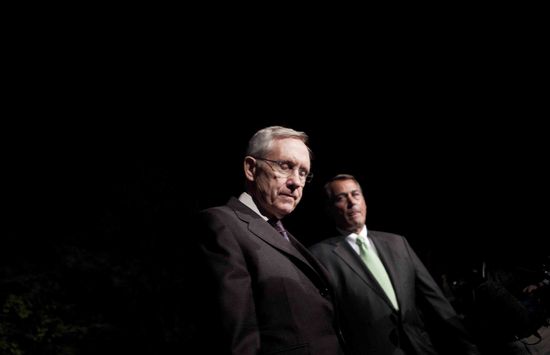
GT_REIDBOEHNER_04072011

Senate Majority Leader Senator Harry Reid (D-NV) and Speaker of the House Leader Representative John Boehner (R-OH) leave after speaking to the press after a meeting with Congressional leaders at the White House April 6, 2011 in Washington, DC. President Barack Obama met with Senate Majority Leader Senator Harry Reid (D-NV) and Speaker of the House Leader Representative John Boehner (R-OH) to break a stalemate in budget negotiations between the White House and Congress which could force the federal government to close on Friday. By Brendan Smialowski/Getty Images.

A Shutdown Surprise? Ctd

Nate Silver expects a government shutdown will focus the public's attention on Washington. Mark Blumenthal agrees

[A] real shutdown will raise the profile of the budget story considerably. The last government shutdown, in late 1995 and early 1996, caused the number of Americans following news about the budget debate "very closely" to nearly double (from 20 percent to 36 percent), while the number following the story "fairly" or "very closely" jumped by 19 points (from 55 percent to 74 percent) on the Pew Research tracking poll.

With that sort of increased spotlight, judgments about blame and performance are very much subject to change.

Trump’s Bump

PPP finds that the Donald has had "a 29 point increase in his net favorability [among Republicans]  over just a very short period of time." The bottom line:

The strength Trump is showing in horse race polls is a less function of Republicans admiring him due to his being a prominent successful businessman for decades and much more a positive reaction to all his far right rhetoric just in the last few months.

It will get much worse before it gets better.

A YouTube Original

Like Netflix, YouTube is getting one step closer to TV by planning to "carve out a niche of original, professionally produced Web videos that it hopes will cultivate loyal viewers":

After Google bought the site for $1.6 billion in 2006 and eventually faced pressure to turn it into a profit center, YouTube went on the hunt for feature content, like TV and movies, expecting such content would make it easier to sell ads. But that effort has been slow going as Google has so far remained unwilling to pay licensing fees on the same scale as Netflix and others.

From the beginning, YouTube also featured plenty of professional entertainment content, but it was often posted without the owners' consent. The site eventually implemented a filtering system in response to complaints from content owners.

Now, it is pursuing a middle way, investing in programming rather than spending huge sums to license it.

Brenna Ehrlich is tracking more developments:

There were also rumors buzzing around in February that YouTube CEO Salar Kamangar will be building out the site’s recently instated talent program by offering big-name stars their own YouTube channels. Those stars would then fill the channels with original content, while also keeping complete control of those three-minute videos. YouTube, in turn, would rake in the ad revenue.

And let’s not forget sports — YouTube is also apparently in talks with some major sporting leagues to bring even more live games to the site (it has already featured livestreaming Indian Premier League cricket matches).