Starving The Beast?

No, not our new colleagues. A reader writes:

As an independent and a long-term fan of the Dish, I read with great interest your initial support for the Ryan budget plan (not without reservation but plainly with much enthusiasm), and your subsequent debate with many of your readers and pundits (ranging from David Frum to Paul Krugman) who cannot understand your enthusiasm for the Ryan plan.  When reading your "defensive" posts, I understand and agree with your observation that Democrats need to have a full-throated response based on their values to compete with this (dreadful) Ryan budget.  Agreed.

But the reason I think your readers cannot understand your reaction is that you do not acknowledge in any of your posts that this Ryan budget plan is mostly a political, and not an economic, plan. 

Indeed, it is the culmination of about a thirty year Republican strategy called "starve the beast," by which Republicans have worked to reduce taxes and increase the national deficit as large as possible -  all to create the supposed "deficit crisis" that we now face and to use that crisis to eliminate programs like Medicare, Medicaid, Social Security and a slew of other programs (EPA, SEC, Planned Parenthood, collective bargaining, etc.) that the Republican class has never been able to eliminate through the democratic process.  This "starve the beast" Republican strategy has been openly acknowledged for years and I know you are well aware of it.  And the Ryan "budget plan" is transparently an attempt to cash in on this long-standing political agenda.

So, frankly, why is there no acknowledgment by you of this? 

There is, in as much as I have detailed my objections to a budget balancing plan that raises no new revenues. But the proposals on Medicare and Medicaid would undoubtedly cut costs over the long run, and would obviously inflict sacrifice on many Americans. That's why I remain of the view that the debate kicked off by Ryan is a good thing, because for the first time, the GOP has essentially owned and fessed up to the human costs of fiscal reform. From Reagan to W, with the great exception of George HW Bush, Republicans have told us we can have our cake and eat it. That's not the tone of Ryan's austerity. And that alone is worth something.

What Happened To “Replace”?

Among Ross's criticisms of Paul Ryan's budget:

It repeals, but doesn’t replace. Obamacare disappears, in other words, and nothing takes its place.

We know that this isn’t Paul Ryan’s personal preference: He wants to repeal the new health care law and replace it with something like the bill he co-sponsored with Oklahoma’s Tom Coburn, which would convert the tax exclusion for employer provided health into a universal credit. But apparently that’s still a bridge too far for many of his colleagues, which means that this budget would take us back to the unacceptable pre-Obamacare landscape, in which the (ever-growing) number of Americans who don’t get health insurance through their employer are massively disadvantaged in the insurance marketplace. In a budget that imposes plenty of pain already, a return to the status quo ante on health care is a very bad idea.

I agree. What we desperately need is some conservative buy-in on the cost-control experiments in the health insurance reform. And an embrace, not a demonization of asking Medicare patients to plan their end-of-life decisions in advance. What if we managed to reduce end-of-life intensive care by a third? There are some huge savings there, which is why Palin's demagoguery has been so toxic to fiscal conservatism. You cannot be a party in favor of fiscal restraint and yet oppose the very cost-controls that Obamacare has innovated.

A Shutdown Surprise?

Most sane people are taking a breather from immersion in politics right now. We're past an election season, the primary battle is in suspended animation, hard news is dominating, as Nate Silver points out. So what if a government shutdown comes at voters like a bolt from the blue at the same time Paul Ryan is marking up his budget plan? Nate notes:

[M]ost voters are not expecting a shutdown, so if one were to occur, the political winds could go from being nearly still to gale-force in a hurry. Mr. Ryan’s proposal covers fiscal year 2012 — not 2011 — so it has nothing to do with the shutdown in a statutory way. But voters could very easily conflate the two, particularly if his proposal is voted on in the House while a shutdown is under way.

Does that mean Democrats ought to be drawing more attention to it? Perhaps, but getting the attention of a voter who is disengaged from politics is no easier than getting the attention of a teenager who is playing with an Xbox. Then again, a shutdown might be the equivalent of the only worthwhile solution: pulling the power cord.

It seems to me to be politically suicidal to shut the government down over relatively trivial sums given the much larger fiscal crisis that looms. But it also seems to me that Boehner has little choice but to placate the Tea Party. And placate them he will. What that might mean for raising the debt ceiling I do not know but fear the worst. And in this battle, voters are already more primed to associate the president with a genuine will to compromise than the GOP.

Moore Award Nominee, Ctd

In response to Wasserman Schultz's "death trap" cant, Weigel digs up a quote of hers at the time of the Tucson shooting:

I think we need to be leaders by example, and when we do that, then hopefully we're gonna be able to push the shock jocks and others outside our process to take a page from our book. And if we have a more productive civil discourse, then we can really live up to President Obama's words and Christina Taylor Green's dreams, her expectations for our democracy.

Why Is NPR Cooler Than PBS?

Mark Oppenheimer explores:

Today, if you want to do creative television, chances are you would take a job at HBO, AMC, or Showtime; it is unclear why, given the greater freedom (and money) those cable stations offer, you would work for PBS. Meanwhile, the radio situation is reversed: it is unclear what kind of self-loathing idiot wants to work on programming at a Clear Channel radio station.

The Clarification We Need

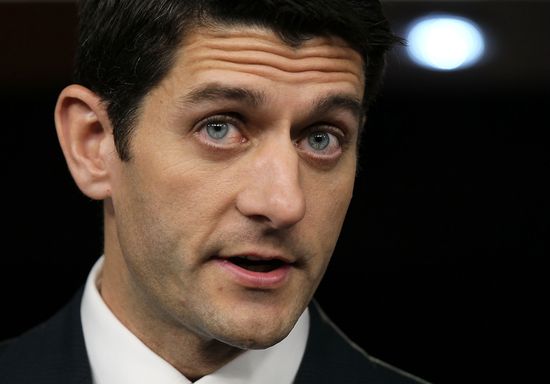
GT_PAULRYANFACE_040611

I don't want to – and haven't dismissed – the real flaws in Paul Ryan's proposal for cutting the debt. In fact, I agree with readers who want much more tax revenue in the plan, and oppose any more tax cuts in the current fiscal climate and find the gutting of all discretionary spending the dumbest form of budget balancing. But here's the thing: I've already heard more proposals from readers to tackle this problem in the last couple of days than I have in ages. Give Ryan credit for opening that debate. Here's a hypothetical liberal alternative:

– Raise spending slightly.  You know, single-payer healthcare, high-speed rail, more education funding, and LOTS of green energy investment.

– Raise taxes on those making over $100,000 to 40%.  Over 250,000 to 50%.  Over $1,000,000 to 60%.  Think that's crazy?  Go look at income tax rates in this country from 1950 through 1980.  We lived.  And we did so at a time with far less government spending.  Corporations?  Let's start with making GE pay its fair share, and we'll go from there.

Both will reduce the deficit (over the very long haul). But guess which America I would want to live in?

The one with rampant poverty, no competitiveness in the global economy, hopelessly addicted to oil we can't afford, and the highest Gini coefficient on the planet?  Or the one with a strong middle class, an answer to our long-term energy needs, real healthcare for all citizens, and rising worker competitiveness due to a better educated populace?

I'm not advocating the hypothetical mirror plan I just devised. But if you are so concerned about deficit control that you are willing to endorse the Ryan plan, despite it being blatantly and ruthlessly built on the backs of the poor, then will you really argue with my plan, built on the backs of the wealthy?

Go ahead, I dare ya.

If the math adds up, I think that proposal would be extremely healthy for the public discourse. What one hopes the Ryan plan might do is generate a debate that actually talks of the necessity of drastic tax hikes or drastic spending cuts. I want the Dems to contribute to this debate by articulating and defending the massive tax hikes they'd prefer with the same candor that Ryan has with entitlements.

The key thing is that we're finally having a real conversation based on the real but nasty choices we have to make sooner rather than later. No more fictions that we can just cut pork or foreign aid and be fine. No more nonsense from the right that no taxes can ever be raised; no more claptrap on the left that we do not face a crippling problem, and that middle class entitlements are sacrosanct. I want some sort of compromise that retains fiscal responsibility. For that to happen one side has to first own their solution. Ryan has now done that – for good or ill.

When will the Democrats?

(Photo: Alex Wong/Getty.)