There’s No App For That Yet, Ctd

A reader writes:

A reader wrote:

"It is necessary to get The Dish in app form, as it is imperative that I be able to absorb Dishness in a non-browser format while I take a crap. Especially in the morning."

You replied:

"We've raised the issue with the Daily Beast's tech team. We'll keep you posted. But it's one of our highest priorities."

Would you say it's your Number Two priority?

Heh. Another suggests a short-term solution:

For those that want to read The Dish on the crapper, but don't have an app, I have three letters: RSS.

Another:

I read the Dish every morning on my subway commute using an RSS reader that downloads all of my favorite blogs locally to my iPhone and iPad. It's called "Pulse". My brother is an intern on the development team. It's awesome, very easy to use, and incredibly intuitive.

Another:

I use the free (ad-supported) version of MobileRSS on an iPhone. The Dish on MobileRSS is just as easy to navigate and read as it was on the Atlantic app, and the former is more stable to boot (so far).

Another:

A great RSS reader: Netvibes – which I can access from my fairly restrictive work site, and which has a cool mobile version (for reading in the subway, on the crapper, etc.)

Another:

A big thank you to the reader who suggested that I can still get my fix of the Dish at work – despite my employer's block on the Beast – by accessing your content through RSS. I'm using Google Reader and it works beautifully.  Also, my shakes are gone.
The Needs Of The Child

VgWvr

Rob Tisani is working on an excellent point-by-point rebuttal to marriage equality foe Robert George. In his post on religious freedom, Tisani asks:

Will it harm children to place them with a couple who will openly condemn homosexuality?

Among his reasons for raising this question:

Our opponents have already accepted this thinking, whether they realize it or not. Their frequent argument against adoption by gays and lesbians? That it should be about the needs of the child, not the wishes of the adult. Surely, then, this applies not just to the wishes of gay and lesbian adults, but the wishes of homophobic ones, too. Either way, the needs of the child come first.

And can we please remember that many children are actually gay? And that gays and families are not mutually exclusive groups?

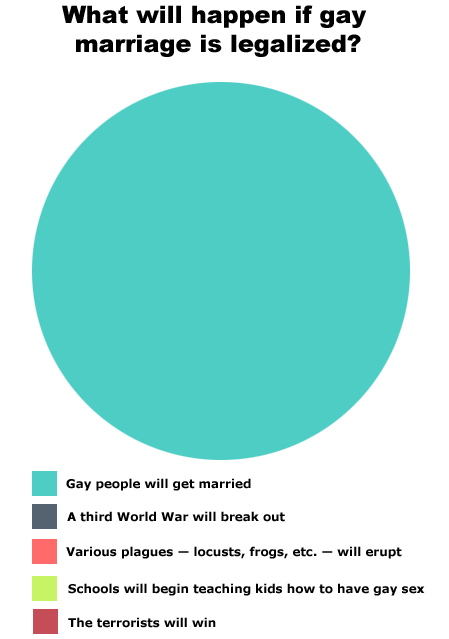
(Chart via Reddit)

The Long-Term

Matt Yglesias asks why the budget gets more attention than the climate:

I can’t quite get my head around the combination of Washington’s obsession with decades-away projected fiscal shortfalls and it’s total lack of interest in decades-away projected climate disaster. If you asked me why the political prospects for addressing the climate crisis are so bleak, I’d say it’s easy to understand. The worst effects of it are in the fairly distant future, the rich old people who run the country will be dead by then, etc. But at the same time, everyone’s obsessed with the idea that Medicare will be too costly in 2070.

Ryan Avent adds that "many of the policies one might want to adopt to reduce emissions are also good ways to raise revenue." Amen. But climate change will not lead to a collapse of the American economy, like fiscal default would. And good luck with what's really necessary: a big gas tax hike.

The View From Your Airplane Window, Ctd

ProvoOremAirplane

A reader writes:

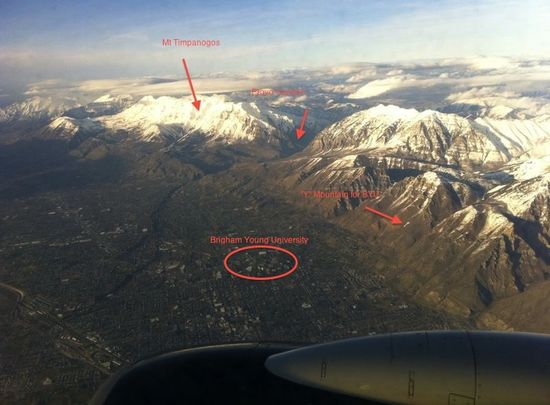
That‘s not Salt Lake City; it’s looking down on Provo and Orem, just farther south. In the middle is Mt. Timpanogos, with Robert Redford’s Sundance resort on its back flank. Provo Canyon leads up the center of the frame off to Park City.  You can see the large concrete “Y” on the mountain just above Brigham Young University, and if you zoom in super close you can see my mom and dad’s house! Thanks for a fun view.

Another sends the above image and writes:

Perhaps a minor detail, but for those of us who call that beautiful valley home, I think the Provo/Orem area deserves its own props.

By the way, we said the previous plane views would be the last batch, but the following pair is simply too stunning to pass up:

Male-Maldives

Male, Maldives, 10 am

Fairbanks-AK-11am

Denali National Park, Alaska, 11 am

Making Libya, From Scratch

Andrew Exum imagines the country after Qaddafi: 

The Italian governors of Libya systematically undermined the old Ottoman administration, which they viewed as a threat. Gadhafi, incredibly, managed to make things worse. Suspicious of the very idea of the Libyan state, he denied such a state was necessary and undermined any attempt to create functioning bureaucracies. This will be the Libya that whoever replaces Moammar Gadhafi will inherit.

The challenges for all international partners who seek to support a new government in Libya will also be immense. Most post-conflict states … go through a stage where external aid exceeds the the government's capacity to effectively administer it, creating conditions ripe for corruption. In Libya's case … , you will [have] a similar situation with both a) a lot of government oil revenues and b) very little bureaucracy capable of redistributing resources within the society.

It could make post-Saddam Iraq look advanced. But in the well-intended rush to prevent a massacre in Benghazi, we took a measure of responsibility for the outcome.

“Childish Drivel” Ctd

Not all emailers have been nasty. Here's a sane one:

Look, I am all for reducing the deficit, massively reducing the deficit. But when these Republicans come up with cut, cut, cut, cut yet not only no tax increases but tax cuts, I find them wanting. It seems their goal is to shrink the deficits with spending cuts, blow it back up with tax cuts, rinse, repeat. When Paul Ryan proposes a plan that matches his spending cuts dollar for dollar with tax increases, then I will call him courageous. Until then, sorry, I just cannot take him seriously.

It would also be possible to come up with a plan that has $2 of cuts for every $1 of tax hikes – which is not far off what the Coalition government in Britain has done.

The reason I am glad that Ryan has put out his report is that it honestly reveals the sheer scale of the problem, and cannot hide the fact that it will hurt seniors, the poor, and the middle class. For so long now, no Republican has fessed up to the pain involved in balancing the budget. Whatever its flaws, the Ryan plan shifts the debate to more realistic grounds, which is a success in and of itself. Another writes:

Like you, I had an initially positive reaction to the Ryan plan, but as I read more and more, the only positive I take away is that someone had the courage to propose a plan that is easy to 'death panel'.  So kudos for showing the courage, but I think his plan falls apart in the details and the assumptions.

Especially related to a number of things Krugman is pointing out:  extreme cuts to domestic spending, his rosy assumptions on a jobs recovery that has no basis in recent (since 2009) or distant (1980's) history and a robust real-estate recovery which has not even started yet despite very low interest rates.  If you assume you can cut more than you can cut and assume that your tax revenues are going shoot up from jobs that probably won't ever appear, you can propose just about anything and look fiscally sound when you roll the numbers up.  I.e.  Garbage in, Garbage out.

That said, I am holding out hope that the other side of the government shutdown mess, we find Obama counter-proposing, perhaps with more realistic assumptions and a more revenue positive proposal.

Yep, the ball is in Obama's court. Will he exploit this for electoral gain or offer a more equitable proposal to get to the same place? The answer to that will tell us a lot.

Bouncing Back?

111751507

A little good news:

Pro-democracy fighters have regained ground in a new advance on the oil port of Brega in eastern Libya. Rebels said the loss of ground early this week to forces loyal to Muammar Gaddafi is a normal occurrence in fluid desert wars, and will not prevent them from ousting the Libyan leader.

Meanwhile, NATO stepped up the pace of its air campaign over Libya on Wednesday, a day after facing fierce criticism of not doing enough to protect civilians in Misurata. The alliance dismissed opposition criticisms saying the safety of civilians is its top priority and pledged to do everything it can to ensure that. It accused Gaddafi's troops of hiding tanks, troops and heavy weapons among civilians to stop NATO aircrafts from air strikes.

But there is a new sign of vulnerability on the rebel side:

Attacks by government troops this week have also halted production in rebel-held oil fields, just as a tanker with the first shipment of crude left Tobruk on Wednesday. The rebels have a deal to export oil via Qatar and use the profits to pay salaries and buy food, medicine and arms to fight Gaddafi.

Hafiz Ghoga, a rebel spokesman, said groups of armoured vehicles attacked the oil field of Messla and of Sarir early this week. "I think we will not depend on oil revenues in the coming stage because our production has been affected in this crisis."

And:

Rebel troops are also being diverted from the frontline to guard the fields.

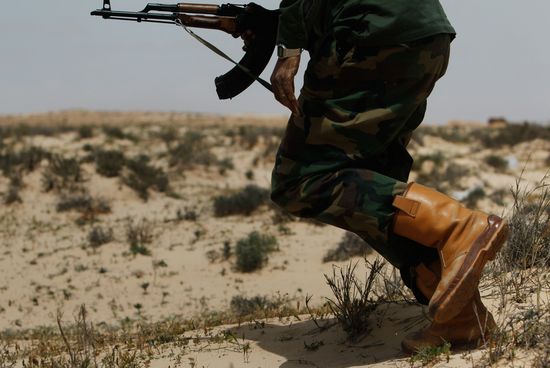
(Photo: A Libyan rebel soldier runs across the sand near front-line positions on April 6, 2011 outside of Brega, Libya. Rebel militias fighting against Libyan government loyalist soldiers continued their stand-off in the eastern Libyan desert today, regaining ground toward a key oil port while awaiting further NATO airstrikes. (Photo by Chris Hondros/Getty Images)

The Daily Wrap

Today on the Dish, Andrew gave more thought to Ryan's budget and the sacrifices we'll all have to make. He heard out readers from the hard left and beyond, but still couldn't stand the gut reaction of some Democrats without a plan of their own. Catherine Rampell reminded us of other budget proposals on the table, Andrew parsed the CBO score, Tyler Cowen criticized the Democrats for criticizing Ryan's plan, and we all wondered what happened to cutting defense. Andrew backed Will Wilkinson's belief that conservatism has to evolve, tried to understand the KSM trial options, and the GOP steered itself towards a fully anti-Islam platform. Jason Pack unpacked the bands of Libyan rebels, and the frontlines kept moving back and forth.

Glenn Beck ended his reign of terror, Bernstein wasn't holding his breath for Bachmann, and Palinism reached Canada. Bristol raked in the celebrity bucks and made the Situation look good, Andrew got psyched for the pot candidate, and we read the tea leaves on a government shutdown. Mark Johnson tracked the economic center of gravity head east, Joseph E. Stiglitz tied the fate of the rich to the fate of the poor, and whiteness in America grew malleable. Ta-Nehisi tried to tap into the voices from the Civil War, Bruce Schneier exposed e-book scams, and Donald Shoup dismissed free parking.  Freddie DeBoer worried about Twitter, an astrophysicist worried about earth's future, and a reader worried about pooping without a Dish app.

Map of the day here, view from your airplane window here, chart of the day here, correction of the day here, apology of the day here, quotes for the day here, here, Moore award here, MHB here, VFYW here, and FOTD here.

–Z.P.

Sad Genius, Ctd

A reader writes:

You've got to temper that clip from The Royal Tenenbaums with a little bit of wisdom. Regardless of what you think of that movie, that scene is just God-awful. It romanticizes and even glamorizes suicide as a kind of artful shrug, while completely burying any consideration of its consequences.

I know, I know. Many of your readers will shout back at me, "It's art!"

I'm a former artist myself, and a staunch free-speech advocate. I wouldn't dare ask you to take the clip down. But we have to realize as a group, whether society at large or readers of The Dish, that speaking about and depicting suicide carelessly, without consideration for those who are prone to it, is a costly practice.

Suicide Contagion, or the emulation of suicidal acts, can be triggered by actual suicides as well as fictionalized ones. Most of us will watch that movie clip and move on. But those harboring thoughts of dying, or God forbid fantasies of dying, may very well find something more meaningful there – and hang onto it.

I know we've got to pick our battles, and I don't mean to be a fanatic, but suicide rates are staggering. One of the reasons is our reluctance to face its many harsh realities and instead see it as a kind of private, solemn, and even beautiful choice.

Trust me as someone who knows: suicide is none of those things. It's not private because it can't be contained. It's not the end of suffering; it's the proliferation of suffering. It's not solemn, because most, if not all of the time, it's a mad scramble. We'd like to dignify suicides with forethought and reason. It's so much easier to digest, say, Virginia Woolf's suicide if we allow her capability and agency. But it can't have been as pretty as Nicole Kidman played it. (The director of The Hours built a railing beneath the water's surface so Kidman would appear more sure-footed going under.)

Finally, there is no beauty in it. Suicide is the wreckage of beauty. When we buried my sister, only 27 at the time, and a vivacious, fun-loving beauty with a laugh you could hear a mile away, I was beside myself with how decrepit she looked. The 20 hours she took to die added 20 brutally hard years to her face.

Say what you will of that scene in The Royal Tenenbaums. Some among us deserve – no, need more.