Correction Of The Day

"The Post incorrectly attributed a quote to Toni Braxton in an article published on March 25. Braxton did not say: "I have a big-ass house, three cars and I fly first class all around the world. Some say I have the perfect life,"" – The New York Post, without any explanation of where the quote came from.

(Hat tip: Laura Nahmias)

Bristol’s Celebrity Money

Think Progress finds that the $262,500 she made last year from the Candie's Foundation was seven times the amount it actually spent on teen pregnancy prevention:

Notably, Bristol’s Candies Foundation group is run by Neil Cole, an executive at the teenage clothing company Iconix Brand Group. Many critics have pointed out that the Candie’s Foundation appears to be geared towards improving the public image of Cole’s company rather than reducing teen pregnancy.

James Joyner doesn't blame Bristol:

[T]hat’s not in any way Bristol Palin’s responsibility. There’s no reason she would have any clue how they disbursed their funds. But it’s yet another object lesson in the inadvisability of donating to “charities” endorsed by celebrities without thorough research.

Agreed, partly. But the way in which the Palin family has gone after money from the get-go, like a Dyson after dog-hair, is, well, the kind of thing we have come to expect from that family.
How The Other 99% Live

Joseph E. Stiglitz addresses increasing inequality:

The top 1 percent have the best houses, the best educations, the best doctors, and the best lifestyles, but there is one thing that money doesn’t seem to have bought: an understanding that their fate is bound up with how the other 99 percent live. Throughout history, this is something that the top 1 percent eventually do learn. Too late.

And all that is why conservatives should be as worried as liberals about the decline of the moderating, uniting force in every human society: a thriving middle class.

(Hat tip: Scott Horton)

Can Michele Bachmann Win?

Jonathan Chait thinks she has a path to the GOP nomination. Jonathan Bernstein isn't convinced:

[T]here's no precedent under the current system for a junior Member of the House to even be a halfway viable candidate — and no precedent for someone as far off the party reservation [as Bachmann] to capture its most important prize. It isn't gonna happen.

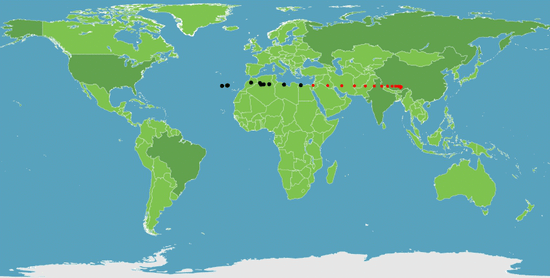
The Economic Center Of Gravity

EconomicCenterGravity

Mark Johnson watches it head east:

Danny Quah of the London School of Economics (LSE) recently wrote a paper describing the dynamics of the global economy’s centre of gravity [WECG]. By economic centre of gravity he refers to the average location of the planet’s economic activity measured by GDP generated across nearly 700 identifiable locations on the Earth’s surface. … The graphic … shows, in 3 year intervals, the WECG 1980-2007 in black and projections for 2010 – 2049 in red.

The Digital Crowd

Freddie DeBoer reflects on the loneliness and potential of the web:

Paradoxically, what I find more and more is that the Internet is a place for people to affirm and support each other. It's as if the understanding of the fundamental weakness of these electronic proxies to represent human connection causes people to push for it more and more. And this could be beautiful. But it can also be dangerous. Because of the depth of the loneliness, I blame no one for how they interact and connect with others online. I just worry.

I worry about the urge towards conformity. I worry about Twitter. I worry that all of those retweets and all of those "right on"s contribute to a kind of coarse postmodernism, where what the truth becomes what is most agreed on. I worry that dissent is confused with a lack of etiquette. And I particularly worry about the echo chamber effect, and the way that small groups of people who are just like each other can come to think of themselves as representing the opinions of everyone. On the Internet, we all make the world in our own image.

Who Are The Libyan Rebels?

AP_LIBYA_REBELS_110402

Jason Pack sorts them into different groups:

[T]he Islamists, like the army defectors, don't comprise the bulk of rebel fighters. The most prevalent form of unit organization is ad hoc: a few brothers or friends sharing gas money, a few rifles, a rebel flag, and a pickup truck. Occasionally, whole villages or subsections of tribes have joined the rebels as a semicoherent unit. Yet even then, village headmen or tribal sheikhs do not appear to be leading or orchestrating the fighting. In fact, military leadership at the front, inasmuch as it exists, is entirely spontaneous. In late March, for example, the top military brass in Benghazi strongly advised the fighters not to push past Ajdabiya when it was retaken due to coalition airstrikes. The fighters did not obey orders and were quickly routed by Qaddafi's counterattacks.

(Photo: Speakers standing behind a large pre-Gadhafi era Libyan flag now used by the opposition, address a rally held after Friday prayers on the corniche in Benghazi, Libya Friday, April 1, 2011. By Ben Curtis/AP)

Free Parking Isn’t Free

Donald Shoup wants car owners to pay for parking directly:

Minimum parking requirements have severed the link between the cost of providing a parking space and the price that drivers pay for it. Cities respond to increasing vehicle travel by increasing their parking requirements, and when citizens then object to traffic congestion, cities respond by restricting development density and requiring even more parking. The increased travel distances between sites surrounded by parking lots increase the need for cars for most trips, and the increased car ownership further inflames the opposition to charging anything for parking.

Neither planners nor politicians seem to realize, however, that the parking requirements (and the free parking they produce) accelerate sprawl. Cars have replaced people as zoning’s real concern, and free parking has become the arbiter of urban form, with serious consequences far beyond parking itself.