Mark Vernon connects the two, by quoting Thomas Lacquer's essay on America's insistence on the death penalty:
Human depravity … makes it necessary for civil government to assume the power of divine authority. … In other words, a government here on earth can cast out and kill certain of its citizens under certain circumstances because God in heaven has ordained that this should be so. Capital punishment is the expression of both divine and communal outrage at those who have excluded themselves from full humanity through their acts.
Bin Laden was, obviously, not a citizen, but his absolute removal at the hands of special forces does feel like 'the expression of both divine and communal outrage at those who have excluded themselves from full humanity through their acts.' Bin Laden is finally consigned to the lowest circle of hell, and America can know, once more, that it is a city upon a hill.
I think that whatever the merits of this as an observation, as a moral statement, it is repellent. What defines a city on a hill is not vengeance. It is justice. And there is a vast difference between justice in domestic criminal matters and justice in a just war. It is perfectly possible to oppose the death penalty, as I do strongly, and to support the killing of enemy forces in a just war. The killing of bin Laden was an act of war against a man who launched a war against us. It was self-defense, and a way of preventing such massacres in the future.
All prisoners subjected to capital punishment are already detained and unable to wreak more havoc. They are also defenseless. And they are part of the criminal justce system, not the laws of war. These distinctions matter.
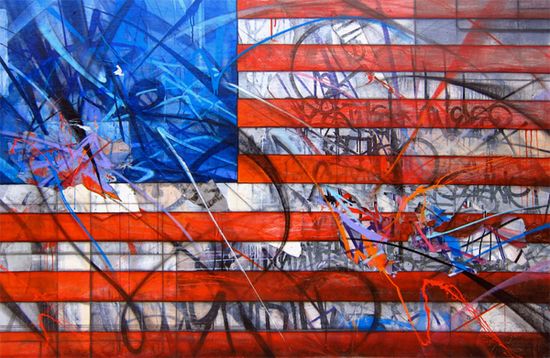
(Image by SABER from his Tarnished series)
 The Dish