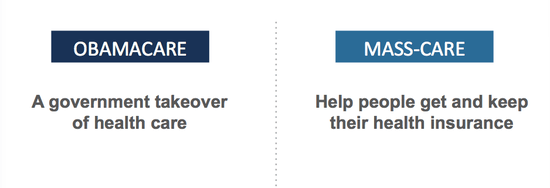
He tried to explain why his problem-solving in Massachusetts shouldn't offend the conservative electorate. But a quick look around the web makes me think conservatives remain offended. As Karen Tumulty noted in her writeup for the Washington Post, “His greatest achievement is also his biggest liability. It is the kind of paradox that would test the most agile of politicians, of whom Mitt Romney is not one.”
The unremarked-upon irony of this situation is that it's fair to say that Mitt Romney's existence — as a credible candidate for President — depends entirely upon his Massachusetts health care reform. … Four years ago, the conventional wisdom was that Romney had deftly co-opted universal health care coverage as an issue, and demonstrated — as only a governor could, goes the narrative — the ability to actually stop talking about the problem and craft a solution.
The idea that the Romneycare issue fades away with time seems totally implausible. Every debate from here on out is bound to feature all the candidates taking pot shots at Romneycare. Far from fading away, Romneycare is going to become the central issue of the nomination campaign–the surest way to take down a major rival and establish a challenger’s conservative credentials to boot. How is Romney going to overcome that? And even if he does, how is he going to unite the party?
"Both RomneyCare and ObamaCare infringe upon individual freedom and exponentially increase the government's healthcare cost burden. RomneyCare has, in fact, not made healthcare better or saved costs in Massachusetts. It's done just the opposite. This is not a failure of execution, but a lack of foresight on Governor Romney's part to understand the implications of his policy proposals. We need leaders who believe in the American people again, not the power of government to solve our problems. Yes, the Governor had the right to implement Romney-ObamaCare at the state-level, but that does not make it the right thing to do."
"Governor Romney showed a lot of courage today by standing his ground on the reforms he put in place in Massachusetts. What he did as governor worked for Massachusetts by getting health insurance to more people."
Quite frankly, I think this underscores much of what is wrong with our politics: that it is often as much about whose side is doing something rather than the value (or not) of what is being done. We have our tribe and that is where we start. Does our tribe like this policy? Does our tribe not like it?
He contrasts MassCare with ObamaCare by claiming that MassCare introduced no new taxes. This is pretty clearly a fib. The law wasn't implemented until after he was gone, and the fact that he didn't raise taxes to pay for it simply meant he refused to deal with the funding issue. His successor as governor, Deval Patrick, had to hike business fees by $100m and raise the cigarette tax by $1 a pack in 2008 to pay for the programme's subsidies.
How can you simultaneously argue that states should have the ultimate responsibility and right to experiment within their own walls (slide 16) AND that people should be able to buy insurance across state lines (slide 18). Don’t get me wrong; both are arguments that conservatives make. It’s just that few people make them at the same time. That’s because they run counter to each other.
Romney may want us to believe that he hates ObamaCare, but his speech resembled nothing so much as a defense of it. If anything, he made the case better than Obama did. And that’s why, in the end, the same criticisms Romney lobbed at ObamaCare apply to his own plan.
Screenshot from Romney's healthcare slides (pdf).
 The Dish